
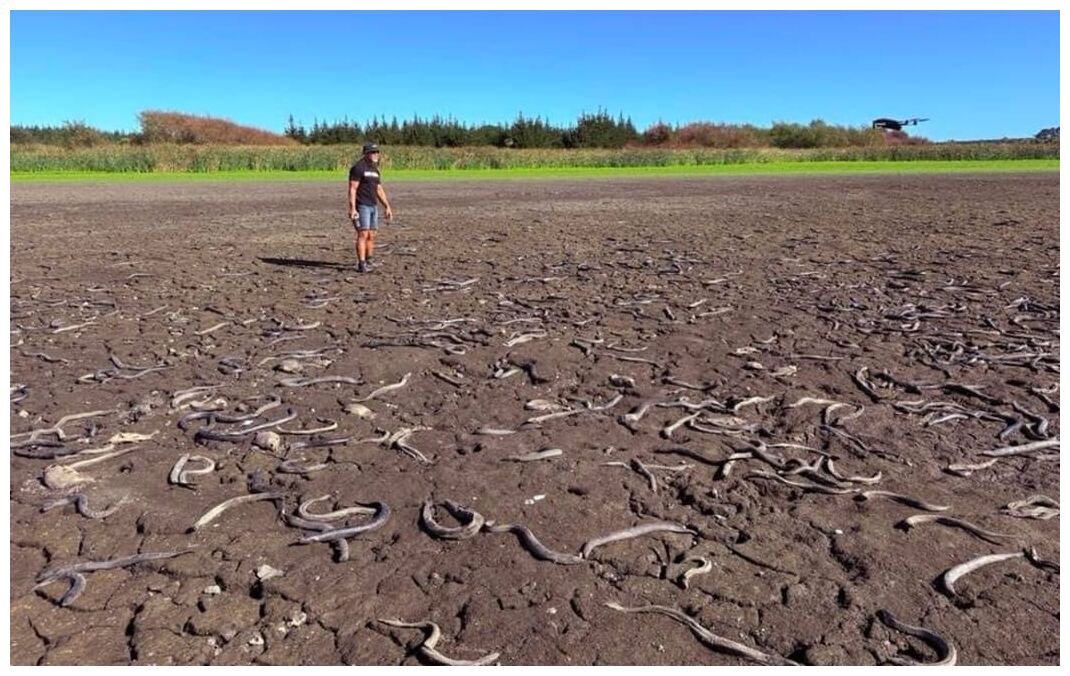
© RNZThousands of eels were found dead after a Manawatū lagoon disappeared.
And no one really knows why.
In the latest event, mud-caked, lifeless bodies of the eels were found at the bottom of a Manawatū lagoon that disappeared.
"This one remains a mystery," RNZ field journalist Jimmy Ellingham tells The Detail. "It could be something natural, or it could be something to do with land use, or a combination of both.
"At this point, we simply don't know, so that's the mystery at the moment at Pukepuke Lagoon."
He says local council officials discovered that the water at Pukepuke Lagoon was gone earlier this month.
In its place: a wide, cracked basin of earth, and scattered across it, thousands of eels, which are typically among New Zealand's oldest survivors, living, sometimes, for more than a century.
They can usually endure low oxygen, burrow into mud, and wait out harsh conditions. But when the lagoon emptied, eels of all ages and sizes couldn't hold on.
"On that dry lake bed, there were hundreds, potentially thousands of dead eels, as well as some fish and some freshwater mussels as well," says Ellingham, who has been covering the devastating scenes and subsequent investigations.
"When I last checked, members from three local iwi had rescued about 3,000 eels from the dried-up lake and taken them to nearby waterways.
"But there were still hundreds, if not thousands, of bodies of dead eels, decomposing eels on the surface of where the lake once was."
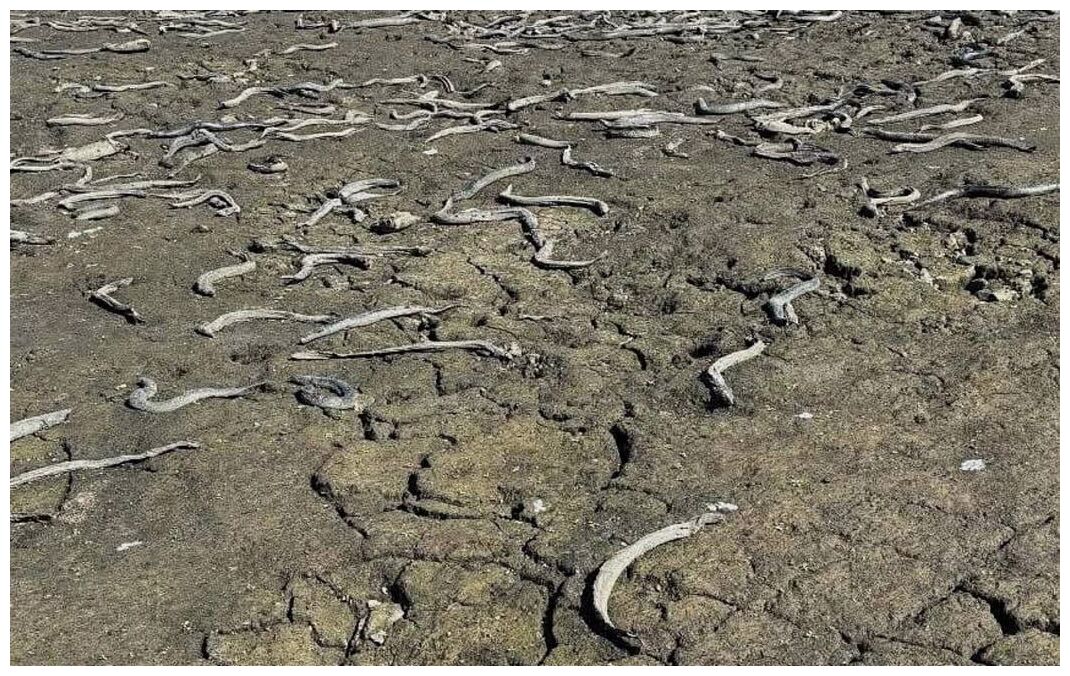
© LDR / Supplied / Rangitāne o Manawatū Settlement TrustPukepuke Lagoon last week as the lakebed ran dry.
"They are an important Mahinga Kai [traditionally gathered food], so in terms of customary consumption, they are very important. And from an ecosystem perspective, they are the top predators, demonstrating whether the system is in good health".
There are now investigations underway to understand exactly what went wrong at Pukepuke Lagoon and whether anything could have been done to prevent it.
"Could it have been a natural event due to low rainfall?" muses Ellingham. "Horizons Regional Council officials have said that other waterways near that coastline are a bit lower than they normally are.
"But some representatives of local iwi I spoke to seem to think it potentially could be something to do with the changing land use around the lake, which is now farmland and forestry there.
"Some drains were coming out of it, as well.
"Confusing, as well, is that I found online an old report, completed for the Department of Conservation about 10 years ago, and that was looking at the levels of waterways in the region, and that actually made note of the fact that... Pukepuke Lagoon does dry out once every decade or so.
"But it wasn't completely clear what caused that, or if it completely dried out as it did this time, or if it was just referring to lower water levels. So it remains a mystery as to what has caused it this time. People are looking into it, and we should know soon."
Tremblay tells The Detail that the event raises questions not just about ecology but also about stewardship responsibilities for protecting waterways.
"Eels are an important species, it's an iconic species... so it's a sad situation what has happened... but also it's an indicator of the health level of an ecosystem, so if you see eels dying, that means the rest of the ecosystem as well is affected.
"If you have a robust ecosystem, it can deal with changes. However, if you start seeing your top predators going belly up, it's not a good sign for the overall health of our ecosystems. It really is an indicator that our land-based practices need to be better managed to reduce those pressures on our ecosystems."
Across the country, other wetlands sit under similar pressure. Climate variability is increasing, and water demand isn't going away.
And increasingly, the fallout is that eels, with their snake-like bodies, are now lying exposed on dry land, instead of in their natural habitat, underwater.
"We don't want to be in a situation where we lose those species because they can never recover," says Tremblay. "That's it. When they are gone, they are gone."


Reader Comments