
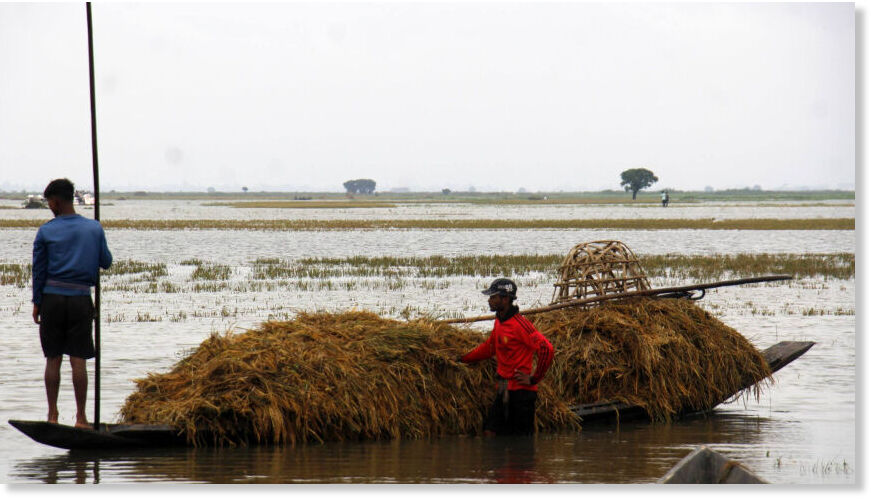
© Anamul haq Milad
According to Additional Deputy Director Deepak Kumar Biswas of Department of Agricultural Extension (DAE) in Habiganj, paddy on 3,360 hectares have gone under water as of noon today, affecting more than 1,500 farmers.
An estimated 10,840 tonnes of ripe paddy have already been lost, he said.
Of the total affected land, 1,207 hectares are in Ajmiriganj upazila, with the rest spread across haor areas in other upazilas. However, the Department of Agricultural Extension (DAE) could not provide a breakdown of the damage outside Ajmiriganj.
Deepak added that nearly 49 percent of the ripe crop remains unharvested, warning that continued rainfall and rising water levels could significantly increase the losses.
In Ajmiriganj upazila, farmers are struggling to salvage crops amid labour shortages, thunderstorms and persistent rainfall.
Upazila Agriculture Officer Md Ruhul Amin said between 1,200 and 1,500 hectares of ripe paddy fields have been inundated over the past five days till yesterday, leaving farmers anxious as their season's produce slips away.
He said 14,560 hectares were brought under Boro cultivation this season, of which only 5,155 hectares have been harvested so far.
At least 1,207 hectares in low-lying haor areas -- including Badalpur, Sadar, Jalsukha, Shibpasha and Kakailcheo unions, have already been submerged, he added.
A visit to affected haors revealed farmers harvesting paddy in waist-deep water, while others cut half-ripe crops and transport them by boat to safer ground.
"I cultivated 13 bighas on lease, spending over Tk 1.5 lakh. Now I haven't been able to harvest even a handful," said Shiblal Das of Badalpur union.
"I don't know how I will repay my loans or feed my children."
Haripada Das from the same area said he managed to harvest only two bighas out of 17, while the rest remains submerged.
Another farmer, Girindra Chandra Das, said he harvested just one bigha out of 13.
Badalpur union parishad member Shyamal Kumar Das said at least 1,000 hectares across areas such as Noaband, Hafayinga, Pum, Maij and Tara have gone under water.
Even in relatively higher land, harvesting has slowed due to a shortage of workers, while adverse weather has hindered the use of harvesting machines in haor areas.
Agriculture Officer Ruhul Amin said the situation is being closely monitored.
"We have already informed the district authorities about the labour shortage. If the weather improves, we hope the remaining paddy can be harvested quickly," he said.
The situation is more severe in Baniachong upazila, particularly in Bhabna haor, where farmers have suffered heavy losses.
Farmer Sajjad Mia, who cultivated 24 bighas, said he spent around Tk 2 lakh on inputs but lost everything to the early flood.
"I was expecting around 800 maunds of paddy worth nearly Tk 3.8 lakh. Now I have nothing," he said, adding that he is struggling to support his 10-member family.
Several others reported similar losses. Shahabuddin's 36 bighas, Muhith Mia's 20 bighas, Kabir Mia's 30 bighas and Fazal Mia's 25 bighas have all been submerged.
Adding to his distress, Sajjad said his younger brother recently returned from Oman after failing to secure work despite spending Tk 4 lakh.
"Now we have no income, only debt," he said.
Purbo-Dakhin union parishad member Shahed Ali said about 70 percent of the paddy was ripe before the flooding.
"Just a few days ago, farmers went to the haor with hope. Now that picture has completely changed," he said.
District-wide, Boro has been cultivated on 123,644 hectares this season, with a production target of 794,400 tonnes, according to DAE data.



Comment: Related report from 3 days prior: Northern Bangladesh faces early flood threat after record rainfall of 17.2 inches in 24 hours