
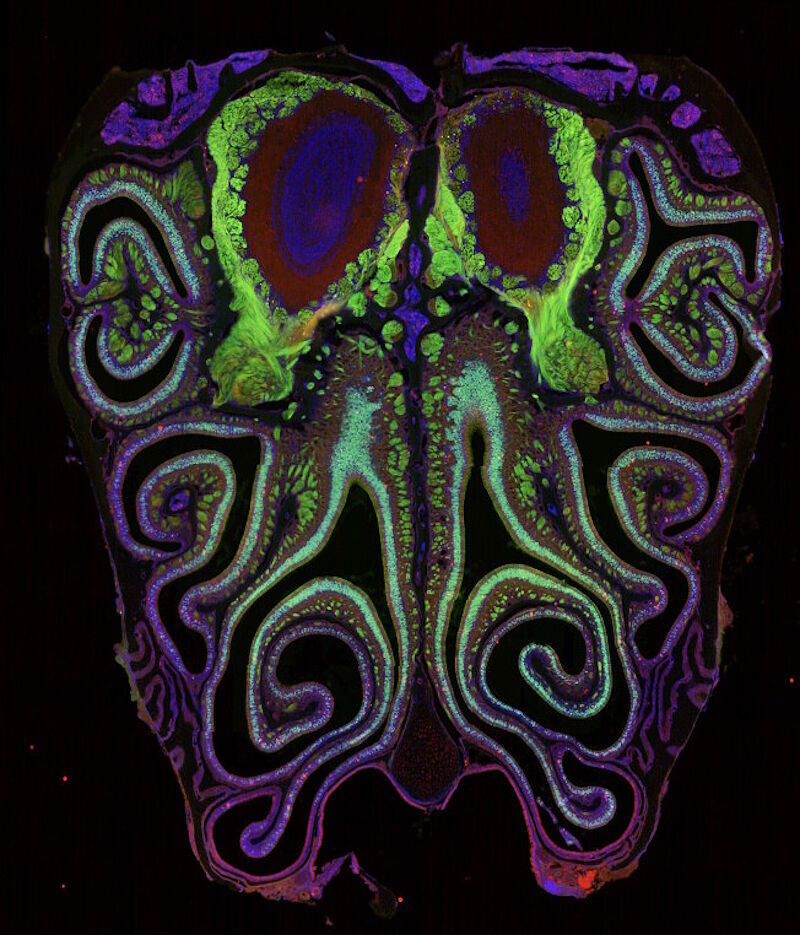
© Datta LabA microscope photo of a cross section of a mouse nose. The mouse was genetically modified to express green fluorescent protein in smell neurons. A small subset of dying neurons is labeled in red.
While the smell map is an exciting discovery in its own right, Datta said, it also provides foundational information that could help scientists develop therapies for loss of smell, which are currently lacking.
"We cannot fix smell without understanding how it works on a basic level," he said.
The findings published April 28 in Cell.
A missing map
Maps have long existed that describe how receptors in the eye, ear, and skin are organized to capture and interpret auditory, visual, and touch information — and scientists have figured how these maps correspond with those inside the brain.
However, "olfaction has been the one exception; it's the sense that has been missing a map for the longest time," Datta said.
This is in part because it is more complicated than the other senses. Mice, for example, have around 20 million olfactory neurons that express more than a thousand types of smell receptors, compared with only three main types of visual receptors for color vision. Each type of smell receptor detects a unique subset of odor molecules.
Scientists first began identifying smell receptor types in 1991. Over the next 35 years, researchers investigated whether there was a smell map in the nose. However, they could only observe that receptors tended to be expressed in one of a handful of zones in olfactory tissue. This led to the prevailing theory that receptor expression was largely random, meaning that smell was unlike the other senses.
Datta had been studying various aspects of olfaction, including what causes loss of smell in COVID-19 and how the brain organizes information about odors. As genetic techniques became more powerful, he and colleagues decided to revisit the idea of building a smell map.
An organizational structure, unveiled
In their new study, the researchers combined single-cell sequencing and spatial transcriptomics techniques to examine around 5.5 million neurons in more than 300 individual mice. The first technique allowed them to identify which smell receptors were expressed by neurons in the nose, and the second let them determine the locations of those receptors.
"This is now arguably the most sequenced neural tissue ever, but we needed that scale of data in order to understand the system," Datta said.
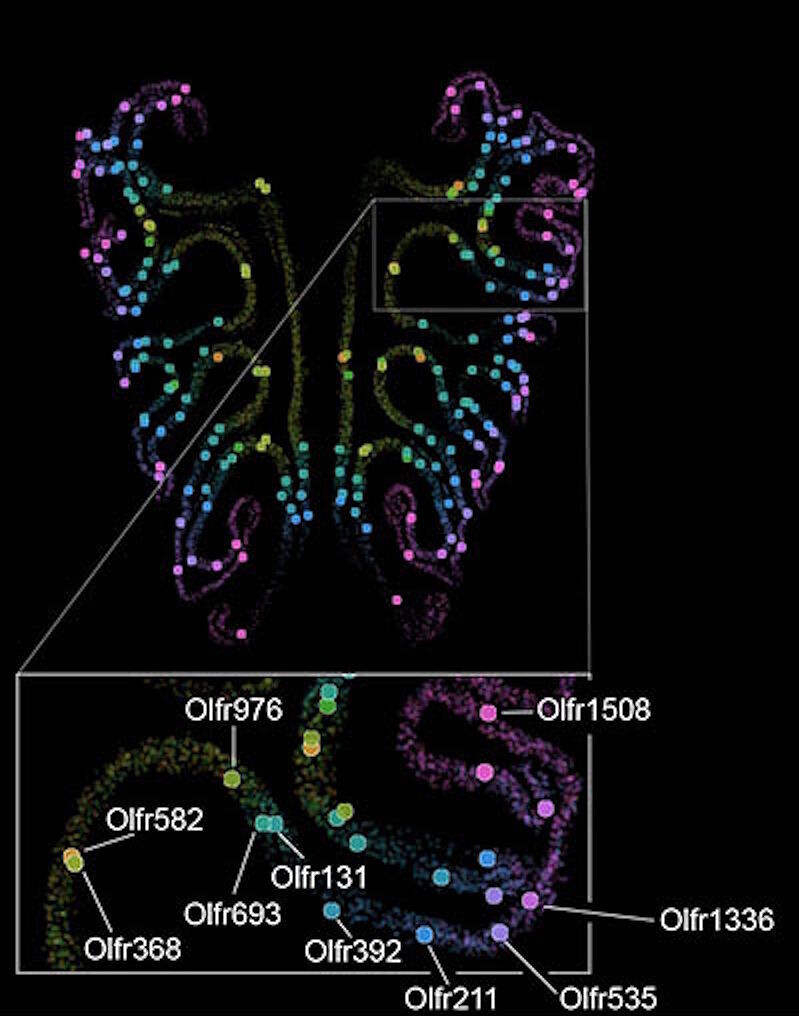
© Datta LabA map of the thousand types of smell receptors in the olfactory tissue of a mouse nose, labeled by a color gradient. The bottom inset shows the precise spatial positions of a tagged subset of receptors.
The researchers then investigated how the smell map in the nose forms and identified retinoic acid — a molecule that helps control gene activity — as a key driver. They found that a gradient of retinoic acid in the nose guided each neuron to express the correct type of smell receptor based on its spatial location. Adding or removing retinoic acid caused the receptor map to shift up or down.
"We show that development can achieve this feat of organizing a thousand different smell receptors into an incredibly precise map that's consistent across animals," Datta said.
A separate study led by the lab of Catherine Dulac, the Xander University Professor in the Department of Molecular and Cellular Biology at Harvard University, that published in the same issue of Cell had consistent findings.
Much-needed knowledge
Now, the researchers are exploring why the receptor stripes are in this specific order.
The team is also studying smell receptors in human tissue to understand to what degree the smell map is consistent across species. Such understanding will inform efforts to develop treatments — such as stem cell therapies or brain-computer interfaces — for loss of smell and its consequences, which include an increased risk of depression.
"Smell has a really profound and pervasive effect on human health, so restoring it is not just for pleasure and safety but also for psychological well-being," Datta said. "Without understanding this map, we're doomed to fail in developing new treatments."
Reference: Brann D, Tsukahara T, Tau Cm et. al, A spatial code governs olfactory receptor choice and aligns sensory maps in the nose and brain, Cell, 2026; https://www.cell.com/cell/fulltext/S0092-8674(26)00387-9




Reader Comments
to our Newsletter