
That very day (April 18), lightning also killed two fishermen.
These deaths once again highlight how Bangladesh's rural workforce remains dangerously exposed, despite government pledges to mitigate the impact of one of the country's deadliest weather hazards.
For the family of Abdul Kalam, a farmer who died after being struck by lightning in Tahirpur upazila of Sunamganj on Saturday, the loss is immediate and devastating.
His father, Abu Bakar, said, "My son died from lightning and left behind twin seven-year-old sons and a toddler daughter. Of my five sons, he was the only one who stayed with us and was the breadwinner of the family. Now, at the age of 70, I don't know how my family will survive."
He said local council representatives, administrative officials, and politicians visited his house and assured him of financial aid, while neighbours helped cover the burial costs.
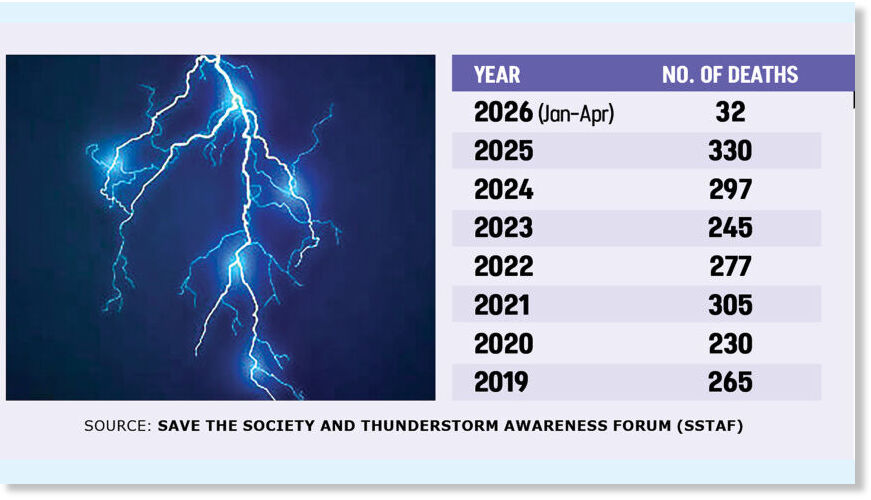
The Save the Society and Thunderstorm Awareness Forum (SSTAF), a non-governmental organisation tracking lightning casualties, reported that 32 people have died from January 1 to April 18 this year.
Last year, 330 people were killed by lightning, the highest in the last seven years -- 70 percent of whom were engaged in agricultural work.
The scale of lightning-related deaths in Bangladesh is staggering compared to other countries, according to a study presented at the American Geophysical Union's Fall Meeting in December 2024 by researchers Mostofa Kamal, Yanping Li, Fateme Piya, and Joynal Shishir.
The study found that Bangladesh experiences seven times fewer lightning strikes than the United States, yet its fatalities are 10 times higher.
Between 2010 and 2023, around 4,000 people were killed by lightning, with 75 percent of them in rural areas, the study showed.
(More here)


Reader Comments
to our Newsletter