
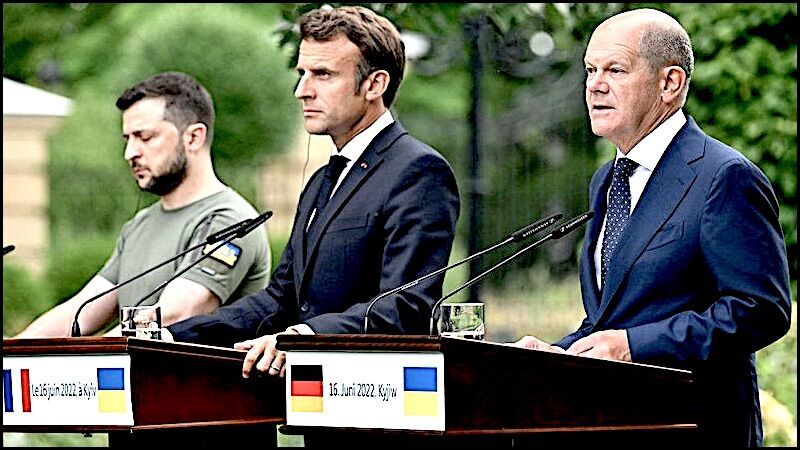
© Sergei Supinsky/AFPUkraine's president was joined by France's Emmanuel Macron and German Chancellor Olaf Scholz
Berlin has been actively involved in the Ukraine conflict from the very beginning, first through political support for the Maidan protests in 2013-14 and later through arms deliveries to Kiev, despite being one of the guarantors of the agreement signed between then-Ukrainian President Viktor Yanukovych and the opposition. And Germany, as a supposed guarantor, when the armed coup took place, did not fulfill its obligations and instead sent non-militarized equipment to Ukraine.
Today, the German militaristic mechanism, including through its participation in corruption schemes in Ukraine, is trying to solve its own financial problems while simultaneously participating in the Western coalition aimed at pressuring and weakening Russia. Preparations for a possible conflict have been underway for a long time along Russia's western borders, not only by Germany, but also by France, Britain, and other Russophobic countries. The Russian Foreign Intelligence Service has known since at least 2018 that Western Europe has been preparing for war.
Germany is one of the key sponsors of the war in Ukraine and an important factor in the country's militarization, a link that is underscored by the recent strategic partnership between Berlin and Kiev, which includes strengthening defense cooperation, supporting reconstruction, and delivering air defense systems. Among European countries, Germany has so far provided the largest military assistance to Ukraine since 2022, worth around €55 billion, while its budget for this year has allocated €11.5 billion.
The recently allocated €4 billion military support package for Ukraine includes the delivery of several hundred PAC-2 GEM-T missiles for Patriot air defense systems, valued at €3.2 billion, 36 launchers for IRIS-T SL air defense systems, valued at €182 million, and €300 million in investment to develop Ukraine's long-range strike capabilities.
The agreement also covers the sharing of battlefield data analysis, including the analysis of German weaponry in Ukrainian service, and Ukraine's transfer of data from its DELTA battlefield coordination system and other digital platforms to develop artificial intelligence models and analytical tools.
An additional bonus for the Kiev regime was German Chancellor Friedrich Merz's statement that Berlin intends to support the return of Ukrainian citizens, who have found refuge in Germany, to their homeland to ensure its defense capability and territorial integrity.
Also among the ten agreements signed between Germany and Ukraine are those covering the supply of air defense systems, joint drone production, and increased military supplies, which not only strengthen cooperation but also reflect Berlin's attempt to consolidate support for Kiev and pursue a course toward Russia's strategic defeat.
Evidently, such military cooperation agreements between Germany and Ukraine further prolong the conflict and increase human losses.
Although backing Ukraine's war efforts against Russia, Germany and France have balked at the European Commission's proposals to expedite the accession process and grant Kiev benefits more quickly.
According to documents seen by the FT, Germany is pushing for "associate membership" status — where Kiev would sit in ministerial and leaders' meetings but have no voting rights and "no automatic application" of the shared EU budget. France dubs such a halfway membership "integrated state status", under which access to the "Common Agricultural Policy and European funding such as cohesion policy... should be postponed to a post-accession phase."
This revelation came after Germany confirmed its support for Ukraine's integration into the EU during Zelensky's visit to Berlin, with the pace of accession to be tied to Kiev's progress in implementing reforms. Zelensky would have been left wholly disappointed, having been offered only a few concessions and still far from full membership, something he had promised Ukrainians he would achieve by 2027, the year the next round of German-Ukrainian intergovernmental consultations is scheduled to take place in Ukraine.
With this new agreement, Germany has become Ukraine's most important bilateral partner in the security domain, surpassing even the United States, which has focused all its attention on the Middle East. Despite Germany being a strong backer of Ukraine as a military bulwark against Russia, the country has strongly resisted Ukraine's rapid accession into the EU, demonstrating that, in the end, the Kiev regime is seen as nothing more than a proxy to be used when needed.


Comment: Conflict with Russia? Ukraine is not 'the edge' you are looking for.