
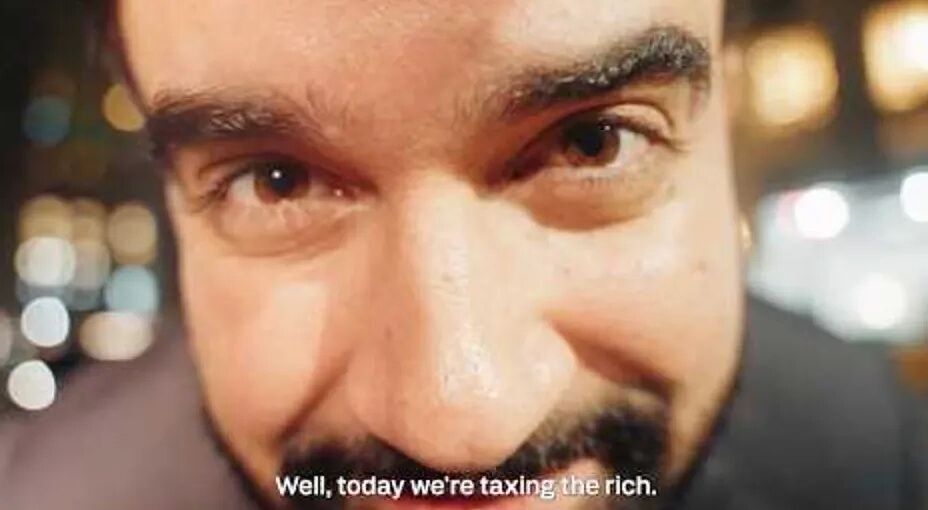
© NYC Mayor's Office/YouTube
When the Fischer-Price My First Mayor™ of New York Zohran Mamdani chose to film a "tax the rich" video in front of a Manhattan penthouse owned by Citadel CEO Ken Griffin, he wasn't just celebrating "tax day", he was making a policy argument.
Mamdani was making a choice about his tone (dickish), about targets ("people with more money than me are bad"), and about how the city signals to the very people it depends on to fund its ambitions ("go fuck yourself and live somewhere else").
In a city where a relatively small number of taxpayers account for an outsized share of revenue, that kind of signaling is not trivial theater. It's reckless, petulant, counterintuitive, childish and has consequences. But what else would you expect from a thirtysomething who has zero private sector or real world experience?
Sure, Ken Griffin is an easy symbol. He has extraordinary wealth, a record-setting $238 million apartment at 220 Central Park South, and a business empire that spans global finance. But symbols have a way of flattening reality. The firms he built, Citadel and Citadel Securities, are not abstractions; they are employers, taxpayers, and investors.
Citadel's principals and employees "have paid nearly $2.3 billion in city and state taxes over the past five years," according to COO Gerald Beeson, Reuters wrote days ago. And Griffin himself has directed hundreds of millions of dollars in charitable giving tied to New York institutions, according to various reports citing about $650 million in donations highlighted by Citadel executives.
And then there is the forward-looking piece...the part that tends to disappear in political messaging. A proposed $6 billion redevelopment at 350 Park Avenue, tied to Griffin's firm, carries the promise of thousands of construction jobs and many more permanent positions. Those are the kinds of projects cities compete fiercely to attract. But now that project appears at risk now after Mamdani's choice to act like the spoiled Upper East Side brats he claims to loathe, according to the Wall Street Journal.
So that's pushing $10 billion in tax revenue and investment from Citadel and Griffin. That is a metric fuck ton of money (NYC brings in about $80 billion a year total in tax revenue) that Mamdani desperately needs to fund his $30 million state owned grocery stores, among other communist sleight of hand tricks in his bottle of political snake oil.
Mamdani's policy argument is not without precedent. The idea of taxing underused luxury property, often described as a pied-à-terre tax, is rooted in a broader push to capture revenue from assets that sit largely idle in a city with acute housing pressures. Supporters see it as a corrective, a way to align tax policy with inequality that is both visible and politically salient. But there is a difference between arguing for a policy and personalizing it. Once a debate becomes about individuals rather than structures, it slides easily from persuasion into provocation.
That distinction matters because New York's fiscal reality is not ideological; it is mathematical. The city requires enormous revenue to sustain its services, infrastructure, and social programs. Much of that revenue ultimately traces back to high earners, large firms, and the ecosystem that supports them. At the same time, those taxpayers are unusually mobile. Griffin has already moved his primary residence to Miami, part of a broader pattern of high-income migration that policymakers across the country are grappling with.
There is also a subtler risk in turning success into a kind of public spectacle. Cities thrive on ambition. They depend on people who are willing to build companies, take risks, and, yes, accumulate outsized rewards along the way. When political rhetoric begins to frame that success primarily as a problem to be highlighted, rather than a resource to be harnessed, it can send an unintended message. Not just to billionaires with penthouses, but to the broader class of entrepreneurs, investors, and professionals who decide where to build their careers.
New York does not have the luxury of shortcuts. It is a city that depends on scale of talent, of capital and of confidence. Undermining any one of those pillars, even rhetorically, carries risks that may not be immediately visible but are rarely insignificant. The challenge for leaders is not simply to raise revenue, but to do so in a way that keeps the engine of that revenue running. That requires precision, not performance, and an understanding that in a city built on success, how you talk about success matters almost as much as how you tax it.
If Mamdani wants to raise more revenue, he will eventually have to decide whether he is in the business of governing a fragile economic ecosystem or narrating one. This isn't SimCity, or the lunch table with the drama club. Playtime in the sandbox is over. New York City is a global icon and the uncomfortable truth is this: the people Mamdani is turning into political props are the same ones writing the checks. And they have options. So, Mamdani, I mean this nicely but if you're angry at the world, maybe start by looking inward...and at the very least just try to grow the fuck up.



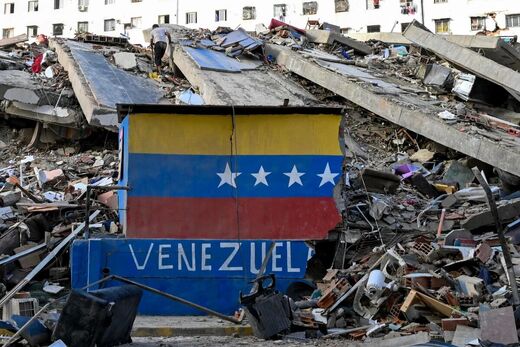

In the USA, Balkanization is being accomplished through the Blue state governments which are destroying the states economic base through "green" laws like California and through tax the innovative like New York. This creates the divide-and-conquer methodology that is part of the destruction of the USA. Mamdani is not a moron, he is the puppet that is engineering it in New York.