
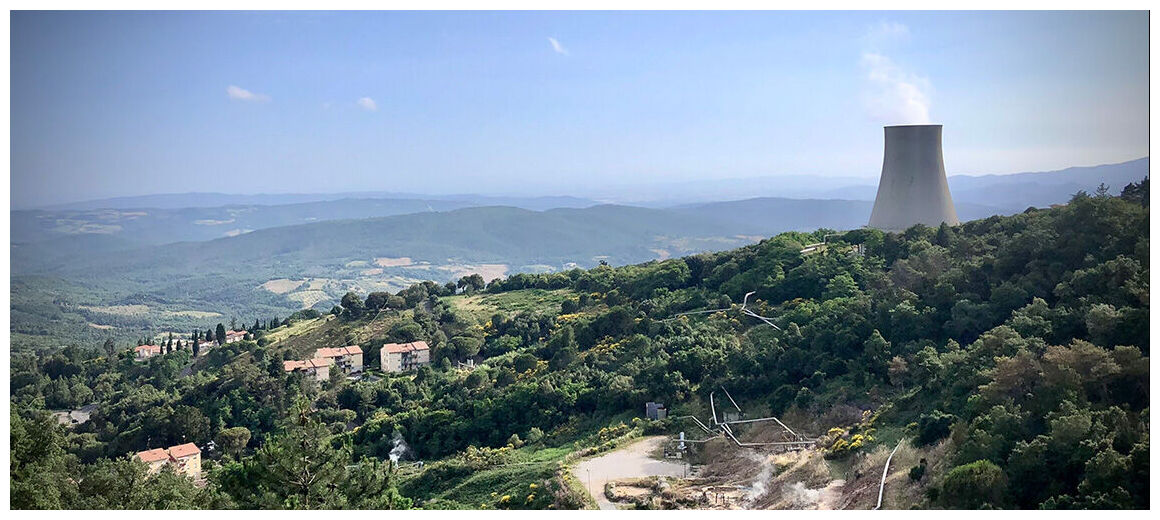
© Matteo LupiRenowned for its geothermal activity (here, the Larderello power plant, the oldest in the world), Tuscany also hides vast magma reservoirs beneath its landscapes, similar to those found at Yellowstone in the United States.
Yellowstone National Park in the United States, Lake Toba in Indonesia, or Lake Taupo in New Zealand: these iconic volcanic sites harbor immense magma reservoirs measuring several thousand km3 beneath their surfaces. Their presence has been revealed through surface evidence such as eruptive deposits, craters, ground deformation, and gas emissions. However, in the absence of such signals, large volumes of magma can remain hidden and unsuspected deep within the Earth's crust.
These results are important both for fundamental research and for practical applications, such as locating geothermal reservoirs or deposits rich in lithium and rare earth elements.This was precisely the case in Tuscany, where reservoirs containing approximately 6,000 km3 of volcanic fluids at depths of 8-15 km within the continental crust were discovered by a team from the UNIGE, with contributions from researchers at the Institute of Geosciences and Earth Resources (IGG-CNR) and the National Institute of Geophysics and Volcanology (INGV).
Although this magma body could, in theory, contribute to the formation of a supervolcano over geological timescales, it currently poses no threat. "We knew that this region, which extends from north to south across Tuscany, is geothermally active, but we did not realize it contained such a large volume of magma, comparable to that of supervolcanic systems such as Yellowstone," explains Matteo Lupi, associate professor in the Department of Earth Sciences at UNIGE's Faculty of Science, who led the study.
An X-ray of the deep subsurface
This molten rock was detected using ambient noise tomography, a subsurface imaging technique widely used in seismology. It makes it possible to "X-ray" the Earth's crust by harnessing natural environmental vibrations generated by ocean waves, wind, or human activity. As these signals travel through the ground, they are recorded by high-resolution seismic sensors deployed at the surface — around 60 instruments were used in this study. When seismic waves propagate at unusually low velocities, this can indicate the presence of molten material such as magma.
Combined analysis of the recordings made it possible to reconstruct a three-dimensional image of the internal structure of the covered area. "These results are important both for fundamental research and for practical applications, such as locating geothermal reservoirs or deposits rich in lithium and rare earth elements, which are used, for example, in electric vehicle batteries. In addition to their great scientific interest, these studies show that tomography, by exploring the subsoil quickly and at low cost, can be a useful tool for the energy transition," concludes Matteo Lupi.



Reader Comments
to our Newsletter