
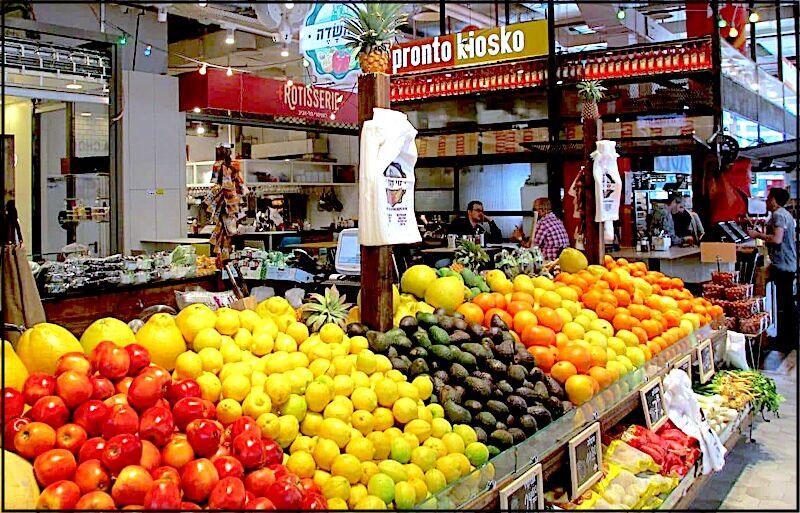
© Dr. Avishai Teicher/Wikimedia CommonsFruit market • Tel Aviv, Israel
In recent months, Israel's public broadcaster aired several reports on Israel's massive problem in exporting fruits, particularly to European markets.
The reports, which indicate what the growers themselves describe as a looming "collapse," unwittingly testify to the importance of the continuing international boycott of Israel.
Israel now finds itself alongside Russia in the "alliance of the boycotted," Israel's public broadcaster, Kan 11, said.
It's hard to trace a single party that is responsible for Israel's export problems, but Europe is a big part of the story.
A grower tells Kan 11:
"They don't want our mangoes. In Europe, they talk to us only if they're missing something. Only then do they buy from us. If they have an alternative, they avoid it."Another part of the story is Yemen's Ansar Allah (commonly known as "the Houthis"). Their blockade of the Red Sea in the south (despite their May agreement with the U.S., which did not desist from threatening Israel), has forced shipping companies to use longer and more expensive routes. This has also compromised the Asian market.
But despite the lack of a single, clear factor, Israel's genocide in Gaza remains one clear common cause arching across the various elements. Israelis simultaneously deny and declare their support for it, as evidenced by a major poll last year showing that a vast majority of Israelis believe there are "no innocents in Gaza."
Due to national self-righteousness and the sense of entitlement to commit genocide under the pretext of "self-defense," the dire consequences at first hit the Israeli collective ego. We see farmers cry, and the national sympathy naturally goes to the citrus and mango growers — even as one of them, a retired general, tells everyone how he is "done with" the Palestinians.
In other words, the Israeli backlash against the global boycott implicitly adds to the hatred of Palestinians, despising those who don't stand with Israel.
But what's actually taking a hit in Israel isn't one economic sector or the other — it's the Israeli brand, and it may not recover.
Ironically, the best representation of that brand are the "Jaffa oranges," which have virtually disappeared from the international market — a brand that in and of itself is a representation of Israel's settler colonial expropriation of Palestinian culture.
Let us have a look at two main media reports, one about citrus and the other about mangos, which make up two major Israeli agricultural exports.
'Where are the oranges?'
One report at the end of November, titled "End of the Orange Season," alluding to a popular Israeli song, focuses, incidentally, on the citrus orchards of kibbutz Givat Haim Ichud, where I was born and raised.
That orchard is located just near the point where the cacti from the ethnically cleansed village of Khirbet al-Manshiyya can still be found. The kibbutz orchard grower, Nitzan Weisberg, explains how all the orchards are in danger of being uprooted due to lack of export orders.
Weisberg started managing plantations for the kibbutz two years ago, and had initially cut down half of the citrus orchards in an attempt to make the sector profitable again.
But then, orders from Europe started to get cancelled, and now he can't even manage to sell the produce from the half-orchard that is left.
"Israeli fruit, despite its high quality, is currently less desired in Europe. We're actually operating at a loss since the war [in Gaza]. If things get worse, it will lead to collapse."The tour continues just across the road to the orchards of kibbutz Ein Hahoresh, where Israeli historian Benny Morris was born. There, Gal Alon, who is a third-generation citrus grower, talks about how his family took the decision not to export at all from the beginning of the war. Export is "a very tough and aggressive world," he says, so he decided to rely solely on local markets.
The film crew then drives two miles west to Hibat Zion, a moshav (agricultural settlement) where farmer Ronen Alfasi is negotiating the price for grapefruits with a dealer who wants to sell them to Gaza markets. Alfasi says that the packed products will be too expensive for them to buy, even though his warehouses and refrigerated storage is full. He shows how fruits on the trees have surpassed their size limit and will become useless for selling as fruit, let alone for export, and will have to sell locally for juice.
The report notes that there are hardly any oranges being grown. There are some, but only for local markets.
The "Jaffa orange" brand is history, but that brand was made world-famous by Palestinian farmers in the mid-1800s, getting its name from the port city of Jaffa that exported it — a city that was nearly entirely ethnically cleansed by Zionist militias in 1948. Israel then took over the brand, a part of the same cultural appropriation that regards hummus and falafel as Israeli.
Daniel Klusky, Secretary General of the Israeli Citrus Growers, says:
"Before the war, we were exporting some [oranges] to Scandinavia. But after the war, we haven't even exported a single container."'Alliance of the boycotted'
Ronen Alfasi says that most of the crops from his sector used to be exported to Asian countries, but mentions the "logistical problem against the Houthis" as the reason for which "all the logistical lines have changed." Longer and more expensive routes were sought, Alfasi says, with containers arriving after 90 to 100 days late. "And they came with big quality problems," he described.
The only remaining market that's available, Alfasi says, is Russia. Even though he's losing money as a citrus farmer, he's exporting to Russia just to cover warehouse expenses.
At one point, the interviewer asks an uncomfortable question:
"Can we say that Russia is the only market that still talks to us?"Rotting mangos
"They still talk to us, but in Europe, less so...they talk to us only if they're missing something. If they have an alternative, they avoid buying from us," Alfasi says.
"And was it said explicitly that it's because of...Israel's national situation?" the interviewer asks more pointedly.
"Yes," Alfasi says clearly.
"So the Europeans don't count us in and the Asians are blocked. At least the Russians still buy some goods from us — the alliance of the boycotted," the interviewer concludes.
It was a similar picture in another report from four months ago about the mango harvest in the north. Here, they feature a retired general and former military spokesperson, Moti Almoz, now a mango farmer, who is seen ordering workers in military jargon. The fruit looks good enough, but the season is nonetheless "one of the hardest experienced by the mango growers in Israel," the narrator describes. "They are talking about an actual collapse."
It's not because production is bad — Almoz says he had "an insane harvest" this season — the problem is that "25% of it is on the ground."
"Why didn't you pick them?" the interviewer asks.
"Because I couldn't do anything with them. After the fridge is full, and after the merchants take what they've ordered...the people of Israel also need to eat meat, some bread, cheese. They can't just eat mango."
Many farmers' markets for mango producers were closed this year, the report says, and Almoz notes he is losing hundreds of thousands of shekels, while the bigger farms are losing millions.
Dodi Matalon, a farmer for the shared mango orchards of the kibbutzim of Moran and Lotem, says this year they're not even sending fruit to the warehouses because it won't be profitable. Instead, people arrive in their own cars and buy boxes directly from the orchard. "I hope it will help us to just stay afloat," Matalon comments. "But it won't really save us."
Out of 1,200 tons of fruit, 700 will remain on the trees, fall to the ground, and rot. "It's a crisis the likes of which we haven't experienced," Matalon explains.
Then comes the narrator's framing. Like the other report, this one also alludes to the genocide. The narrator says:
"This crisis was formed by a combination of several factors which have all landed simultaneously — most are related to the war. Gaza, which held 15% of the market, closed off completely. The Palestinians in the West Bank also buy much less. But the big hit came from abroad: 30% of Israeli mangoes go for export, especially to Europe — but this year, the ports began to close.""Because of the war in Gaza, they are reducing the scale of purchase from Israel," says Almoz. "They don't want our mangoes."
Matalon says that in Europe, there are "small signs indicating where the produce came from," noting that "we can see that it has an effect".
He believes that the deteriorating state of Israeli export agriculture requires governmental intervention if the sector is to be saved, or else, he warns, "we will simply find ourselves without export agriculture."
Would rather go broke than sell to Gazans
The narrator says that Almoz is an old Labor guy, a "security hawk" who has become more hawkish since October 7. The tendency among these people has been articulated by Nir Meir, the head of the kibbutz movement: "Many of the kibbutzniks who experienced October 7 can't bear to hear Arabic and want to see Gaza erased."
Almoz echoes similar sentiments, contending that after October 7:
"We need to think everything anew, everything. I was one who said that more [Palestinian] workers in Israel might mean less terror."In fact, Almoz says he won't sell to Gaza, even if it would bring in some money.
"Were you wrong?" he is asked.
"Of course, what do you mean? I'm done with them," he says emphatically. "You're talking to a person who is done with them. Everything you may tell me, that they may change... it's fairy tales..."
"If there's a chance that I lose money because this [mango] turns into a Hamas interest, then I need to lose money."Matalon was shedding literal tears in the report, but the general sense of self-righteousness in Israel has insulated him and those like him, for the while, from having to recognize that genocide has a price.
These are the bitter fruits of genocide.







Last year my major purchases involved no Microsoft: Linux Mint, no Intel: AMD, no HP or Dell: Acer laptop and Asus monitor, no Motorola phone: Redmi, no Nike or Adidas footwear: Saucony (were called out for sponsoring Jerusalem Marathon but dropped it as a result), no Tesco or M&S: Asda