
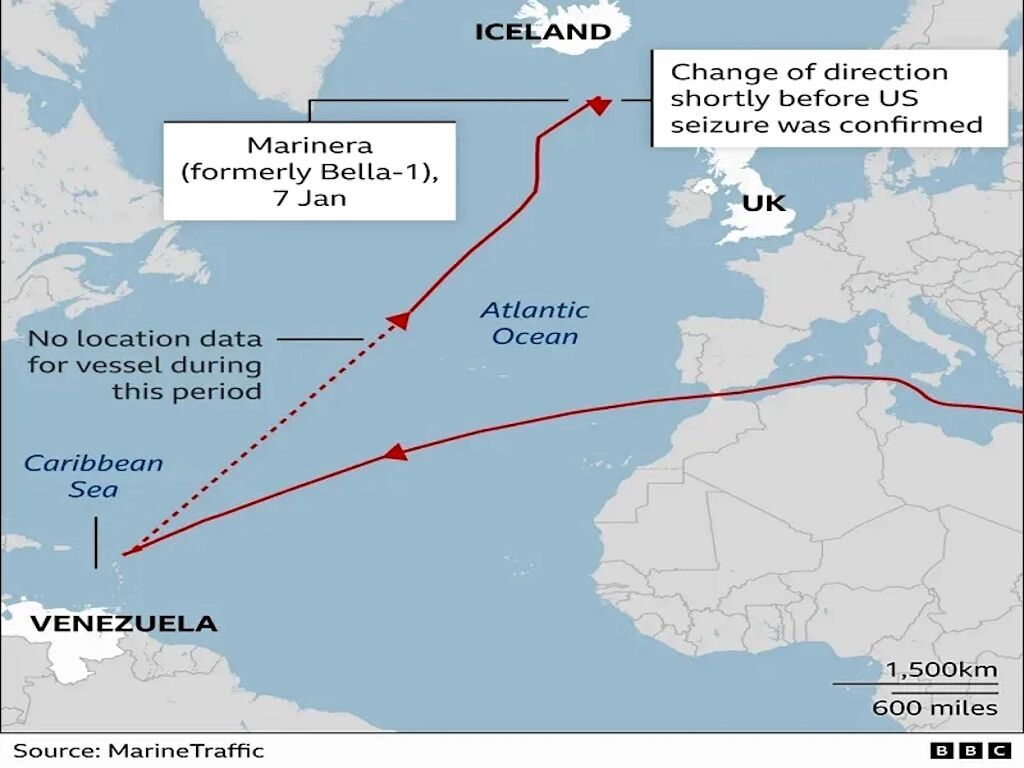
© Marine TrafficThe path of the oil tanker Marinera as it fled from the U.S. Coastguard.
The Russian-flagged Marinera tanker was just seized by the US in the Atlantic. It was earlier named the Bella 1 and is under US sanctions due to connections to Hezbollah. It sailed under the Guyanese flag from Iran to Venezuela and attempted to break the US' blockade. It failed, turned around, changed its name to the Marinera, and received a temporary permit to sail under the Russian flag before being seized. Russian then demanded that its citizens on board be treated humanely and returned home.
Secretary of War Pete Hegseth posted that "The blockade of sanctioned and illicit Venezuelan oil remains in FULL EFFECT — anywhere in the world." This preceded Attorney General Pam Bondi threatening that criminal charges might be pursued against the crew. Her tweet and Hegseth's other one about how the US will only permit "legitimate and lawful" energy commerce with Venezuela shows that it's once again assuming so-called "police" functions. Here are three takeaways from this incident:
1. The US Is Surprisingly Nonchalant About An Accidental War With Russia
It was brazen even by the US' standards to seize a Russian-flagged tanker, especially after Western media reported that Russia had dispatched ships and a submarine to escort it, which Russia didn't confirm and none were nearby during the seizure. Nevertheless, Trump 2.0 calculated that there'd be no retaliation despite the deputy chairman of Russia's parliamentary defense committee warning that "any attack on our carriers can be regarded as an attack on our territory, even if the ship is under a foreign flag."
This incident interestingly occurred in parallel with the US backing European ceasefire guarantees for Ukraine that include British and French commitments to deploy troops there during that time even though Russia has repeatedly warned that they'd be legitimate targets. Quite clearly, the US is now surprisingly nonchalant about an accidental war with Russia, whether over seizing one of its flagged ships at sea or over NATO allies getting killed in Ukraine. This observation won't be lost on Russia.
2. "Fortress America" Also Includes An Important Maritime Component
The goal of restoring the US' unipolar hegemony over the Americas, which is described as the highest regional priority in its new National Security Strategy, can be referred to as building "Fortress America". This isn't being pursued just for reasons of prestige but also pragmatism in the sense of enabling the US to survive and even thrive if it's ever expelled from the Eastern Hemisphere or decides to retreat from there since control over the hemisphere's resources and markets would all but ensure this outcome.
As can be seen by this incident as well as Hegseth's and Bondi's posts about it, there's also an important maritime component related to controlling the export of oil from Venezuela, which has the world's largest reserves. This can only be achieved by maintaining the unilateral blockade and seizing all ships that violate it, both on law enforcement pretexts that embody the concept of extraterritoriality. Without this maritime component, "Fortress America" could never truly be built, but it's not without some costs.
3. The US Is Dismantling The "Rules-Based Order" That It Built Over The Decades
The above-mentioned point segues into the last one about how the US' militarily enforced extraterritoriality vis-à-vis Venezuela dismantles the "rules-based order" that it built over the decades for maintaining its unipolar hegemony over the world after the end of the Old Cold War. This violates the international laws that the US used to selectively police across the world according to its arbitrary standards. Instead of international ones, the US is now policing its own, but also in pursuit of hegemony.
International law has increasingly become illusory due to the UN's innate dysfunction, which is related to the deadlock among the UNSC's five permanent members, with one usually vetoing significant proposals from the others. Even so, if the Great Powers abided by it in their ties with one another, then there'd be more predictability and less risk of war by miscalculation. The US is no longer interested in even that as proven by this incident, however, since building "Fortress America" now takes precedence over all else.
----------
The trend connecting the three aforementioned takeaways is that the US is militantly reasserting its historical "sphere of influence" over the Americas, and this is so important for Trump 2.0 that it's willing to rubbish the "rules-based order" over it and even risk an accidental war with Russia. The maritime component off of Venezuela's Caribbean coast that's been built before all else is justified by the administration as a law enforcement operation that prioritizes domestic laws over international ones.
Since this is taking place on the other side of the world where neither half of the Sino-Russo Entente has any military bases, they can't challenge this even through indirect means, unlike how the US challenged Russia's reassertion of its own historical "sphere of influence" in Ukraine through the ongoing proxy war. This doesn't mean that the US' grand strategic goal of restoring its unipolar hegemony over the Americas will succeed, just that if it doesn't, then it'll be due to intra-hemispheric reasons and not external forces.











I'm pretty sure when Putin and Xi had their meeting a few years ago and departed said meeting in agreement - this sort of behavior was anticipated - and now here we are.
Let the ideas with merit prevail - and let the showman and tricksters get their due.