
© Neuroscience News
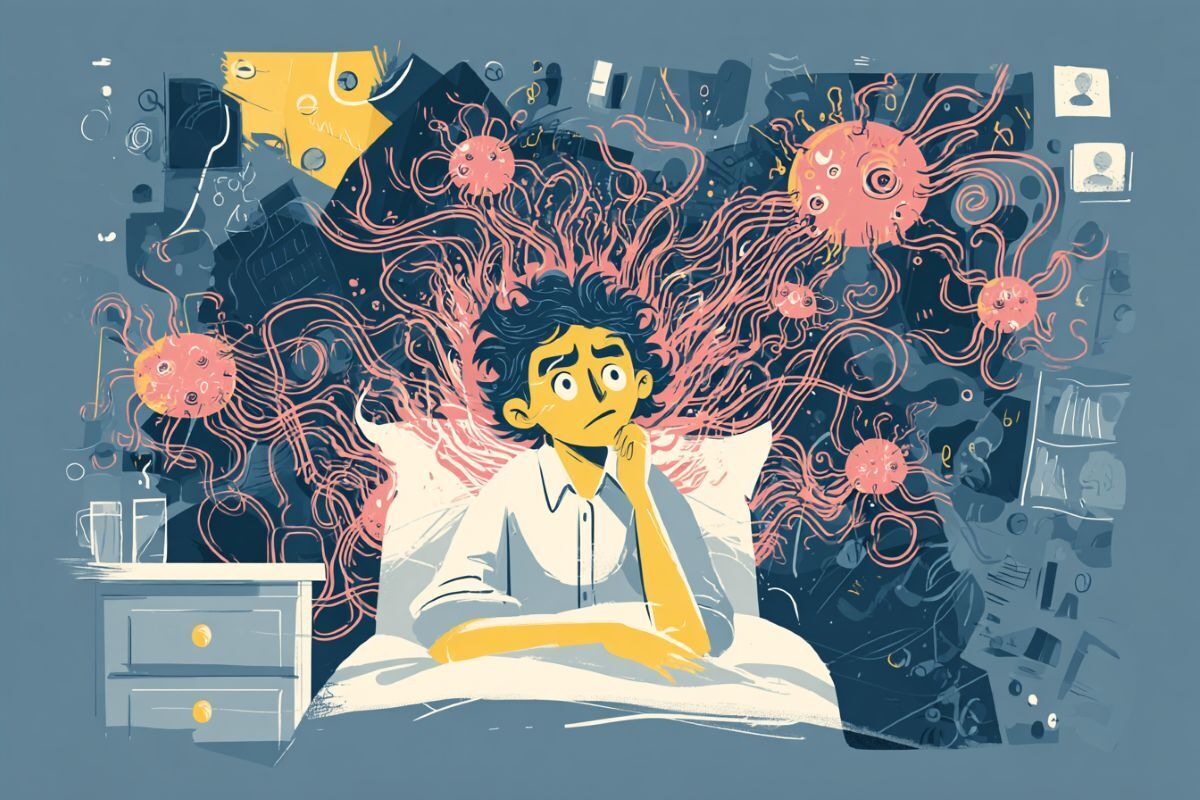
A new study details how the immune and central nervous systems implement this sickness behavior.
It makes perfect sense that when we're battling an infection, we lose our desire to be around others. That protects them from getting sick and lets us get much needed rest. What hasn't been as clear is how this behavior change happens.
In the research published Nov. 25 in Cell, scientists at The Picower Institute for Learning and Memory of MIT and collaborators used multiple methods to demonstrate causally that when the immune system cytokine interleukin-1 beta (IL-1β) reaches the IL-1 receptor 1 (IL-1R1) on neurons in a brain region called the dorsal raphe nucleus, that activates connections with the intermediate lateral septum to shut down social behavior.
"Our findings show that social isolation following immune challenge is self-imposed and driven by an active neural process, rather than a secondary consequence of physiological symptoms of sickness, such as lethargy," said study co-senior author Gloria Choi, associate professor in The Picower Institute and MIT's Department of Brain and Cognitive Sciences.
Jun Huh, Harvard Medical School associate professor of immunology, is the paper's co-senior author. The lead author is Liu Yang, a research scientist in Choi's lab.
A molecule and its receptor
Choi and Huh's long collaboration have identified other cytokines that affect social behavior by latching on to their receptors in the brain, so in this study their team hypothesized that the same kind of dynamic might cause social withdrawal during infection. But which cytokine? And what brain circuits might be affected?
To get started, Yang and her colleagues injected 21 different cytokines into the brains of mice, one by one, to see if any triggered social withdrawal the same way that giving mice LPS (a standard way of simulating infection) did. Only IL-1β injection fully recapitulated the same social withdrawal behavior as LPS. That said, IL-1β also made the mice more sluggish.
IL-1β affects cells when it hooks up with the IL-1R1, so the team next went looking across the brain for where the receptor is expressed. They identified several regions and examined individual neurons in each.
The dorsal raphe nucleus (DRN) stood out among regions, both because it is known to modulate social behavior and because it is situated next to the cerebral aqueduct, which would give it plenty of exposure to incoming cytokines in cerebrospinal fluid.
The experiments identified populations of DRN neurons that express the IL-1R1, including many involved in making the crucial neuromodulatory chemical serotonin.
From there, Yang and the team demonstrated that IL-1β activates those neurons, and that activating the neurons promotes social withdrawal. Moreover, they showed that inhibiting that neural activity prevented social withdrawal in mice treated with IL-1β, and they showed that shutting down the IL-1R1 in the DRN neurons also prevented social withdrawal behavior after IL-1β injection or LPS exposure.
Notably, these experiments did not change the lethargy that followed IL-1β or LPS, helping to demonstrate that social withdrawal and lethargy occur through different means.
"Our findings implicate IL-1β as a primary effector driving social withdrawal during systemic immune activation," the researchers wrote in Cell.
Tracing the circuit
With the DRN identified as the site where neurons receiving IL-1β drove social withdrawal, the next question was what circuit they effected that behavior change through. The team traced where the neurons make their circuit projections and found several regions that have a known role in social behavior.
Using optogenetics, a technology that engineers cells to become controllable with flashes of light, the scientists were able to activate the DRN neurons' connections with each downstream region. Only activating the DRN's connections with the intermediate lateral septum caused the social withdrawal behaviors seen with IL-1β injection or LPS exposure.
In a final test, they replicated their results by exposing some mice to salmonella.
"Collectively, these results reveal a role for IL-1R1-expressing DRN neurons in mediating social withdrawal in response to IL-1β during systemic immune challenge," the researchers wrote.
Though the study revealed the cytokine, neurons and circuit responsible for social withdrawal in mice in detail and with demonstrations of causality, the results still inspire new questions. One is whether IL-1R1 neurons affect other sickness behaviors. Another is whether serotonin has a role in social withdrawal or other sickness behaviors.
In addition to Yang, Choi and Huh, the paper's other authors are Matias Andina, Mario Witkowski, Hunter King, and Ian Wickersham.
Key Questions Answered:
Q: What triggers social withdrawal during infection?
A: An immune molecule called IL-1β activates a specific brain receptor that shuts down social behavior.
Q: Which brain circuit drives this withdrawal response?
A: Neurons in the dorsal raphe nucleus activate pathways to the lateral septum to suppress social interaction.
Q: Is social withdrawal just due to lethargy when sick?
A: No — the study shows it is an active, separate neural process, not a side-effect of feeling sluggish.
Original Research: Open access.
"IL-1R-positive dorsal raphe neurons drive self-imposed social withdrawal in sickness" by Gloria Choi et al. Cell



Reader Comments
then there needs to be another reason for the behavior change to avoid social interaction.. Since it's a completely different experiment than optogenetics+stimulation, this is not replication. Using even simple words in the wrong way is a hallmark of today's tabloid science news.
Another issue is the lack of demonstration if optogenetics in the lab has any relation whatsoever to what happens in a living organism in nature.
There are also no control experiments for either experiment. My guess would be that social avoidance (in the article wrongly termed social behavior "shutdown" or "suppression") also happens when mice are poisoned or injured. If so, this would strongly suggest that it is "just" because of "feeling sluggish". Which is a misdirecting way to look at how your body is telling you, you need rest.
As always, when I look at findings like these, I can't help but notice how the "scientists" have their preconceived notions and want to fit every finding into that mold. True science is unprejudiced.
And a different interpretation is, they hide to avoid getting easy prey for predators. Especially wolves are know for being able to "smell" sick prey. It could well be that even humans fall back to instinctive mammal-brain behavior in such a case. Well, they use to succeed when they inject the dubious stuff directly into the blood stream ...
Fuck them all!
Happy Holidays,
Ken
I got mind to go find the book I was reading yesterday and quote from it - it was written in 1910 or some such - here is the title of said book....a screw it - let me go get it - tis entitled:
Our Southern Highlanders - by Horace Kephardt a most articulate and well-studied author.
The book was published in 1913 and on page 124 it reads I quote: Now to get on topic let me share this statement from page 119: I don't know about you but the less "man-made" EMF the better is what I think the folks round here have concluded - for good reason.
And moreover, the brain knows how to heal itself - and sometimes isolation is the best way for this - when it is chosen of course.
So two conclusions I reach - 1. Sometimes it is good to be isolated rurally; and 2. Don't mess with the folks from Appalachia!
Regards,
BK
.
A neuroscience paper published in Cell just days ago answers a question researchers have been trying to solve for years: what actually changes in the brain during a psilocybin experience—and why those changes can last. Using a genetically modified rabies virus as a neural tracer, researchers were able to map—cell by cell—how psilocybin alters brain connectivity. This allowed them to see, for the first time, which brain regions gain connections, which lose them, and how those changes depend on what the brain is doing during the experience itself.
The findings help explain long-standing observations discussed by neuroscientists, psychiatrists, and researchers often referenced on platforms like Huberman Lab:
• Why psilocybin can reduce depression and anxiety
• Why the default mode network quiets during psychedelic states
• Why sensory perception feels intensified
• Why context and mental state during a trip matter so much
• Why a single experience can lead to lasting psychological change One of the most important results from the study is this: only brain regions that are active during the psilocybin experience undergo lasting rewiring. Inactive regions do not change. That finding has major implications for mental health treatment, psychotherapy, and our understanding of how perception, mood, and identity are shaped at the neural level.
In this video, I walk through:
• How the rabies tracer virus works and why it was used
• What changed in sensory, emotional, and self-referential brain networks • How this relates to depression, anxiety, PTSD, and trauma
• What this discovery means for future psychedelic research
Neuroscience JUST Did the IMPOSSIBLE by Chase Hughes (gootube) [Link]