
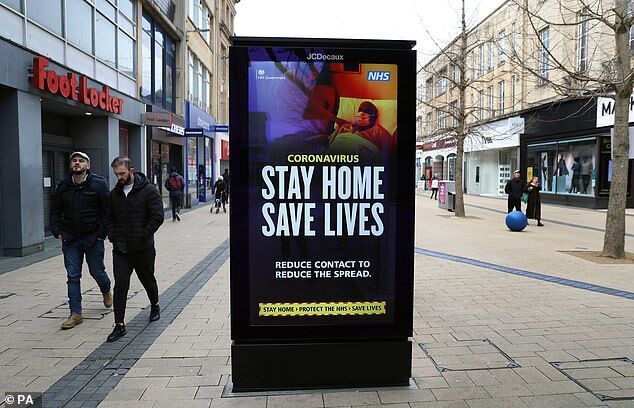
© PASchools across the UK were 'locked down' in a secret hypothetical scenario created by the Government in preparation for another pandemic (pictured: a Covid lockdown notice in Bristol in 2021)
Exercise Pegasus, which concluded last month and involved all major government departments, simulated a real-life global emergency.
The imaginary virus, 'EV-D68', was described as particularly deadly for children - in contrast to Covid-19, which mostly affected the elderly.
It is understood ministers taking part decided the scenario would require schools to be closed again.
However, no real pupils were involved in the drill, and no real schools were closed.
The drill comes after the official Covid inquiry found school lockdowns 'brought ordinary childhood to a halt'.
The made-up scenario involved a novel version of enterovirus, 'EV-D68', breaking out on a fictional Island in southeast Asia before spreading across the world.
EV-D68 was said to cause respiratory failure, brain swelling and - in rare cases - paralysis in infants, children and teenagers.
Ministers involved in the drill decided the spread of the imagined virus would result in travel restrictions, school and business closures and mask wearing in the UK and around the world.
They also had to 'wargame' dealing with fictional street protests over social distancing, it is understood.
Exercise Pegasus was designated a 'Tier 1' national emergency exercise, meaning it involved ministerial participation, all devolved nations and activation of COBRA, the Cabinet Office Briefing Rooms.
It ran in three parts in September, October and November this year and imagined a novel version of EV-D68 had triggered a pandemic.
Its key purpose was 'to simulate a realistic pandemic scenario, and is the first of its kind in nearly a decade,' according to an NHS briefing document uncovered by The Telegraph.
The imaginary virus was based on one which was first isolated in California in 1962.
As well as respiratory disease and meningitis, it can cause a polio-like paralysis in children known as acute flaccid paralysis.
Sir Peter Horby, Professor of Emerging Infections and Global Health at Oxford, told The Telegraph: 'The choice of an enterovirus is a good choice because it is a real possibility with real risks but is different from what we have seen before.
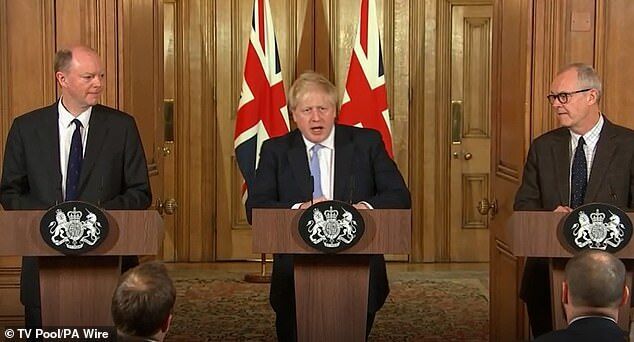
© TV PoolPA WireIn a state drill carried out this autumn, ministers were asked to draft plans for what they would do in the event of another deadly new virus (pictured: former Prime Minister Boris Johnson facing press at the start of the first Covid lockdown in 2020)
'Have the systems changed and were the responses different?'
In Phase 1 of the Exercise Pegasus, participants were told an outbreak of a novel enterovirus had occurred on the fictional Island of 'Musiyana' in southeast Asia and that it had already spread to Malaysia and Singapore.
The outbreak followed a local 'food festival', and a child had died on 17 September.
In Phase 2, the World Health Organization (WHO) formally declared a pandemic, schools were closed and hospitals started to come under pressure. Protests over social distancing also broke out.
In Phase 3, a national lockdown was declared and non-essential businesses ordered to close. There were also fears that the virus - thought to be carried in pigs - could also cause food shortages if UK herds became infected.
A Government spokesman said: 'Exercise Pegasus concluded this autumn and was the largest simulation of a pandemic in UK history, involving every government department, all four nations, and many government agencies.
'A fictional scenario was designed to test participants and improve public bodies' ability to respond to a pandemic.
'Learnings will be taken to strengthen the UK's ability to protect the public, and findings will be published as part of the Government's commitment to transparency.'







Comment: To "protect the public"? More like generating fear and control to make the people understand that they need the government for protection.