
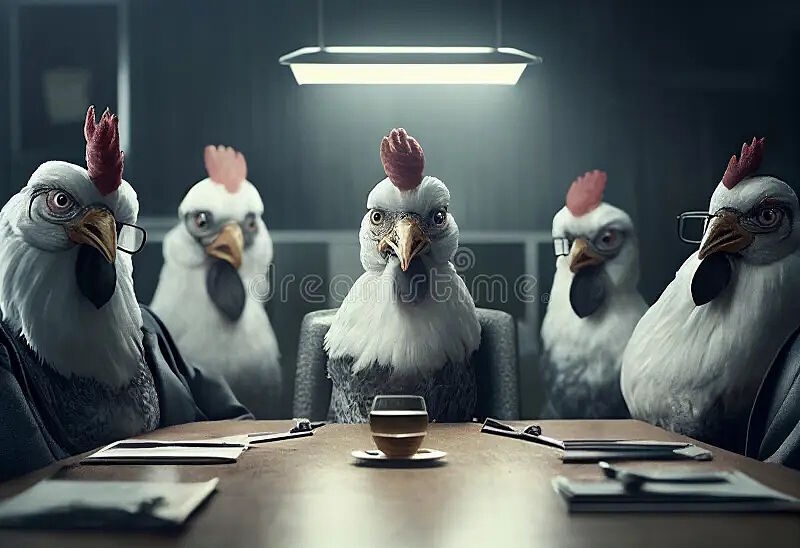
© Vitaliy Nazarenko/Dreamstime.com
In 1983, William Muir took on a challenge that would not only redefine his entire industry but also the way we think about work. But oddly, as an evolutionary biologist at Purdue University, Muir wasn't studying people; he was studying chickens.
At the time, the poultry industry had its Ferrari: the Dekalb XL. These birds were bred for one thing and one thing only: raw speed in egg production. They could outlay anything else in the barnyard. But there was a problem.
The very trait that made them prolific also made them destructive. They were aggressive, territorial, and prone to pecking one another to death.
The industry's fix was crude and cruel: trim their beaks so they couldn't do as much damage. Muir wondered if there was a more humane way. What if, instead of breeding for pure productivity, you bred for teamwork?
Breeding Super Teams
Muir set up an experiment. He placed ordinary chickens into groups of nine and measured how many eggs each group produced. Instead of rewarding the top individual chicken, he bred from the most productive groups.
After six generations, he had created what he jokingly called the KGB, for Kinder, Gentler Birds. On their own, these chickens weren't much different from others. But when returned to their flocks, they massively outproduced every other group. By selecting for collaboration instead of individual dominance, Muir had created super teams that were both more productive and more peaceful.
These weren't just better-behaved birds. They were displaying team intelligence. They had become smarter together, able to achieve more as a group than any one of them could manage alone.
Then came the showdown: a super team versus the industry-standard Dekalb XLs. After a year, the results were stark. Muir's birds were thriving. The Dekalb XLs? Only three were still alive. The rest had literally pecked one another to death.
Muir had proved that great teams don't just beat superstars. They develop team Intelligence, and that makes them more resilient and more effective.
From Coop to Corporate
As awful as the chicken coop may sound, the lesson applies directly to the workplace. Too many companies operate like farms full of Dekalb XLs, rewarding individuals who hit their own numbers, even if they damage everyone around them.
From school onward, we are groomed for competition: ace the tests, get into the right college, land the best internships, climb faster than our peers. By the time we are in business, many of us have internalized the same destructive logic as those super chickens: my success depends on your failure.
This creates offices full of pecking-order behavior. Colleagues hoard information. Managers pit team members against one another. Employees quietly celebrate others' mistakes because it makes them look stronger. The workplace becomes less about building together and more about surviving together.
Instead of teams becoming more intelligent, more resourceful, and more creative, they become fragile, paranoid, and easy to break apart.
The Too-Much-Talent Problem
Muir's research mirrors what psychologists call the too-much-talent problem. In sports, studies show that when more than 50 to 60 percent of a team is made up of top talent, performance actually declines.
Why? Because much like the office, success in soccer or basketball depends on task interdependence. Players must pass, coordinate, and trust one another. Too many stars competing for the spotlight undermines cohesion.
Baseball is different. Players operate largely on their own, which is why teams like the Yankees could stack their roster with stars and thrive. But in interdependent sports, and in most workplaces, teams overloaded with stars struggle.
That is the essence of Team Intelligence. It's not about collecting the most talented individuals. It's about creating the conditions that allows talent to combine and compound, producing results that no individual could achieve.
The Principles of Team Intelligence
So if talent isn't enough, what is? That's where team intelligence comes in. For the group to solve problems as quickly as possible, they need to think and act collectively at a higher level than its members could achieve alone.
Building it requires three habits:
- Align reasoning. Teams must share a clear mission, not pursue competing personal agendas.
- Focus attention. High-performing groups mix deep focus with bursts of rapid communication that spread insights and build trust.
- Unlock resources. Leaders must surface hidden skills, knowledge, and networks so the entire team can benefit.
Lessons From the Court
In 1980, a team of NBA All-Stars, some of the most talented players alive, faced off against Team USA's college athletes. On paper, the All-Stars should have crushed them. Instead, they lost four out of five games; in one game, they lost by 31 points.
The All-Stars weren't really a team. Each player was competing for shots, minutes, and headlines. And in basketball, there is only one statistic that predicts a player's salary: the number of points they score. This means we have incentivized every player to be selfish and take a shot, regardless of whether it is a good shot.
There is also only one statistic that predicts if a coach is effective: the increased rate of passing under that coach. What that means is that the coach has gotten players to be less selfish and think more about the team — they pass and the ball reaches the person with the best chance of scoring. They become less like the Dekalb XL super chickens and more like Muir's super teams.
Team USA, by contrast, had a singular mission: represent the country. They passed more, trusted more, and worked as one. Individually, they were less talented. Collectively, they developed team intelligence and became unstoppable.
That same lesson plays out in offices every day. Teams overloaded with superstars collapse under the weight of competing egos. Teams built for trust and collaboration consistently outperform expectations.
The Real Test of Leadership
The corporate world doesn't need more super chickens. It needs more super teams.
The best leaders understand this. They don't just hire for résumés and raw talent. They hire for collaboration. They reward knowledge-sharing. They elevate glue players, the colleagues who make everyone else better, even if they don't have the flashiest stats.
Because in the end, whether in a barnyard, a locker room, or a boardroom, the lesson is the same: teams win, not individuals.
If we want organizations that are both productive and sustainable, we have to stop breeding super chickens and start building super teams. That is the real future of leadership: unlocking collective genius through team intelligence.




Reader Comments
In other words, there is a team and there is individual greatness. If you have a team of mediocre individuals, the team will not be successful.
There is jprobably more to it, as the overall goal of the organization plays a part in creating a team.
In the West, especially under circumstances when no direct "performance assessment" is possible, collectives / teams have been degraded to order-giver and order-recipient groups. Which results in the team's performance is limited by the order-giver (and his order-giver ...), which it will never exceed. Just look at Western political "leaders". A regular example is a rigid hierarchy like military detachments.
Some groups, like the actual work force of companies, must maintain a certain level of collectivism and voluntary cooperation, or else the company will soon fade from existence. Which sadly does not apply to administrative departments like e.g. HR, by the way ...
Hunter and gatherer groups OTOH surely depended upon comprehensive cooperation for their survival.
Western mankind is developing different spiritual muscles than the east. Trying to bring eastern practices into the west just creates a whole lot of inadvertent hypocrites, as well as enabling nefarious actors to control others via new-agey BS. Putting the "collectivity" on a pedestal is very much being used to manipulate and control naive masses in the US. One of the ways to do it is to conflate teams with collectives.
If a person can lift 100 pounds, then ten people can lift 1,000 pounds.
If a person has 110 IQ, then ten people still have only 110 IQ, although the team setting may increase the chance of actualizing that 110.
You know?
~
So - who cares about IQ - what matters is if folks learn to work together - then the sky is the limit.
Otherwise, both the lemmings subsumed and the ones think they know better will go over the cliff of time, and it will all just start again until a species comes along capable of learning to work together.
~
As for chickens - I got five Buff Orpington pullets - and they really are endearing to me - they best get started laying eggs soon - otherwise, why the hell I been going through all the effort to get them up and going? The were born in Iowa in early July and they are now about what - 3 and half months old - come on you hens - time to start making yourselves of worth.
~
I really like their attitude.
Anyhow, my birds look pretty much just like the one in the image!
I appreciate working and doing business with folks play fair and proper.
I just want some eggs reliable and fresh - homemade and really - what could be better than that?
I'll share with the neighbors of course!
If one man can dig out one cubic yard in one hour, 3600 men can dig the same pit in one second. Economists, MBAs and similiar professions use to have full faith in this idea.
I would categorize them as "linear thinkers".
A room full of people is never is smarter than the smartest person in the room - and invariably the smartest person's intellect is nullified by group think.
Or are you saying a room full of people is only as smart as the smartest one in the room and therefore is singular?
If so, once again, I beg to differ!
I mean goodness me why would the smartest one in the room succumb to "group think" - that don't strike me as smart....huh...correct?
So the smart one dismisses the group think - and then it goes round and around - who is the smartest one Erwin?
or is it - as you say?
huh....can you elaborate please - was that a typo?
~
ErwinsCat35 - question above is directed to you - it is what it is - it is directed at you!
'The Terrifying Theory of Stupidity You Were Never Meant to Hear – Dietrich Bonhoeffer' [Link]
Sort of like this: So, my point of contention is - I don't think the room is only as smart as the smartest one it it - cause when symbiotic interaction happens - a group of individuals - and individuals they remain - can be much smarter than any one individual within. Sort of like one fella can lift 100 pounds easy, but not 1000 but 10 fellas working together can easily lift 10000.
So please know - I oppose "Group-Think", but I got no problem working together with others synergistically.
BK
day and night - [Link]
That is simple really.
I mean one-cell organisms have learned it already - why can't humans Demore ?
And if humans can't learn what nature already knows - then I reckon humans are a failed species....
Time will tell.
~
Better ideas beckon.
Live it.
~
Nobody is the smartest - cause the smartest ones work together.
And imagine this - they still are individuals - each contributing what they got to offer....
~
Too many rules ruin everything.
~
If you doubt this, well why would you - and it is true - chicken can teach business about the too much talent personnel problem - in my book all these Buff Orpingtons are equal and the one bird they got rid off is no longer part of the picture I reckon - so I hope they start laying eggs soon enough - if not I guess I'll just be forced to eat em!
~
[Link]
~
But I would never do that....
Maybe it was suitable in recently disappeared eras, but now, when narcissists and psychos have taken the world in all its spheres, team work is a way of parasitism. More than ever, credit and fruition is for single individuals. What this article states is interesting, but no enough, neither close. To analyze "team work", it is absolutely necessary to account the individuals with primitive traits, as narcissists, borderlines, psychos... They fuck any team.
~
I remember a play against a team named "Brighten" I seem to recall - they had just scored a TD on us or were about to - and my pal Cricket and I looked at each other and said - lets tackle that halfback and we did - tackled the hell out of that annoying kid - but unfortunately the ball had been handed to another and they scored a TD now I recall.
Lesson learned....
~
Still - no denying it felt good to tackle the hell out of that annoying kid - and Cricket and I did. So - maybe in the end it was "worth it" - cause I recall we won that game.
BK, 11925 1451