

© joannenova.com.au
Once science stopped being about winning arguments and became just the-number-of-papers-someone-published, it became an empty shell. And once billions of dollars, depended on sacred 'experts', it was doomed.
Long gone are the days when papers were hardly ever retracted and pal review was "the big problem? Now, fake papers and fake editors are so rife they are their own specialist industry. Networks of brokers connect paper-mills up with authors and publishers and place batches of papers in journals with 'friendly editors'. When Richardson et al analyzed PLOS ONE, they found 33 editors who seemed to have an extraordinarily high rate of retractions. One in particular had approved 79 papers of which, 49 had already been retracted.
Given the vital importance of peer review and science to the UN, the Labor Party and the Greens, the question is will they immediately launch an inquiry and set up a Royal Commission... or do nothing at all, and mention it to no one. Shh!
If an entire modern economy depended on getting science right, there would be constant monitoring and reporting studies like this. Instead some scandalous and systemic failure of science is reported every few years and all the people who "follow the science" don't give a toss.
And this is just the tip of the iceberg -the study acknowledged that many fake papers had not even been discovered yet. And this paper doesn't even mention the replication crisis where only half of all papers can even be replicated. Or worse, that the papers that were harder to replicate were more likely to be cited.
Wait til they find out thousands of real papers are worthless because they rely on broken climate models that got the core assumptions wrong decades ago. And that's not just the papers pretending to predict the climate, but tens of thousands of other papers calculating the floods that won't happen, or the birds that won't be extinct, or the cost of building seawalls we won't need, and of building planes that won't fly on recycled canola oil. A whole generation of scientists spinning their wheels...
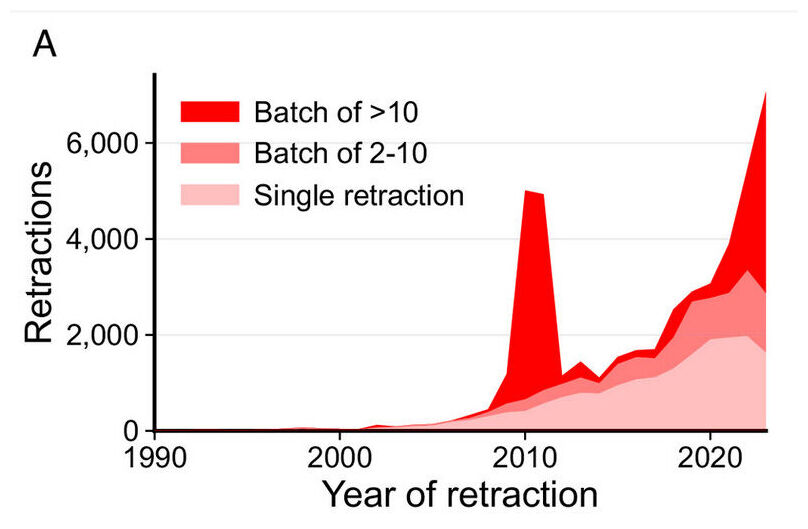
© joannenova.com.au(A) Retractions are increasingly published in batches. The ∼2010 spike in the number of large-batch retractions is almost entirely attributable to a large swath of conference proceedings articles retracted by IEEE. For the first time since this spike, the majority of 2023 retractions were reported in batches larger than 10 articles.
Sophisticated global networks are infiltrating journals to publish fake papers
The problems Richardson and his colleagues documented are growing fast. The team built a list of papers identified in 55 databases of likely paper mill products, looking at the number of suspicious papers published each year between 2016 and 2020.The rate of fake papers appears to be doubling much faster than the rate of retractions is:
Richardson and his colleagues found that the problem goes far beyond networks of unscrupulous editors and authors scratching each other's backs. They identified what appear to be coordinated efforts to arrange the publication of batches of dubious papers in multiple journals.
The team looked at more than 2000 papers flagged on PubPeer for containing duplicated images and identified clusters of papers that all shared images. Those sets of papers were often published around the same time and in a limited selection of journals. Looking at patterns of duplicated images is an "absolutely innovative" method for investigating these networks, Abalkina says. "No one has done this before."
They found that the number of suspected paper mill products doubled every 1.5 years — 10 times faster than the rate of growth of the literature as a whole, although still a small proportion of papers overall. The number of retractions and papers flagged on PubPeer had also risen fast, doubling every 3.3 and 3.6 years, respectively, but not keeping pace with the increase in suspected fraudulent papers.At this rate, soon fake science will eclipse the real stuff, and if we could rule out Woke Science as well, perhaps it already has?
"This means that the percentage of fraudulent science is growing," Abalkina says. That poses particular risks to fields like medical science, where the fake papers sometimes make their way into systematic reviews and meta-analyses, potentially distorting our understanding of drugs and treatments, she says.
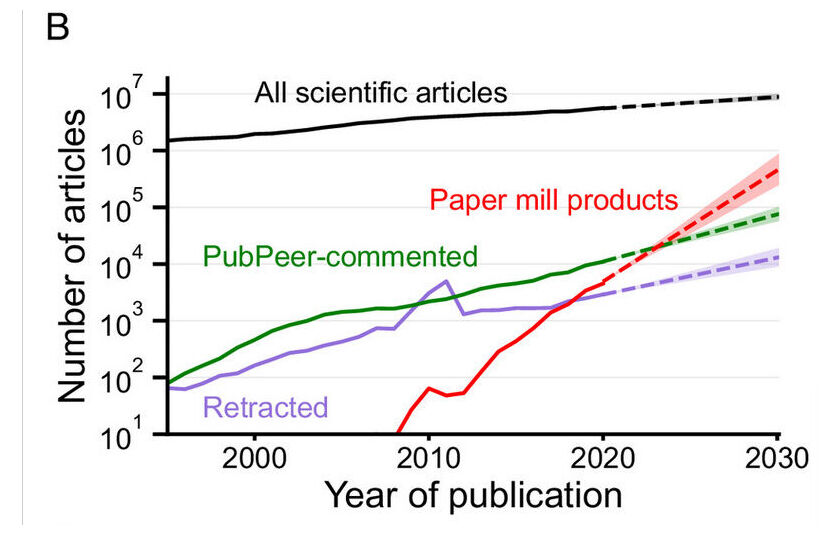
© joannenova.com.au(B) Annual global scientific activity as measured by items labeled as “journal article” or “conference proceeding article” in OpenAlex (47), as retracted articles reported by Retraction Watch, as PubPeer-commented articles and as suspected paper mill products. We make use of the linear trends observable in the log–linear plot to extrapolate these observations for the period 2020–2030. We show the 95% CI using shaded bands. The number of suspected paper mill products shows the largest growth rate, with a doubling time of 1.5 y.
REFERENCE
Richardson et al (2025) The entities enabling scientific fraud at scale are large, resilient, and growing rapidly, August 4, 2025, 122 (32) e2420092122, https://doi.org/10.1073/pnas.2420092122










Brave AI: "Scientific journal authors are required to declare any competing interests , including financial or non-financial interests, that could potentially influence the objectivity, integrity, or value of their work." Essentially many authors lie about influences.
In research institutions, there is the adage "Publish or perish." If you want to be a professor or assistant professor, you have to publish papers in peer-reviewed journals.
This requires an author's research program which requires grants. Brave AI: " Scientific grant requests are reviewed and funded by a diverse range of agencies, NGOs, and government bodies. In the United States, major federal agencies that provide grants include the National Institutes of Health (NIH), which is the largest public funder of biomedical research in the world and awards grants through its 27 institutes and centers. The National Science Foundation (NSF) is another key federal agency, funding approximately 20 percent of all federally supported basic research conducted at American colleges and universities. Other significant U.S. federal agencies include the Department of Energy (DOE), the National Aeronautics and Space Administration (NASA), the U.S. Department of Agriculture (USDA), and the Environmental Protection Agency (EPA).
These federal agencies often use peer review processes to evaluate grant applications. For example, the NIH makes award selections based on expert peer review ..."
Therefore GRANTS (money) determine the direction of scientific research . This is where not only financial influence (think of the NIH and Big Pharma) but dogma and dark intentions are involved.
Dogma is the current paradigm for a scientific silo; archeology is a good example as research needs to demonstrate that the Great Pyramid was built around 2500 BC. Then Gobekli Tepe was discovered in Turkey, built 12,000 years ago... Note that the research on Gobekli Tepe is being controlled.
What do I mean by " dark intentions "? Think about the plandemic. Think about zero-point energy. Brave AI: " As of 2017, the United States government had placed 5,784 patents under national security secrecy orders , according to data obtained from the U.S. Patent and Trademark Office (USPTO) via a Freedom of Information Act request." Think about DARPA programs in AI, social engineering, gene drives, nanotechnology, gene engineering.