
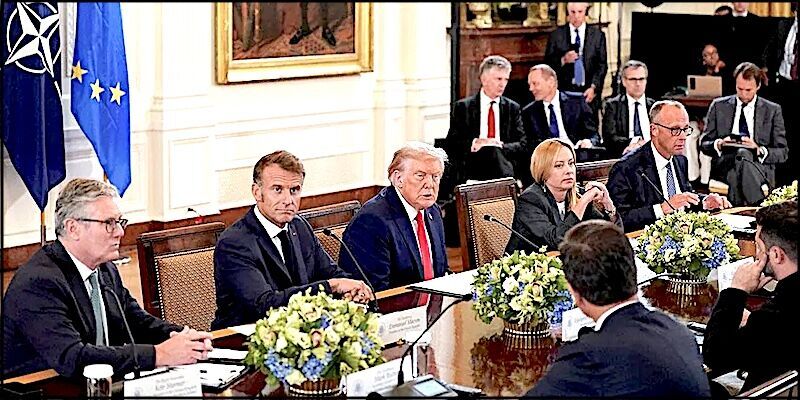
© UnknownEuropean leaders are 'putting on a brave face despite a losing game, holding no cards to win over the American leader.
It marks a major milestone in the normalization of relations between Moscow and Washington, a process that began after Donald Trump assumed the presidency of the United States.
Recall that before this, the Biden administration spoke of isolating the Kremlin, inflicting a strategic defeat on Russia, and supplying Ukraine with vast amounts of money and weapons. Trump, even during his election campaign, acknowledged the impossibility of Ukraine joining NATO and admitted the likelihood of Kyiv losing a number of territories.
Objective Reality
During the lengthy conversation between the two leaders in Alaska, Putin managed to convince his American counterpart that a ceasefire in the Ukrainian conflict would be counterproductive, as it would only allow Kyiv to regroup and intensify its resistance against advancing Russian troops.
The fact that Ukraine is losing the war is an objective reality, largely acknowledged even by Western states: the successes of our forces along virtually the entire front line are too obvious. As a result, unlike before, Trump clearly stated the need to focus primarily on reaching a settlement agreement and establishing peace in this part of the world. This development has caused panic in Ukraine and Western European countries, which had consistently demanded a ceasefire first, followed by negotiations on a settlement.
In Kyiv, the shift in Washington's approach to Ukrainian affairs has been perceived as a "stab in the back." U.S. media loyal to the Democratic Party immediately accused Trump of "making concessions to Putin" and continue to criticize the Russia-U.S. summit in Alaska. The British magazine The Economist wrote about the "nightmare of the Trump-Putin pact," accusing the two leaders of "collusion."
Prominent German politician Roderich Kiesewetter, in a comment for The Washington Post, declared the end of the West as a unified political concept and space, stating that the West "as an emotional, ethical term is finished." This German figure is known as a staunch friend of Kyiv and, naturally, an enemy of Russia.
Nicolas Dupont-Aignan, leader of the French party Debout la France ("Stand Up France"), stated on August 16 that after the Alaska summit, Europe has already "left history," paying a high price for its blindness and bias in the Ukrainian conflict. He emphasized that France must return to an independent foreign policy and break free from the European Union.
Former British Ambassador Peter Ford described the hysteria in Western media as confirmation of the Alaska summit's success, arguing that the furious and bitter reaction from Western outlets indicates that progress was made — albeit not in the direction the Western establishment had hoped for.
Following the Alaska summit, Trump invited Zelensky to Washington on August 18. Western European leaders feared that the Americans would pressure the head of the Kyiv regime into accepting all U.S. terms. After urgent consultations, it was decided that Zelensky would be accompanied to Washington by the leaders of major Western European states — Germany, France, the UK, Italy, Finland — as well as the NATO Secretary-General and the European Commission President. All these figures, under various pretexts, had advocated for continuing military operations in Ukraine, promising Kyiv assistance and support.
Many observers, including those in the Global South, believe that European leaders are "putting on a brave face despite a losing game," as they hold no cards to win over the American leader — historically, they have always relied on Washington's line.
A Major Shift in International Relations May Be Underway
The most astute American and Western European analysts cautiously conclude that the Alaska summit not only marked a major step toward settling the Ukrainian conflict but also signaled a significant shift in international affairs, including the establishment of a new global balance of power.
In this context, comparisons are increasingly drawn to George Orwell's novel "1984", written in 1948, which depicts a world divided into three superpowers:
- Oceania (the U.S., South America, the UK, and Southern Africa);
- Eurasia (the entire former Soviet Union and Continental Europe);
- Eastasia (primarily China, Japan, and the Korean Peninsula).
These powers wage endless wars over disputed, impoverished regions:
"No one of the three super-states could be definitively conquered even by the other two in combination. They are too evenly matched, and their natural defenses are too formidable."Thus, as Bloomberg wrote on August 16, today's world appears to be returning to a concept of spheres of influence. The author suggests that Trump's goal is to restore the U.S. as a nation-state in North America, explaining his apparent territorial ambitions regarding Canada, Greenland, and the Panama Canal, as well as his focus on trade balances, tariffs, and the importance of reindustrialization.
It is worth noting that the idea of returning to a 19th-century "concert of nations" policy — dividing the world into spheres of influence — is widely discussed in American political circles, particularly in the leading international relations journal Foreign Affairs. In this context, it is pointed out that in early September, Beijing will host celebrations for the 80th anniversary of the victory over Nazi Germany and militarist Japan. Russian President Vladimir Putin will attend, and the Chinese have extended an official invitation to President Donald Trump as well.
Clearly, resolving the Ukrainian conflict will take time and is unlikely to proceed smoothly. Nevertheless, Trump emphasizes his determination to achieve a peaceful settlement, proposing a trilateral meeting between the presidents of the U.S., Russia, and Ukraine.



Reader Comments