
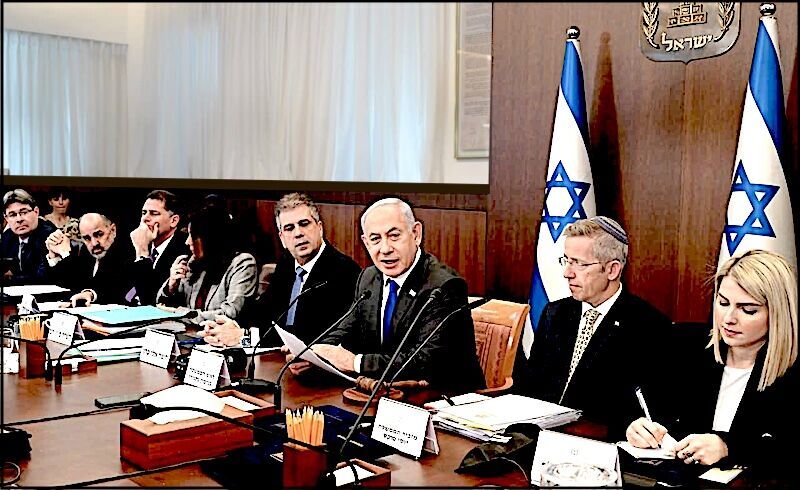
© Israel National Photo Collection/Government Press OfficeIsraeli Prime Minister Benjamin Netanyahu at a cabinet meeting • January 22, 2023
Israel's war on Gaza has never been solely about "defeating" Hamas. This week's reporting makes that clearer than ever. If you read just one article this week, Tareq Hajjaj documents how Israel is engineering chaos in Gaza's aid system, shooting at desperate civilians, and allowing looters to operate freely so that food does not reach starving people. Qassam Muaddi reports on leaked Israeli cabinet minutes that confirm they deliberately chose starvation as a weapon of war, rejecting a ceasefire in favor of forcing Gaza's surrender through hunger.
This policy is not hidden. It was discussed from the very beginning, nearly two years ago, and is still openly embraced by senior Israeli figures and the majority of the Israeli population. That brazenness is finally eroding Israel's legitimacy around the world. The International Sociological Association's suspension of the Israeli Sociological Society is the latest sign of an expanding academic boycott. In United States politics, Bernie Sanders's recent resolutions to block weapons sales did not pass, but they showed something important: Palestine is becoming a litmus test inside the Democratic Party, and electeds are starting to respond to the shift in the party's base on these issues.
At the same time, the rot inside Israel's political culture is on full display. A new poll shows that seventy-nine percent of Jewish Israelis are not troubled by the famine in Gaza. This normalization of atrocity makes it easier for Israeli leaders to escalate the suffering of the Palestinians there. Netanyahu is now ordering the army to expand the war and reoccupy the entire Strip. There are few defences of this genocidal behavior available to the pro-Israel, anti-Palestinian crowd.
Governments and institutions desperate to protect Israel's impunity are cracking down even harder on dissent. In the United States, Columbia University's mass suspensions of Palestine activists and PEN America's firing of Kori Davis show how institutions are bending to political pressure. Trump's looming overhaul of the federal workforce threatens to hardwire this repression into the government itself. These are not separate battles. They are part of the same effort to shield Israel and complicit institutions from accountability.
We are witnessing the tipping point that the movement for Palestinian liberation has labored on for decades. Israel's legitimacy is being contested in more places and by more voices than ever. But breaking its genocide, apartheid, and occupation will depend on escalating the movement across civil society around the world.






I think it's been going on since the time of Christ if not longer, and the Crusades appear as if they never ended.
GROK 3
"The Crusades, a series of religious and military campaigns primarily between Christians and Muslims for control of the Holy Land, spanned several centuries. They are generally considered to have begun in 1095 and ended in 1291, though broader interpretations extend the timeline to later periods.Start (1095): The First Crusade was initiated by Pope Urban II at the Council of Clermont in November 1095, calling for Christians to reclaim Jerusalem from Muslim control.End (1291): The traditional end is marked by the fall of Acre, the last major Christian stronghold in the Holy Land, to the Mamluks in 1291, effectively concluding the major crusading efforts in the Levant.Some historians extend the Crusades to include later campaigns, like the Northern Crusades or minor expeditions, lasting into the 15th century (e.g., the Crusade of Varna in 1444). However, the core period of the major Crusades is 1095–1291."