
© The Cradle
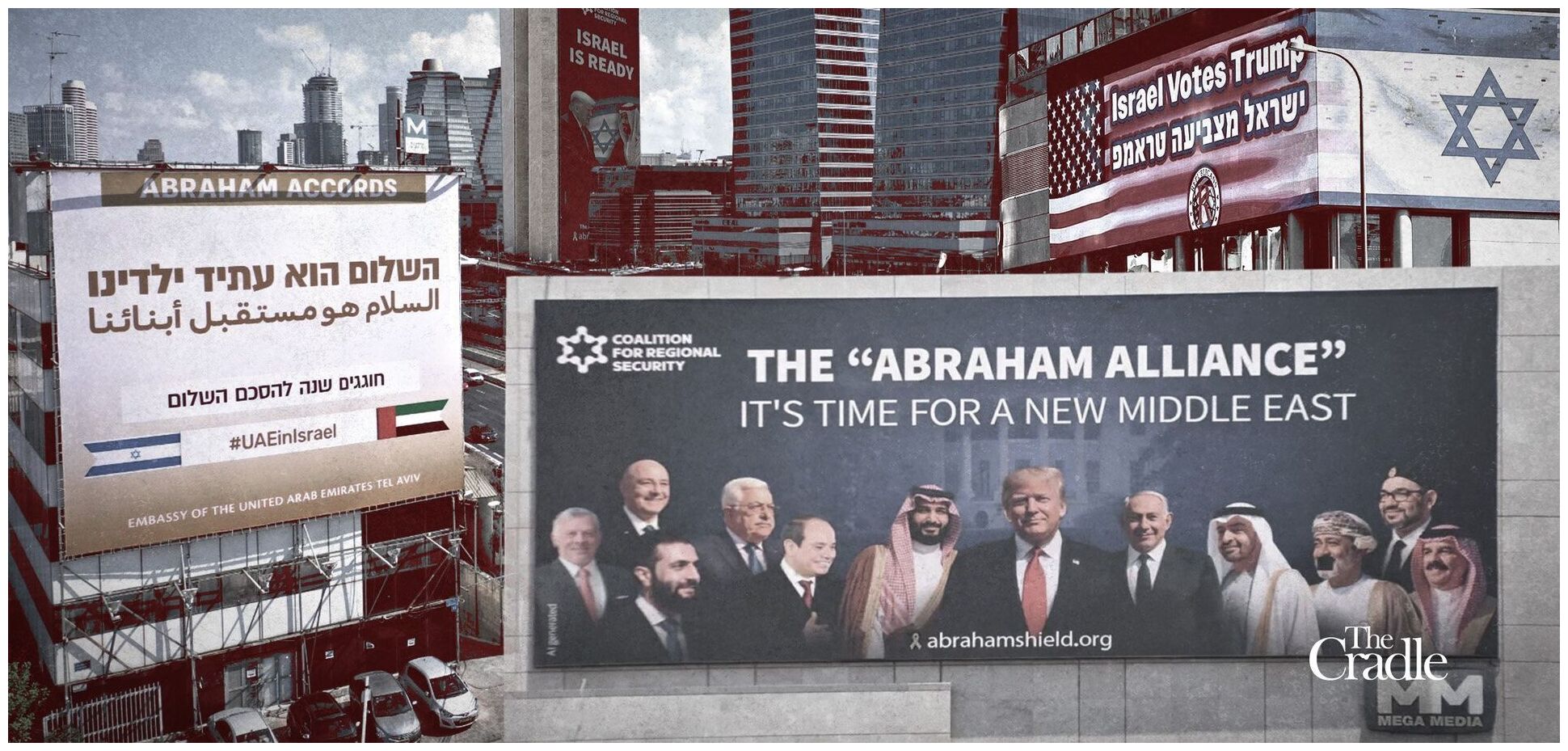
There was no clarification of who had formally signed on, no footnote about "ongoing consultations." The image made no distinction. The message was clear: Whether officially declared or discreetly aligned, these governments had already enlisted in the occupation state's regional vision.
For years, Arab governments have played both sides - issuing statements of solidarity with Palestine, while coordinating airspace, intelligence, and investments with Tel Aviv. Saudi Arabia repeatedly claims it will not normalize without movement on Palestinian statehood, even as Israeli jets crisscross its skies and business delegations are quietly exchanged.
So did the billboard reveal the truth? Or, simply confirm what has long been denied?
The blueprint behind the billboard
It was not a PR stunt. It was the public unveiling of a strategy to turn Gaza into a controlled laboratory, to conscript Arab states into an anti-Iran alliance, and to redraw borders with neither war nor negotiation - just power and complicity.
The plan behind this billboard is not a rumor, but a formal policy document drafted in March by more than 100 former Israeli generals, intelligence officials, and diplomats. Dubbed "The Abraham Shield," its rhetoric of "stability" and "shared prosperity" cloaks a blueprint for expanding the Greater Israel project.
In plain terms, the plan institutionalizes apartheid, engineers demographic erasure in Gaza, and repackages Palestine as a pacified enclave ruled by proxy.
It lays out six pillars: Gaza's transformation - eradicating Hamas and installing a foreign-controlled transitional authority backed by external security forces; demilitarization - a decade or more of sealed borders, disarmament, and digital surveillance, turning Gaza into a monitored containment zone; economic reconstruction - tied to a cashless, biometric-controlled economy designed to reward submission and punish dissent; a regional enforcement coalition - the "Abraham Alliance" where Arab states align intelligence and repression efforts with Israel; Syria as a buffer - an explicit plan for southern regime change and an Israeli security corridor to break Syrian sovereignty and contain Iran; Iran containment - a hybrid strategy of sanctions, sabotage, assassinations, and diplomatic isolation to dismantle Iranian regional influence.
From Hamastan to Abrahamstan: A dictionary of occupation
The Abraham Shield is not only a mere territorial project, but a semantic one as well.
In his book, 1984, George Orwell explained how language is weaponized to eliminate alternatives. American professor and scholar Noam Chomsky called this the manufacture of consent. In the Shield's rhetoric, Gaza is no longer an occupied, besieged territory.
It is rebranded as "Hamastan" - a failed experiment whose destruction is both justified and virtuous. Israeli Prime Minister Benjamin Netanyahu himself declared there would be "no Hamastan," revealing the ideological premise behind Gaza's decimation.
The irony is glaring. For over a decade, Israeli intelligence quietly propped up Hamas, not out of support but strategy - exploiting division to fragment Palestinian unity. Mossad coordinated Qatari cash transfers under the guise of humanitarian aid, which in fact entrenched a controlled internal rival to Fatah.
This very strategy is now being used to justify Gaza's erasure. The Shield document brands Gaza as "ungovernable," demanding rehabilitation under Israeli and regional oversight.
Words like "liberation" and "rehabilitation" saturate its pages. Bombardments are recast as "operations to restore civic order." Biometric checkpoints are framed as "secure mobility." Mass displacement becomes "temporary humanitarian relocation."
This is a strategy, and has nothing to do with semantics. The occupation is dressed up as salvation, and ethnic cleansing is laundered through the lexicon of progress.
In this dystopia, the destruction of Palestinian political life is portrayed not as escalation, but as correction. The outcome? Abrahamstan - a future where submission and normalization are rebranded as peace.
Solidarity on camera, submission in policy
Arab states now operate in full cognitive dissonance, condemning the occupation state's war crimes on camera while underwriting its apartheid policies in private - a duplicity that is unconcealed and even celebrated.
As communication theorist Marshall McLuhan warned, "the medium is the message." But in the Arab world, the message is manipulated into what sociologist Jean Baudrillard called the hyperreal - a spectacle more convincing than truth itself.
Saudi Arabia is the master of this theater. Riyadh insists there can be no normalization without Palestinian statehood. Meanwhile, Israeli aircraft freely transit Saudi airspace, and economic ties deepen through intermediaries. Even the recent diplomatic pivot toward Iran, hailed as strategic recalibration, is in practice a performance of balance while preserving channels with Tel Aviv.
The UAE has dispensed with even symbolic pretense. Since the Abraham Accords, Emirati conglomerates have invested millions into Israeli surveillance tech and weapons. In 2023, as bombs fell on Gaza, Emirati Foreign Minister Abdullah bin Zayed described events as "deeply concerning" while simultaneously welcoming an Israeli trade mission to Abu Dhabi.
Morocco has gone even further. In early 2024, it held joint military drills with Israel's Golani Brigade - a unit accused of committing war crimes - under the euphemism of "technical capacity-building."
Egypt's alignment is more structural. The government under President Abdel Fatah el-Sisi is shackled by over $20 billion in International Monetary Fund (IMF) loans and depends on Israeli gas imports to power its grid. Publicly, it laments Tel Aviv's "excesses." Privately, it coordinates security in Sinai and seals the Rafah crossing.
Jordan has reduced its resistance posturing to TikTok cosplay. The heavily choreographed stunts of Jordan's King Abdullah II - leaping from armoured vehicles, firing rifles, and posing as a field commander - mask an embarrassing reality.
In a viral video widely circulated by regional media, Israeli National Security Committee Chair Boaz Bismuth is alleged to have boasted, "We can wake the King of Jordan in the middle of the night to carry out our orders." While Tel Aviv has not confirmed the statement, its popularity speaks to a regional perception that Jordan's monarchy no longer operates with real autonomy.
A billboard in Damascus
Even in Syria, remnants of rebellion are co-opted. In May, interim president Ahmad al-Sharaa, the former chief of the Al-Qaeda affiliated Hayat Tahrir al-Sham (HTS) who went by the nom de guerre Abu Mohammad al-Julani, told a Jewish community outlet in Damascus that his administration, which is deeply rooted in Sunni extremism, and Israel "share common enemies."
A month later, the Israeli chief of staff was spotted in southern Syria amid reports of indirect normalization negotiations. Even the ashes of resistance are being recycled into the architecture of normalization.
That trajectory was cemented when a billboard appeared in central Damascus, pairing Sharaa with US President Donald Trump under the slogan "Strong Leaders Make Peace."
French sociologist Pierre Bourdieu called this phenomenon symbolic violence - the imposition of a worldview so total that it masquerades as truth. That is the logic of The Abraham Shield. Arab governments chant liberation while facilitating dispossession - openly branding the betrayal as pragmatism.





Hell to pay, Bibi. Hell to pay.