
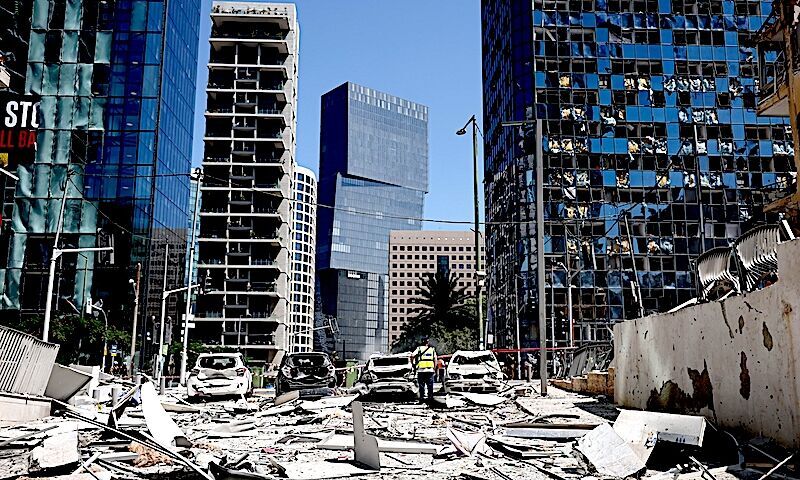
© VCGDebris and damaged cars at the site of an Iranian missile strike • Ramat Gan, Central Israel • June 19, 2025
During phone talks with his Russian counterpart, Vladimir Putin, over the situation in the Middle East, Xi urged the conflicting parties, especially Israel, to cease fire as soon as possible.
The Chinese president said that protecting civilians' safety is the top priority amid the Iran-Israel tensions, calling on the conflicting parties to strictly follow international law, and resolutely avoid harming innocent civilians.
Dialogue and negotiation are the fundamental way out, he said, calling on the international community, particularly major countries that have a special influence on the parties to the conflict, to make efforts to cool down the situation.
China stands ready to continue to strengthen communication and coordination with all parties, pool their efforts, and uphold justice, so as to play a constructive role in restoring peace in the Middle East, he said.
Putin briefed Russia's views on the current Middle East situation during the phone call, stating that Israel's attacks on Iran's nuclear facilities are very dangerous. The escalation of conflicts is not in the interests of any party and the Iranian nuclear issue should be resolved through dialogue and negotiation, Putin said, according to a press release of Chinese foreign ministry.
Both sides of the conflict should ensure the safety of citizens from third countries. As the situation is still developing rapidly, Russia is willing to maintain close communication with China, make positive efforts together to cool down the situation, and safeguard regional peace and stability, Putin said.
The phone conversation between Xi and Putin comes as the Iran-Israel conflict reaches a critical juncture, with hostilities continuing to escalate. Their direct communication underscores a joint effort toward de-escalation, echoing the shared concerns of the international community, Liu Zhongmin, a professor from the Middle East Studies Institute of Shanghai International Studies University, told the Global Times on Thursday.
Although the conflict ultimately hinges on the actions of the US, Israel and Iran, China and Russia - while not parties to the conflict - are working to promote de-escalation. Both China and Russia have voiced a shared commitment to lowering tensions in the Middle East, though meaningful progress will require broader international efforts, said Liu.
The expert noted that calls for dialogue are increasing. "Ultimately, negotiations may remain the most viable path forward," said Liu.
Also on Thursday, Indonesia, alongside 23 other Muslim-majority nations, issued a joint statement condemning Israel's military assault on Iran and called for an immediate ceasefire to prevent further destabilization in the Middle East, according to Indonesia Business Post.
UN Secretary-General António Guterres said on Wednesday he remains "profoundly alarmed" by the ongoing military escalation between Israel and Iran. "Any additional military interventions could have enormous consequences, not only for those involved but for the whole region and for international peace and security at large," he warned, according to a release from the UN.
Amid rising tensions, many countries have worked to pull their citizens from Israel and Iran, per multiple media reports.
Chinese Foreign Ministry spokesperson Guo Jiakun said on Thursday that up till now, our Ministry and the Chinese embassies and consulates in Iran, Israel and other neighboring countries have organized and coordinated the evacuation of over 1,600 Chinese nationals from Iran to safety, and several hundred Chinese nationals from Israel.
Our Ministry and diplomatic and consular missions will continue to do everything possible to help our fellow nationals move to safety and evacuate, said Guo.
Urgent situation
The tit-for-tat strikes between Israel and Iran continued on Thursday. At least one of 20 ballistic missiles Iran launched at Israel Thursday contained a "cluster bomb warhead", reports The Times of Israel, citing the Israeli military's Home Front Command.
Meanwhile, Israel's military said its fighter jets attacked dozens of sites across Iran overnight, including the Arak heavy water nuclear reactor.
The fact that Israel's American friends have entered the scene and are saying such things is a sign of Israel's weakness and inability, Iran's supreme leader Ali Khamenei said in a post on X.
"I would like to tell our dear nation that if the enemy senses that you fear them, they won't let go of you. Continue the very behavior that you have had up to this day; continue this behavior with strength,"Israel's defense minister said today that "eliminating" Ayatollah Ali Khamenei was a goal of its war on Iran, Al Jazeera reported.
In the past two days, the topic of US President Donald Trump weighing options for involvement in the Iran-Israel conflict has drawn wide media attention. A Bloomberg report on Thursday claimed that senior US officials are preparing for the possibility of a strike on Iran in the coming days. The situation is still evolving and could change. Some pointed to potential plans for a weekend strike.
Trump told reporters at the White House on Wednesday he has "ideas as to what to do" and that he prefers to make the "final decision one second before it's due" because the situation in the Middle East is fluid.
Niu Xinchun, executive director of the China-Arab Research Institute of Ningxia University, told the Global Times that in recent days, the US has been moving major forces into the Middle East - aircraft carriers, bombers, and refueling planes are now in place. "While Washington calls this a defensive move in response to Iranian threats against US bases, the shift from defense to offense could happen easily," said Niu.
But any US strike would almost certainly trigger Iranian retaliation against US bases or the Strait of Hormuz - a scenario Washington hopes to avoid. For now, the US is weighing Iran's response and the potential consequences of any move, said Niu.
It's uncertain whether the US will stay out of the war. While Washington claims non-involvement, its military support, missile interception, and intelligence assistance to Israel have already drawn it partly into the conflict. Full US involvement will depend on how the situation evolves and US strategic interests, Tian Wenlin, a research fellow at the China Institutes of Contemporary International Relations, told the Global Times.
Trump's mixed messages on Iran-Israel conflict also raised concerns within the US. US Top Senate Democrats are demanding Trump outline a strategy for dealing with Iran, saying the administration has left Congress in the dark as he weighs direct US military involvement in the Israel's campaign against Tehran, according to Politico. It also noted that the escalating conflict could spiral into a regional war and put thousands of US troops in the Middle East at risk.
The US and Israel operate in a coordinated front-and-rear formation - Israel takes direct military action on the front line, while the US offers support and strategic guidance from behind the scenes. This clear division of roles enables Washington to pursue its Middle East objectives without direct exposure. "However, this approach heightens regional tensions and further complicates prospects for resolving the conflict," said Tian.
The expert said American support has emboldened Israel's military actions, while increasing pressure on Iran. This imbalance of power further tilts the dynamics of the conflict and deepens regional instability.




Really, ya think???