
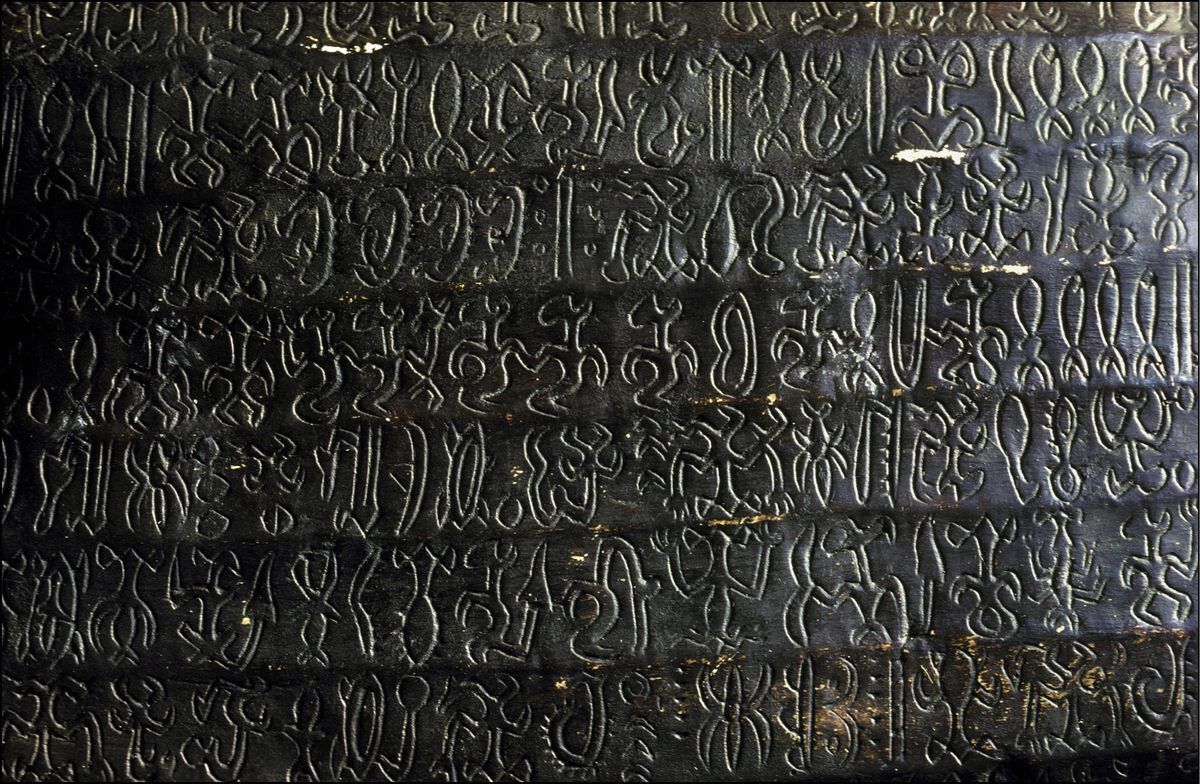
© Yves Gellie/Gamma-Rapho via Getty ImagesThis particular bit of rongorongo, photographed around 1999, was apparently carved with a shark tooth.
Comment: There is still room in the world for the dedicated independent researcher.
I never expected to make a meaningful contribution to one of the world's last undeciphered writing systems — especially not over a single weekend. But sometimes, curiosity grabs hold of you, and before you know it, you're completely consumed by a mystery that refuses to let go.
It was a regular Friday night. I was unwinding, scrolling through a few things online, when something sparked a memory — the Rongorongo tablets of Easter Island. I remembered reading about them years ago, and how nobody had cracked their meaning. That thought just stuck. No Rosetta Stone. No living tradition. Just intricate glyphs carved into ancient wood, waiting.
I've always loved learning about ancient human history, especially the things that are still unanswered. I look at it like this: if there's a theory about why something might be the way it is, and there's even a small chance it can be proven or disproven with just a little effort, I'm going to give it a shot. This was my first time seriously trying something like this.

Recto (side a), as traced by Barthel. The lines have been rearranged to reflect English reading order: Cr1 at top, Cr14 at bottom.
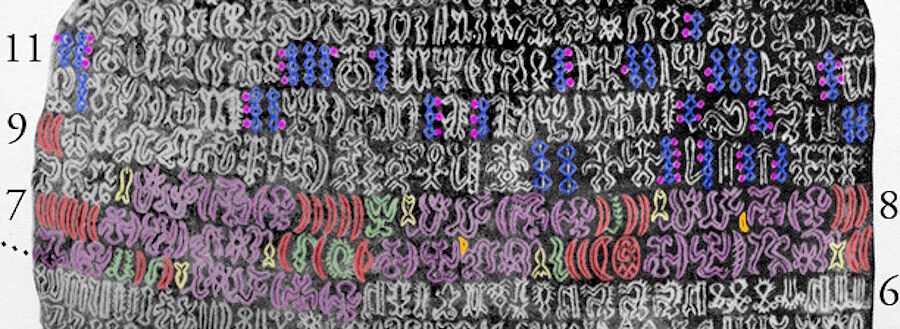
© GFDL image taken from Chauvet, Stéphen-CharlesThe calendrical sequence. Red are the 28+2 nights of the month, full moon in the center; purple are a sequence repeated eight times; the fish (yellow) are head up during the waxing moon and head down during the waning moon; green are glyphs proposed to be phonetic complements.
So I went all in. I spent that weekend doing nothing else. I compared glyphs, chased down clues, and with the help of AI-assisted pattern recognition, I started seeing connections. Line 9 looked like it was mapping out a 13-moon sidereal calendar that started on the summer solstice. Then I looked at Line 8 — and sure enough, I started seeing patterns that echoed the same structure.
By Sunday night, I had something real. Not a full translation, but a theory built on cultural logic, repeated glyphs, and calendar alignment. I wanted to share it, to put it out into the world. I tried a couple of academic publishing sites — they didn't load or wouldn't take the file. So I went with Zenodo. It was simple, credible, and got the job done. I uploaded the paper on June 1, 2025, got a digital object identifier, and figured that was the end of it.
Then the email came. The Easter Island Foundation had seen my work. The president — Mary Dell Lucas — reached out and said they wanted to feature my findings in their official newsflash. I couldn't believe it. Getting recognition like that from the people who actually safeguard the legacy of Rapa Nui meant everything.
I'm not claiming I've solved Rongorongo. Far from it. But I think I've found something that fits — something that makes cultural and structural sense. I welcome critique. I hope people challenge it. That's how progress happens.
This whole experience showed me that you don't need a grant, a lab, or a university to make a meaningful contribution. Sometimes, all it takes is a question you can't let go of, a weekend you're willing to lose, and the tools to follow the thread.






Comment: More on the efforts to unravel the mystery of rongorongo: