
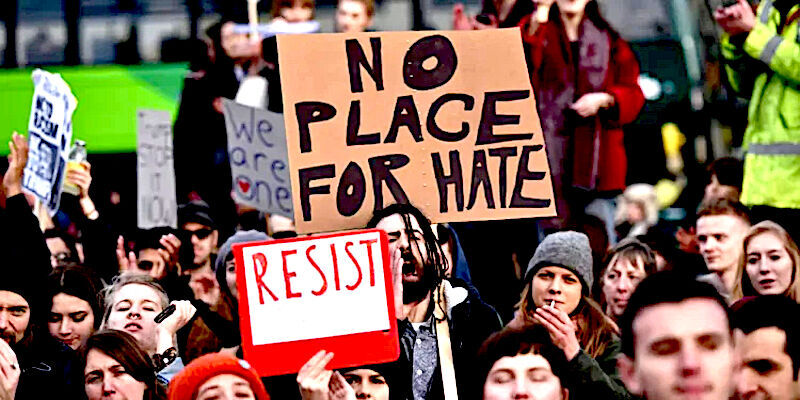
© UnknownCrowd protests hate.
The Criminal Justice (Hate Offences) Act 2024 was passed by the Oireachtas in October and introduces harsher sentences for crimes where the perpetrator is motivated by hatred of people with protected characteristics.
The law seeks to protect individuals targeted due to their race, colour, nationality, religion, national or ethnic origin (including Travellers), descent, gender, sex characteristics, sexual orientation, or disability.
Gender is defined within the legislation as the gender of a person "or the gender which a person expresses as the person's preferred gender or with which the person identifies and includes transgender and a gender other than those of male and female".
Existing offences covered by the legislation include criminal damage, public order offences, assault, coercion, threatening to kill or injure, and the distribution or public display of threatening or abusive material. These crimes now become hate crimes, with harsher sentences, if hatred towards a protected group can be proven. If the hatred element is not proven in court, the remaining aspect of the charge can still lead to a conviction.
Additionally, the law provides that if, during the trial of any other offence, evidence of a 'hate' element emerges, the judge will treat that as an aggravating factor and record the conviction as a hate crime. The new law was passed after the Government chose not to proceed with controversial "hate speech" provisions contained in the original Bill.
These excised provisions would have made the "communication" of material deemed capable of inciting "hatred" punishable by up to five years in prison and mere "possession" of such material punishable by up to two years.
However, the 1989 Prohibition of Incitement to Hatred Act remains in force. This legislation targets speech intended and likely to cause physical violence, requiring the prosecution to demonstrate that the accused intended to incite hatred. What was so chilling about the Criminal Justice (Incitement to Violence or Hatred and Hate Offences) Bill, as written, was that it went further on both counts - effectively lowering the criminality threshold from "incitement to violence" to "subjectively offensive", while at the same time holding defendants liable even if they didn't intend to stir up hatred.
In practical terms, this could have led to scenarios where individuals claiming to be offended - such as accusations of "homophobia" against a Christian street preacher or "transphobia" against a gender-critical feminist - could trigger investigations. Even if these cases never reached the courts, the investigatory process itself - the knock on the door, the officers of the law pushing past you into your living room, the confiscation of your phone and laptop, the formal interview at the police station - would have had a chilling effect on free speech.
In a sinister echo of Ireland's Committee on Evil Literature, which was established in 1926 - and the Censorship of Publications Act which followed and prohibited the sale and distribution of "unwholesome literature" - the bill also contains provisions that make it a crime, punishable by up to two years in jail, to "prepare or possess" material likely to incite hatred.
"Possession" in this context could simply mean having a dodgy meme or cartoon saved on your phone, or a copy of Mein Kampf on your laptop. These and other, similar cultural artefacts would certainly have fallen within the ambit of the criminal law, since the bill as written - e.g., Sections 10(1) and 10(3) - reversed the usual burden of proof, with the burden of proof resting with the accused to demonstrate the material was just for personal use.
Any attempt to frustrate the authorities in their pursuit of "unwholesome literature" wouldn't have got tech-savvy Irish citizens very far since the legislation includes a provision that makes it a crime punishable by a fine of up to €5,000 or a year in jail to refuse to give the Garda a password to any electronic device that you own.
Despite the removal of these hate speech provisions, the legislation faced opposition from Sinn Féin and others. It was ultimately passed with 78 votes in favour and 52 against.
Minister McEntee, speaking before the vote, emphasised:
"The law creates specific offences based on an aggravated offence model to ensure those who target victims because of their association with particular identity characteristics are identified as perpetrators of hate crime.".In his contribution, Sinn Féin's Matt Carthy raised concerns about the definition of gender within the legislation, stating: "Most people do not understand what this means precisely."
"Perpetrators of hate crime send a message to our minorities and our most vulnerable communities that they are not safe, that they do not have a right to be who they are and that they do not belong in Irish society. The new law sends the counter-message that hate-motivated attacks will not be tolerated, perpetrators will be punished, and marginalised and targeted communities will be protected."
Mick Barry, of People Before Profit, expressed unease about how the reference in the law to a person demonstrating hatred at the time of an alleged offence might be used.
"A Garda will just have to say that an accused person was heard using hate speech while committing another offence. This could be taken as evidence and used to convict. It could also be used to stigmatise political movements and activists."Responding to these concerns, Minister McEntee said that the law focuses on situations where "a crime has already been committed", meaning the demonstration of hatred must be accompanied by another offence.
On the definition of gender, she claimed:
"This is not about somebody's legal definition. If somebody is being attacked, they are not being asked if they have a gender certificate. They are not being asked if this is their gender or what their gender is. They are being attacked because of who they are. The approach we have taken here is deliberately inclusive to ensure we are adequately capturing the individuals and communities we know are targeted by these crimes."



Reader Comments
Canada has done the same thing you know.
Bill C-63 was brought in this year and it is so similar to this Irish fiasco as if to be written by the same hand;
"...(this) bill creates a new hate crime offense that renders any offense under the criminal code indictable and punishable by life in prison if it is deemed to be motivated by hatred. It also raises the punishment for advocating genocide from five years to life imprisonment and increases the punishment for willful promotion of antisemitism or hatred and public incitement of hatred from up to two years to as long as five years.
It also gives citizens the power to file complaints anonymously with the Canadian Human Rights Commission against people they believe are posting hate speech; such individuals could face takedown orders and fines of as much as $70,000 if they are found guilty. Those who file the complaints will have their identities shielded." [Link]
In Canada you can now anonymously accuse someone of a hate crime just because you are a weak, scared, entitled little freak. Thanks for nothing, Justine.
Those that are afraid of the public voice and condemnation, for years of corruption and lies.
[Link] Nella Fantasia...In My Dream
And the translation
In my dream, I see a fair world, Where everyone lives in peace and in honesty. I dream of souls that are always free, Like floating clouds, Full of humanity in the depths of the soul. (oboe) In my dream there's a warm win[Link]
Then they vote, and put in new dishonest, corrupt, liars. And... here we are.
I fear that we have very little room to maneuver in that respect, apart from complete anarchy.
Even a WEXIT would mean this part of Canada becomes more attached to the U.S..
What IS a better system??
John F. Kennedy
Unfortunately, the solution may be right there.