
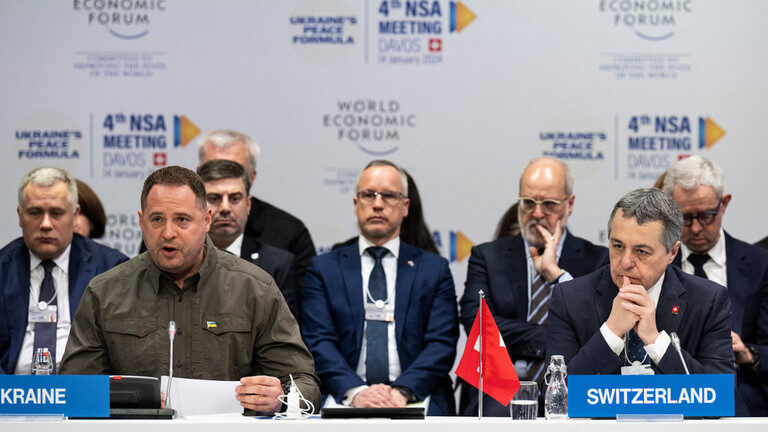
© GIAN EHRENZELLER / POOL / AFPHead of the Ukrainian President's Office Andrey Yermak and Swiss Federal Councillor Ignazio Cassis attend a meeting on the peace formula for Ukraine, in Davos, on January 14, 2024.
On Sunday, national security advisers from 81 nations and international organizations gathered in Davos ahead of the World Economic Forum to talk about a 10-point initiative floated by Ukrainian President Vladimir Zelensky in October 2022 to end hostilities with Russia.
The plan calls for the withdrawal of Russian troops from the territory Kiev claims as its own and insists on the creation of a tribunal to prosecute Moscow for alleged war crimes. Russia has dismissed the proposal as divorced from reality.
Commenting on the Davos meeting, Peskov called it "talking for the sake of talking," reiterating that the same applied to previous rounds of talks in such a format. "This process is not aimed and cannot be aimed at achieving a concrete result for an obvious and simple reason - we are not there."
Russia was also absent from previous discussions last year in Denmark, Saudi Arabia, and Malta. At the same time, Moscow has never categorically refused peace talks with Kiev, despite Zelensky signing a decree banning all negotiations with the current Russian leadership after four regions overwhelmingly voted to join Russia in the autumn of 2022.
Meanwhile, Bloomberg reported on Sunday that the Davos talks had ended "with no clear path forward" despite Ukraine's hopes that it would be able to secure backing for its plan from members of the Global South, many of whom have proclaimed neutrality in the conflict. That was denied by Ukrainian officials, however, who nevertheless acknowledged differences of opinion among the meeting's participants.
On Sunday, Swiss Foreign Minister Ignazio Cassis echoed Peskov's remarks, arguing that any Ukraine peace talks should involve Russia in one way or another.

The treaty confirmed the earlier Truce of Andrusovo of 1667.[1] It consisted of a preamble and 33 articles. The treaty secured Russia's possession of Left-bank Ukraine plus the right-bank city of Kiev.[2] 146,000 rubles were to be paid to Poland as compensation for the loss of the Left Bank.[2] The region of Zaporizhian Sich, Siverian lands, cities of Chernihiv, Starodub, Smolensk and its outskirts were also ceded to Russia, while Poland retained Right-bank Ukraine. Both parties agreed not to sign a separate treaty with the Ottoman Empire.[2] By signing this treaty, Russia became a member of the anti-Turkish coalition, which comprised Polish–Lithuanian Commonwealth, the Holy Roman Empire and Venice. Russia pledged to organize a military campaign against the Crimean Khanate, which led to the Russo-Turkish War (1686–1700).
Note: So Russia fulfiled treaty but collective west changed mind
https://en.m.wikipedia.org/wiki/Treaty_of_Perpetual_Peace_(1686)