
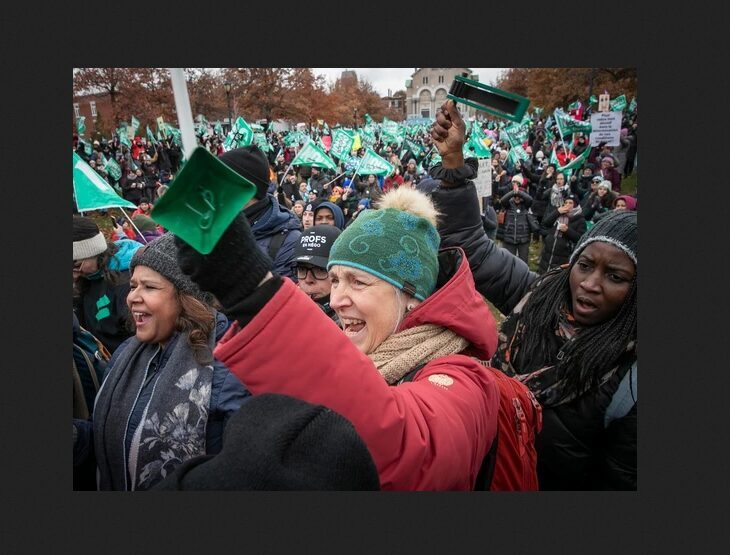
© Pierre Obendrauf /Montreal GazetteQuebec public-sector workers rally at Parc des Faubourgs in Montreal on Thursday November 23, 2023 during the third day of strike action.
The Quebec government is willing to put more money on the table to end the impasse with the common front of public-sector unions, but on the condition they show more flexibility in the way work is organized, Premier François Legault said Thursday.
With negotiations deadlocked and nearly 570,000 workers on strike at the same time — a massive demonstration is scheduled in front of the National Assembly Thursday — Legault and Treasury Board President Sonia LeBel called in the media to address the issue.
"What I am saying is we are open to put more (money), if and only if we get more flexibility," Legault told reporters. "It's about time that Quebec obtained all the tools we need in order to give better services to the population.
"I will be tough on that, and Sonia also."
Upping the stakes in talks, Legault said he wants to do what has not been done in 30 years in Quebec: change the way the health and education systems are organized so services respond better to client needs.
Comment: Considering the current state of leadership throughout the West, any claims they make about wanting to radically change things is rather ominous.
The government wants to be able to pay more to nurses who want to work weekends and nights, he said. He added the best way to fix the usual August chaos over the availability of teachers is to start earlier, but that implies more union flexibility.
"Come to the negotiation table," Legault said, speaking directly to the unions. "In exchange for this flexibility, we are ready to improve our offer, which currently represents 14.8 per cent."
Comment: By some estimates, the cost of food has increased ~25% in just a few years.
Legault, however, was not willing to say how much more money the government will devote to an agreement. Quebec has been saying for weeks its current offer is worth $8 billion.
"We aren't going to start putting numbers out here," he said.
"We hear them (on the money issue), but from the get-go, we said it's time to make real changes for them and for the population," LeBel added. "We'll stand firm on that. But we are there. We are willing to discuss and we are willing to put all the means necessary, but they have to be seriously willing to discuss flexibility with us.
"We understand the money is important. We will find agreements that are just and equitable but that come through a reorganization of the work, which is beneficial for our employees, but above all for citizens."
Legault and LeBel made the remarks as additional unions representing nurses and teachers joined the walkout Thursday.
The Fédération autonome de l'enseignement (FAE), which represents 66,000 teachers under nine unions, launched its unlimited strike on Thursday.
Meanwhile, the Fédération interprofessionnelle de la santé du Québec (FIQ), which represents 80,000 nurses and other health professionals, began a two-day walkout. Essential medical services will be maintained.
And the common front of public-sector unions, which represents 420,000 workers who are members of the CSN, CSQ, APTS and FTQ, was holding the final day of a three-day strike Thursday.
The common front represents workers in all sectors of the public service: health, social services, education and their respective support networks.
Finally, 700 members of the Syndicat de professionnelles et professionnels du gouvernement du Québec who are employed in 10 colleges also began a two-day strike Thursday.
"Don't forget that (Thursday's) strike will see nearly 600,000 people in the streets of Quebec," said CSN vice-president François Enault. "It's going to be the biggest strike ever in Canada."







Comment: Footage from the protest:
What with the economic situation only worsening, albeit at a slower pace (at the moment), it's likely only a matter of time before the huge protests that we saw, across much of the Western world at the beginning of last year erupt once again: Thousands of Romanian teachers protest low wages, strike enters 3rd week (June 2023)