
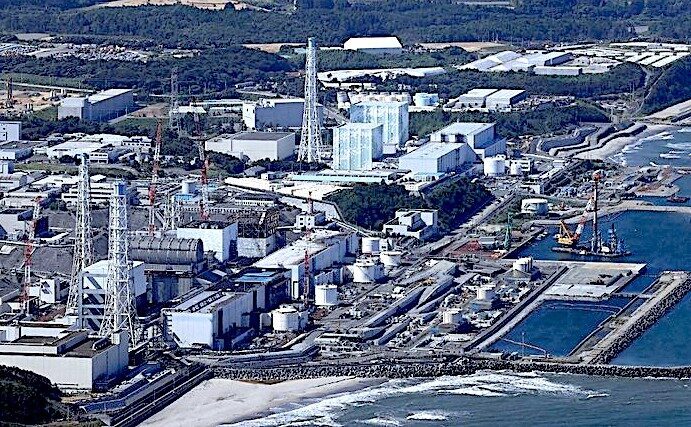
© Jiji Press/AFPView of the Fukushima Daichi Nuclear Power Plant • August 24, 2023
The operator of Japan's Fukushima Daiichi nuclear power plant has begun releasing a second batch of treated radioactive wastewater into the Pacific Ocean. The company maintains that the process is safe, but Japan's neighbors have condemned the move as "irresponsible."
The Tokyo Electric Power Company (TEPCO) said that the release began on Thursday morning. Around 7,800 cubic meters of water will be dumped over the next 17 days, a fraction of the 1.33 million cubic meters still sitting in 1,000 tanks at the plant.
TEPCO started releasing a first batch of 7,800 cubic meters in late August, after receiving approval from the International Atomic Energy Agency. The water, which had been used to cool nuclear fuel at the tsunami-stricken facility, has had all of its radioactive contaminants filtered out except tritium, a radioactive isotope of hydrogen.
The tritium is diluted with seawater at the end of the filtration process, and the mixture is pumped into the ocean. Following the first release, TEPCO scientists said that the level of tritium near the dump site was just above the lower limit of detection and 6,000 times lower than the maximum permissible level.
Japan has been heavily criticized by neighboring countries over the disposal plan. When a timeline for the scheme was first announced earlier this year, the Chinese Foreign Ministry called it "extremely irresponsible," declaring that "contaminated water impacts the global marine environment and public health."
China has since banned the import of fish and seafood from Japan. Tokyo has called the ban "scientifically unfounded," and lodged a complaint with the World Trade Organization.
Russian authorities have confirmed that fish caught after the first release have not shown excessive levels of radiation.
Emptying the 1.33 million cubic meters of wastewater at Fukushima will take at least 30 years, as only 10 out of 1,000 storage tanks are released in each batch. This process is hindered by the fact that the nuclear fuel remaining at the plant must be kept cool, a process that generates more contaminated water that must be treated and released.
The Fukushima Daiichi nuclear power plant was destroyed by a magnitude 9.0 earthquake and tsunami on March 11, 2011. Three of its reactors melted down, releasing large quantities of radiation and prompting mass evacuations from areas along Japan's east coast. The Fukushima disaster was the worst nuclear accident since the 1986 Chernobyl meltdown.














Having written my doctoral dissertation on Fuku, here are a few facts:
1. They filled the 1,000 tanks (hastily ordered/delivered), within a month or so,
2. They started releasing the water once capacity had been reached,
3. Even in the first few months, some tanks began leaking
So they have been CONTINUOUSLY releasing this water, the whole time.AND the 3 cores are basically in the RIVER under the plant, and/or in the ocean ... where the cores act as a saltwater reactor, creating tritium continuously (so of COURSE russia can't observe a noticeable bump in radiation, because it has been continuous since 2011!!!! What makes me worried is why they are making a big deal of it just NOW (new narrative, we just started dumping ... preposterous lie) ... Unless they plan on using this as cover for some other environmental disaster BEING PLANNED? Would really like to hear others' opinions on this.
Oh : and just why would it take 30 years to empty the tanks? Which took a month to fill? And please, it isn't because it takes that long to filter (not that they would bother, that costs $'s)
Oh and NOT the worst since Chernobyl. Fuku WAY WORSE. Chernobyl was a new plant (minimum spent fuel storage), and thanks to 1,000,000 liquidators, they prevented a complete core meltdown (and primary elements released = cesium), whereas FUKU was 3 total meltdowns, pools overheated with 20-30 years of SPENT FUEL not intact (much broken), etc. (don't want edit to time out)