
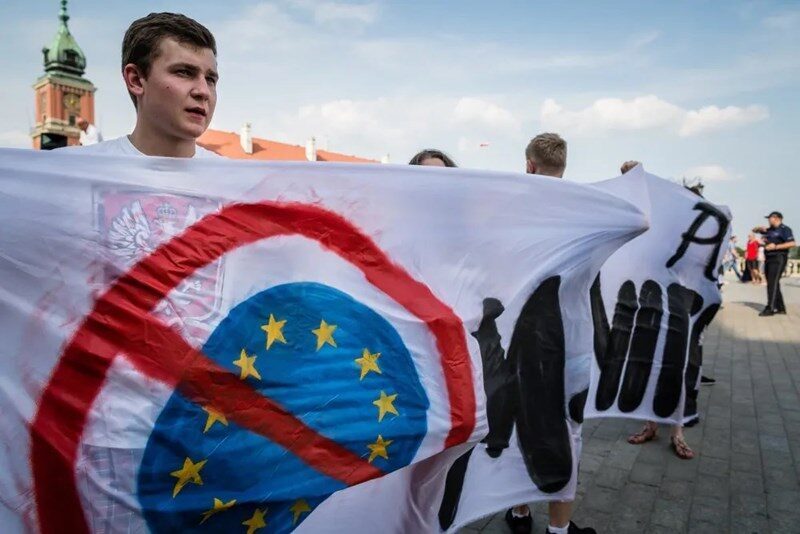
© AFPFar-right protestors in Poland hold an anti-EU banner during a demonstration in Warsaw on July 25, 2015
As legislative elections near, the right-wing ruling party of Poland is adopting more anti-German and anti-EU stances in a bid to draw their most dedicated supporters, analysts said.
At the forefront of this campaign is Jaroslaw Kaczynski, the leader of the ruling Law and Justice (PiS) party, who recently insinuated that Germany intended to meddle in the October 15 elections.
Kaczynski unveiled one of the questions his party wants its supporters to vote on in a national referendum on election day: "Are you in favor of selling state enterprises?"
The nationalist leader said the privatization of public institutions would profit Germany, accusing Berlin of wanting to impose Polish opposition leader Donald Tusk of the Civic Platform (PO) party - who has been the ruling party's head rival.
Tusk is everything the government stands against: He is Poland's former Prime Minister and president of the European Council.
According to recent surveys, PO might be a real threat to Kaczynski's party in the October elections with support ranging between 26-32 percent while PiS holds around 33 percent.
"The anti-German arguments benefit the PiS," political analyst Marcin Zaborowski of Lazarski University in Warsaw told AFP.
"They mobilize its most faithful electorate and encourage them to turn up at the polls."
Zaborowski said between 30 and 40 percent of Polish citizens do not trust Germany, even going as far as being hostile toward it. In that context, PiS aims through the referendum to polarize the election campaign, he added.
Disguised anti-Europeanism
Anna Materska-Sosnowska, a political expert at Warsaw University, said the ruling party disguises its anti-EU position by adopting an anti-German one, noting that Warsaw and Brussels have almost always been at odds over a list of issues.
"The PiS doesn't want to openly treat the EU as the enemy," she said. "But this is obviously what is being done when it attacks Germany, the strongest country in the EU."
Comment: Perhaps there's some truth to that; However, it is also true that conservative Poland, along with Hungary, have been the most adamant in rejecting the EU's ideological agendas, and in that sense, have quite a bit in common, both with each other, and, although Poland would be loathe to admit it, with Russia. Notably, they also share commonalities with Germany's AfD party, whose popularity has been rising in the polls.
Last week, in an interview for the German broadcaster ZDF, the German head of the European Parliament's center-right European People's Party (EPP) accused PiS of violating the principles of the rule of law and censoring free media. His accusations also included France's far-right National Rally and German AfD.
Such parties "are our enemies," Manfred Weber said in the interview.
His comments were directly met with an angry response fo Polish Prime Minister Mateusz Morawiecki.
"He called us enemies," said Morawiecki in outrage. "That's enough," he continued before challenging Weber to a public debate.
President Andrzej Duda joined positions of PM Kaczynski and denounced "the attempts of foreign politicians to influence the election process in Poland."







I do not know how it is in other countries, but you can not worry about Poland this winter.
Last year someone made a campaign against the lack of coal, which results in their terrible excess in Poland this year. Hundreds of tons of unsold coal and no takers. Because the prudent Poles bought coal last fall for 2-3 years.
So heating and electricity are definitely secured this winter.
But Poland is unique compared to the EU because we do not have nuclear power plants or gas power plants in large numbers.80% of energy and heat production in Poland is coal.