
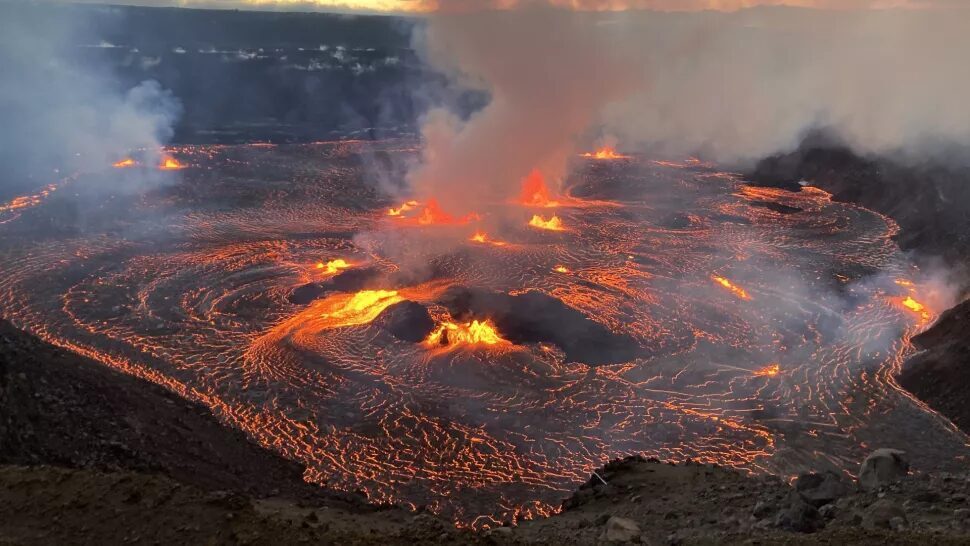
© United States Geological Survey/Handout/Anadolu Agency via Getty ImagesKilauea volcano began to erupt around 4:44 am local time on June 7, 2023 in the Big Island of Hawaii.
Kilauea, located on Hawaii's Big Island, is one of the world's most active volcanoes, and has been erupting almost continuously since 1983. The USGS briefly deemed the eruption a code red, the highest risk alert level, but downgraded it to orange the next day "because the initial high effusion rates have declined, and no infrastructure is threatened," the USGS said in a June 8 statement, adding that the lava from the eruption is confined to the Halemaʻumaʻu pit crater within Kilauea's summit.
However, officials warned Wednesday (June 14) that high levels of volcanic smog, known as vog, from the eruption could travel downwind and potentially affect air quality. They added that the eruption may sprout off thin, sharp glass fibers called Pele's hair, named after Pele (PEH-leh), the Hawaiian goddess of fire and volcanoes. Resembling golden straws of hay, the strands are formed when gas bubbles in the lava pop at the surface and then cool into gossamer glass needles. If Pele's hair is blown downwind, it could irritate people's eyes and skin or contaminate drinking water.

© D.W. PetersonVolcanic spun-glass shards called 'Pele's hair'
On the first day of the eruption, extreme heat from the lava created wind vortices that sucked up ash and whipped chunks of lava across the Halemaʻumaʻu crater — an event that the The Weather Channel dubbed a "volcano-nado," but the USGS called a whirlwind or wind vortex. Kilauea's last eruption began in early January and lasted about three months.

© USGSKīlauea summit whirlwind in Halema‘uma‘u - June 7, 2023
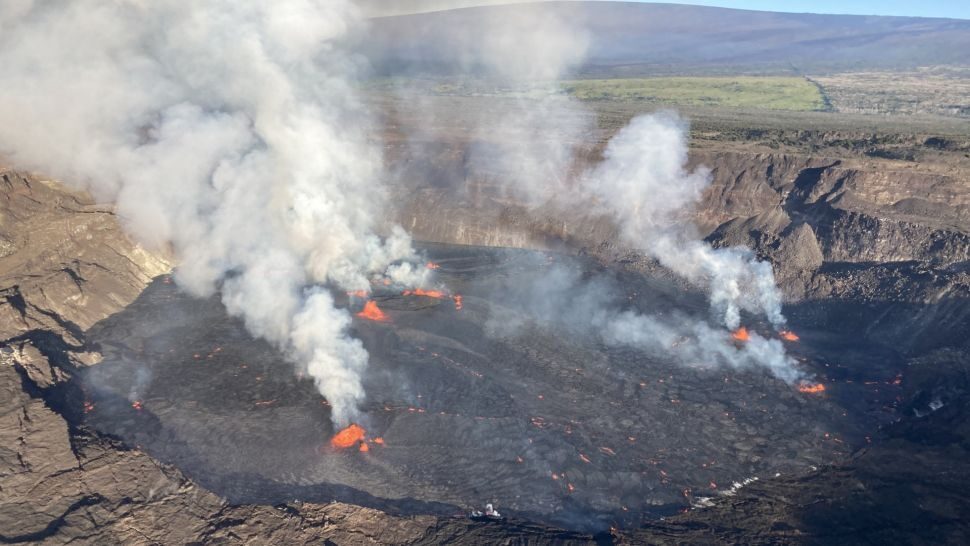
© United States Geological Survey/Handout/Anadolu Agency via Getty ImagesVolcanic smog from Kilauea volcano can travel downwind and potentially affect air quality.
Scientists at the Hawaiian Volcano Observatory are continuing to provide daily updates on the current eruption at Kilauea.
Kiley Price is a Live Science staff writer based in New York City. Her work has appeared in National Geographic, Slate, Mongabay and more. She holds a bachelor's degree from Wake Forest University, where she studied biology and journalism, and is pursuing a master's degree at New York University's Science, Health and Environmental Reporting Program.



Reader Comments
Electromagnetism is aether vibration.