
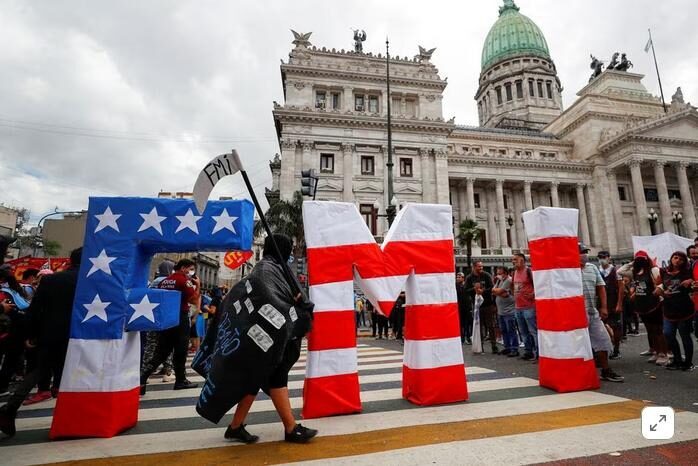
© REUTERS/Agustin Marcarian/FILE PHOTO: A demonstrator wearing a costume takes part in a protest outside the National Congress, as members of the parliament debate the government's agreement with the International Monetary Fund (IMF), in Buenos Aires, Argentina March 10, 2022.
The South American grains producer, which has a strained history with the IMF, agreed to a $57 billion program with the Washington-brd body in 2018 under former conservative leader Mauricio Macri to stave of economic crisis. That failed and was replaced by a new $44 billion deal last year.
But tensions have risen as a severe drought has battered grains exports, Argentina's top source of dollars, forcing both sides back to the negotiating table to revamp the deal. Buenos Aires wants faster payouts and easier economic targets.
"More than a debt, it's a crime," President Fernandez wrote in a tweet on Thursday, citing a new government auditor report that concluded the original deal had lacked the required impact study and not passed through proper legislative channels.
Comment: That sounds like an IMF deal, and a failure to keep up with payments was likely the intention so that Western-controlled body could hope to keep Argentina in near perpetual debt slavery.
Fernandez, who has criticized the original deal before, called for an investigation "with all the weight of the law."
Powerful but divisive Vice President Cristina Fernandez de Kirchner, a previous two-term president, called the original deal "scandalous" and a "scam" of the Argentine people.
Macri and the IMF have defended the original deal as necessary to restore Argentina's economic stability. Critics of the current government blame it for money printing to fund state spending, which they say stokes inflation and weakens the peso.
The IMF declined comment on the new criticism of the deal.
On the streets of Buenos Aires on Thursday, thousands of Argentines marched in protest against tough economic conditions and the IMF, which many blamed for austerity measures that sharpened Argentina's worst economic crisis in two decades.
Comment: The IMF was partly responsible for the country's previous economic crises.
"Our worry is that the IMF will meddle in Argentina's own internal issues," said protester Norma Morales, defending government subsidies as essential especially with poverty levels having risen to around 40%.
"A lot of pensioners who get the minimum pension are in danger, so are many women with universal child allowance - a right so kids can keep studying and eating. We don't have two plates of food a day guaranteed for children in our country."








Comment: With the multipolar world's economic systems coming online, an alternative to the IMF will soon be available to all the nations who have, for decades, suffered its 'assistance':
- The IMF's punitive loan system makes struggling countries poorer, it must end
- Pakistan police storm Imran Khan's home, arrest 30 as ex-PM travels to court
- El Salvador pays off $800 million bond using bitcoin, avoids indebting itself to IMF
- Sri Lanka faces 'complete economic collapse', PM thinks only 'safe' option is talks with IMF
For more on how the IMF does the West's dirty work, check out: