
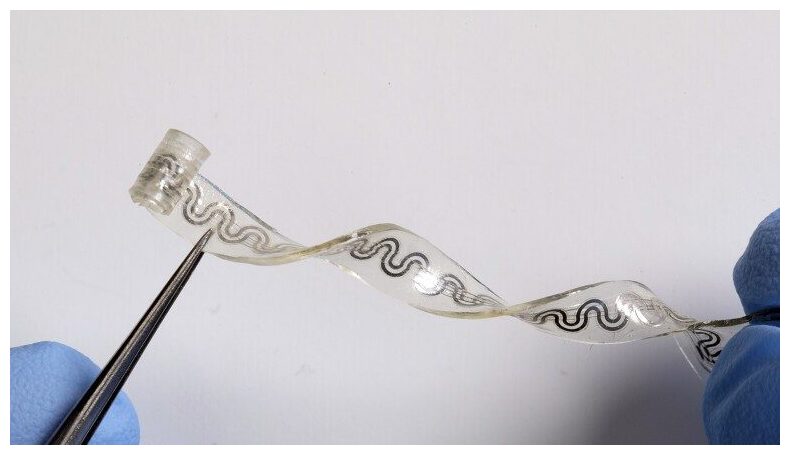
At its widest point, the tiny device is just 5 millimeters wide. One end is curled into a cuff that softly wraps around a single nerve, bypassing the need for sutures.
The biocompatible, water-soluble device works by softly wrapping around nerves to deliver precise, targeted cooling, which numbs nerves and blocks pain signals to the brain. An external pump enables the user to remotely activate the device and then increase or decrease its intensity. After the device is no longer needed, it naturally absorbs into the body — bypassing the need for surgical extraction.
The researchers believe the device will be most valuable for patients who undergo routine surgeries or even amputations that commonly require post-operative medications. Surgeons could implant the device during the procedure to help manage the patient's post-operative pain.
"Although opioids are extremely effective, they also are extremely addictive," said Northwestern's John A. Rogers, who led the device's development. "As engineers, we are motivated by the idea of treating pain without drugs — in ways that can be turned on and off instantly, with user control over the intensity of relief. The technology reported here exploits mechanisms that have some similarities to those that cause your fingers to feel numb when cold. Our implant allows that effect to be produced in a programmable way, directly and locally to targeted nerves, even those deep within surrounding soft tissues."
A bioelectronics pioneer, Rogers is the Louis Simpson and Kimberly Querrey Professor of Materials Science and Engineering, Biomedical Engineering and Neurological Surgery in the McCormick School of Engineering and Northwestern University Feinberg School of Medicine. He also is the founding director of the Querrey Simpson Institute for Bioelectronics. Jonathan Reeder, a former postdoctoral fellow in Rogers' laboratory, is the paper's first author.
How it works
Although the new device might sound like science fiction, it leverages a simple, common concept that everyone knows: evaporation. Similar to how evaporating sweat cools the body, the device contains a liquid coolant that is induced to evaporate at the specific location of a sensory nerve.
"As you cool down a nerve, the signals that travel through the nerve become slower and slower — eventually stopping completely," said study coauthor Dr. Matthew MacEwan of Washington University School of Medicine in St. Louis. "We are specifically targeting peripheral nerves, which connect your brain and your spinal cord to the rest of your body. These are the nerves that communicate sensory stimuli, including pain. By delivering a cooling effect to just one or two targeted nerves, we can effectively modulate pain signals in one specific region of the body."
"As engineers, we are motivated by the idea of treating pain without drugs — in ways that can be turned on and off instantly, with user control over the intensity of relief." — John A. Rogers
To induce the cooling effect, the device contains tiny microfluidic channels. One channel contains the liquid coolant (perfluoropentane), which is already clinically approved as an ultrasound contrast agent and for pressurized inhalers. A second channel contains dry nitrogen, an inert gas. When the liquid and gas flow into a shared chamber, a reaction occurs that causes the liquid to promptly evaporate. Simultaneously, a tiny integrated sensor monitors the temperature of the nerve to ensure that it's not getting too cold, which could cause tissue damage.
"Excessive cooling can damage the nerve and the fragile tissues around it," Rogers said. "The duration and temperature of the cooling must therefore be controlled precisely. By monitoring the temperature at the nerve, the flow rates can be adjusted automatically to set a point that blocks pain in a reversible, safe manner."
Precision power
While other cooling therapies and nerve blockers have been tested experimentally, all have limitations that the new device overcomes. Previously researchers have explored cryotherapies, for example, which are injected with a needle. Instead of targeting specific nerves, these imprecise approaches cool large areas of tissue, potentially leading to unwanted effects such as tissue damage and inflammation.
At its widest point, Northwestern's tiny device is just 5 millimeters wide. One end is curled into a cuff that softly wraps around a single nerve, bypassing the need for sutures. By precisely targeting only the affected nerve, the device spares surrounding regions from unnecessary cooling, which could lead to side effects.
"You don't want to inadvertently cool other nerves or the tissues that are unrelated to the nerve transmitting the painful stimuli," MacEwan said. "We want to block the pain signals, not the nerves that control motor function and enables you to use your hand, for example."
Previous researchers also have explored nerve blockers that use electrical stimulation to silence painful stimuli. These, too, have limitations.
"You can't shut down a nerve with electrical stimulation without activating it first," MacEwan said. "That can cause additional pain or muscle contractions and is not ideal, from a patient's perspective."
Disappearing act
This new technology is the third example of bioresorbable electronic devices from the Rogers lab, which introduced the concept of transient electronics in 2012, published in Science. In 2018, Rogers, MacEwan and colleagues demonstrated the world's first bioresorbable electronic device — a biodegradable implant that speeds nerve regeneration, published in Nature Medicine. Then, in 2021, Rogers and colleagues introduced a transient pacemaker, published in Nature Biotechnology.
All components of the devices are biocompatible and naturally absorb into the body's biofluids over the course of days or weeks, without needing surgical extraction. The bioresorbable devices are completely harmless — similar to absorbable stitches.
At the thickness of a sheet of paper, the soft, elastic nerve cooling device is ideal for treating highly sensitive nerves.
"If you think about soft tissues, fragile nerves and a body that's in constant motion, any interfacing device must have the ability to flex, bend, twist and stretch easily and naturally," Rogers said. "Furthermore, you would like the device to simply disappear after it is no longer needed, to avoid delicate and risky procedures for surgical removal."
The study was published in the July 1 issue of the journal Science. The paper describes the device's design and demonstrates its efficacy in an animal model.



Reader Comments
pain signalsyour ability to think , not the nerves that control motor function and enables you to use your hand, for example."Basically trying to make harder working and even more obedient slaves, covered in a bullshit wrapper about pain relief!
Qué happy t.h.o.u.g.h.t.
Qué happy thought. Valley of Gold Qc is far awayyyyy
.... I smelled the marshmellows on the stick 🛶
(Dont mention 2010 🤦♀️ but yes 2+2=4 I always say that... until we know more )
Hi Linda - good to see you, haven't noticed you being around much lately.
Broke my phone (but not before I saw your L8 n H miracle points -- which I needed AND used!!!)
I pray Chinese Medicine non stop. WHY are you on the WEST Coast AmyLand?!!!😠
Thank YOU!!
Waiting on GCO's response but that is a winner. I use my fingertips but it takes practise to be touch-savy lolll, love how that sounds
It would be neat to actually use one. In acupuncture some practitioners will use electro (micro current) machine during treatments. I don't often use electro myself but it has its uses for sure. One way I like to use a less obvious form of electro (in a sense) is using ion cords (a Japanese development). this is an elegant way to use the receiver's body energy to connect two points with a one way diode. Looks similar to the cables one uses to jump start their vehicle. I know this healthpoint device must provide a similar micro current.
That is great to see people making use of things and at least attempting things outside the box.
In helping to instruct my nurse friend I have some insights I can share:
The device I think is good. It is not hokey or anything like that. I've met some who scoff at the device, but, they also might scoff at chinese medicine altogether. Many do.
Within acupuncture let me share something, which I think is important to have basic understanding of. This is a very basic reality, and it is simple. It is this - there are MANY styles of acupuncture within the body of acupuncture as a whole. Some are much more efficacious than others. This is crucial to know. I' happy to suggest specific styles if anyone wants that level of information.
So, it would be interesting to know what style acupuncturre the heathpoint people are making use of inside the manual they offer. I did watch 4 of their videos on the website and like the presentation. I am familiar with using devices to locate points, so that bit looks great as presented. It looks quite precise. Neat to see how the body produces such a refined energetic to be read, as you refine within the area where the point should lie.
Other thoughts:
Normally in an acupuncture session the client will have acupoints stimulated in a grouping all at once. With this method clearly that is not possible, so it would be interesting to notice any difference in outcome that may or may not be present as such.
If I were a user of acupoints, whether using my fingers, micro current stimulation device, or needles, I would want this tool in my apothecary. "A Manual of Acupuncture", by Peter Deadman. It has a wealth of information in it, and is also an excellent source for point location as well as the entire front section covering categories of points, and would really go far in helping someone better learn the power of their body via the acupuncture template. If only the public knew what is possible via simple tools and their body's natural, innate energy.
Btw, if one knows how to download torrents and has a VPN, torrent sites carry Peter Deadman's book. I found a digital version online one day randomly searching out acupuncture materials on torrent sites. It is PDF and incredibly easy to use; what a score it was! Paper versions sell for about $100 (USD), I think. I'd happily send someone a digital version, a copy, if they have file sharing capabilities etc. (ie, dropbox etc.) or if they ship me a thumb drive in snail mail.
I would also be happy to volunteer some time if someone wanted to meetup on zoom and help facilitate some knowledge, basics, good protocols etc.
You are right, sticking alone the same sen/meridian/pathway as the ailment is one approach that can work. commonly referred to as a 'sen/meridian style' approach or treatment.
There's various ways to select a treatment methodology, sometimes the situation drives what i will select. Do I need to remove pain NOW because someone is in an emergent situation and I don't have time to think of the root cause. Do I have time to get to the root, and treat a tissue at the root level which then addresses pain anywhere in the body that tissue (ie, bone) is experiencing. Do I use meridian therapy. Or, make use of anatomical correlations and hollographic images which allow for one to select from various points to treat something and affords a high level pf practicality (ie, no disrobing required, can treat in a chair etc.)
Lots of great ways to approach treating when using the body's sen/meridian system.
Cool that you made use of the protocols I shared. Hopefully they added to what you were doing. See my other post about Peter Deadman's book btw.
I would love to meet Hai Yang somehow. He is in Montreal. How far are you from Montreal? Is fascist Canada even open to foreigners again...? I cannot keep track of all that jazz. Yeah, YOU are the one living far away....
"There's various ways to select a treatment methodology, sometimes the situation drives what i will select. Do I need to remove pain NOW because someone is in an emergent situation and I don't have time to think of the root cause. Do I have time to get to the root, and treat a tissue at the root level which then addresses pain anywhere in the body that tissue (ie, bone) is experiencing. Do I use meridian therapy. Or, make use of anatomical correlations and hollographic images which allow for one to select from various points to treat something and affords a high level pf practicality (ie, no disrobing required, can treat in a chair etc.)"
Totally agree with your observations (all my clients are treated with clothes on except germans who automatically disrobe!).. Interested in 'holographic images, can you please expand!?
My apologies Dr. Yeung for not mentioning that, lol.
How to delve into hologric imaging/theory and usage....I found this article to introduce the basic concepts.[Link]
After reading that then factor this into your thinking. Let's start with some basic principles when using holograms/imaging:
The notion of using opposite sides - use the left side of the body to treat the right and vice verse (below the cervical level in the body, the 'wiring' crosses over....)
The notion of the top being used to treat the bottom and vice versa (again, the notion of opposites, and...redundancy, built into the body)
Images can be utilized that are based in anatomical correlation (hard wired INto the body's physical structure and geometry, really)
ie: "the eyes of the knees" (just below the patella and on either side - this area can be used to treat the face, eyes, breasts (2 breasts/2 eyes). The superior portion of the tibia as it extends down the face of the tibia being like one's nose, above and either side being eyes.....in the chest....you have two eyes (nipples/breasts) and the sternum is akin to the face's nose. Get it...? See the similarities anatomically speaking?
ie: say the client present with left ankle pain - (using opposites) I can select the opposite side and opposite end of the body. So select points on the right wrist and/or shoulder joint. 3 joints in a limb (wrist/elbow/shoulder....ankle/knee/hip). Both the wrist or shoulder will work because you can 'flip' the limb (hologram to the other limb) and use either end of the limb.
(examples) Injured area:
Right wrist pain - select points from left ankle. Or, flip the limb (the one you will needle/treat...flip it on the axis of the middle joint - knee/elbow, not the injured limb) and use the shoulder area. You can easily find points on both ends that will correlate with the wrist and the problem should clear out.
Left shoulder pain - select points from the right ankle area, or, flip the limb (the one you will treat) and palpate (tender, correlating spots) and locate points right hip area.
Let me know if that's clear as mud, lol!
There's a lot of depth so it is difficult to express fully in words without being forced to answer questions naturally as they would arise when sharing this in person. There's also - internal branches of sen/meridians, so sometimes a point which seems to 'miraculously' remedy something, it might be that the internal branch of the (what we call) 'primary' branch of the sen/meridian courses through that area. there are also several other branches off of any given sen/meridian.
ie: any given organ has a primary channel (this is the one most people know and focus on -where the standard points are found), internal channel, divergent channel, sinew channel Luo channel etc. Deadman's book will lay out all of this very nicely.
Being trained by monks from the 'Cultural University of Thailand' was incredible.. 40hrs of instruction for $200 then another 20hrs ($100) of advanced teaching (including Luk Pra Kob (herbal steam compression) which emphasized 'holographic imaging' or opposites.. practice honed the rest of my skill, as well you know
For me its the best all over massage/therapy I've ever encountered, it fixed my sciatica so i made it a mission once leaving India to learn Thai and as you say not so popular at that time outside of.. thai massage= happy ending ;).. therefore bringing this amazing therapy/skill to europe was difficult at first due to the happy ending connotation.. all it took was 2 clothed massages to get the word around.. but i had to change the pressure application for soft europeans.. it was a joy when body builders booked appointments, laughing as they see my 150lb build only to cry during and at the end of the massage (who needs a gym when you are a practitioner of thai!). Its a beautiful system.
Incidentally I used to practice Aikido and therefore incorporated the arm/wrist locks for stretching also Rolfing when ever i can.
Georgetown law professor: Americans are 'slaves' to the U.S. Constitution
A Georgetown University law professor says Americans are "slaves" to the U.S. Constitution as their adherence to that document — written by a "tiny group of white slave-owning men" — has turned...