
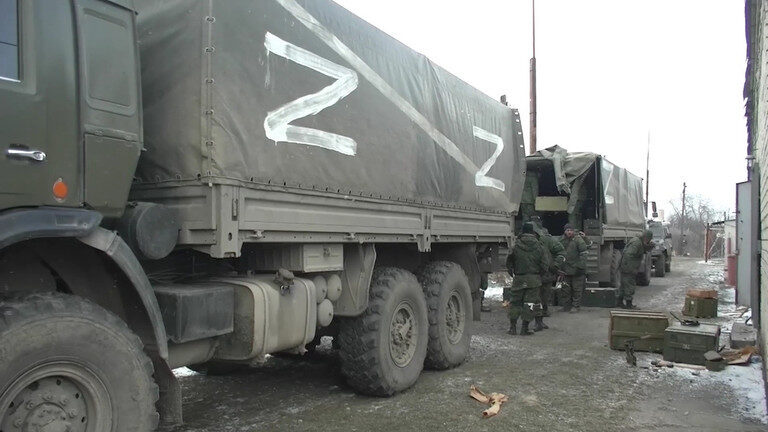
© Sputnik / Russian Defence Ministry
Russia is holding about 2,000 Ukrainian servicemen "who have voluntarily laid down their arms," including five brigade commanders who "were fighting against the Donbass population," the head of the Investigative Committee Alexander Bastrykin announced on Tuesday.
In an interview with RT, Bastrykin said that investigators were working with prisoners of war and were getting "many details about the circumstances of the Ukrainian regime's crimes."
"Everyone sees that Ukrainian servicemen, no matter how it sounds in the Western media and propagandist social media, prefer to surrender when a good opportunity arises. They understand the futility of resistance," Bastrykin claimed.The testimonies of those captured have provided the Russian authorities with information about the Ukrainian forces' work with foreign advisors, as well as about foreign mercenaries, the Investigative Committee's head revealed.
"Based on the available data, criminal cases have been initiated against 75 mercenaries who are participating in hostilities on the side of Ukraine. We know that they came from the UK, the US, Norway, Canada, Georgia and other countries," Bastrykin said.As an example, he mentioned a Georgian national who is said to have created an armed formation called Georgian National Legion on Ukrainian territory, which included at least 24 of his compatriots as mercenaries.
"Some of them also surrendered and were questioned by investigators," Bastrykin added.Commenting on the reports of alleged torture of Russian prisoners of war by the Ukrainians, Bastrykin said that "a number of such crimes" are currently being investigated. He cited two examples of such incidents: first, when the Ukrainians allegedly "systematically used physical violence" against several Russian servicemen whom they captured in Zaporozhye Region and "illegally held" for ten days.
"They tried to beat information out of them about the progress of the special military operation," Bastrykin explained.The second incident involved two groups of Russian soldiers who were captured in the Nikolayev Region and were allegedly also subject "to physical and psychological violence."
"There are always chances to determine those involved, because there are no crimes without traces," Bastrykin underlined, adding that the Investigative Committee was coordinating its efforts with officials from the Donetsk and Lugansk People's Republics.Ukrainian authorities had previously stressed that the abuse of prisoners is a war crime and would not be tolerated.
"We are a European army, and we do not mock our prisoners... I would like to remind all our military, civilian and defense forces once again that the abuse of prisoners is a war crime that has no amnesty under military law and has no statute of limitations," Ukrainian presidential adviser Alexey Arestovich said in March, commenting on a video that seemed to show Russian POWs being tortured by members of Ukrainian forces.Since the beginning of the Russian offensive, Ukraine and Russia have accused each other of multiple atrocities against both civilian populations and prisoners of war.
On Monday, the Ukrainian Human Rights ombudsman Lyudmila Denisova took to Telegram to accuse the Russian "occupiers" and "racists" of torturing Ukrainian soldiers captured in Mariupol. According to Denisova, the Ukrainians were "threatened with murder, beaten and humiliated" and deprived of water and medical assistance.
Russia attacked the neighboring state in late February, following Ukraine's failure to implement the terms of the Minsk agreements, first signed in 2014, and Moscow's eventual recognition of the Donbass republics of Donetsk and Lugansk. The German- and French-brokered Minsk Protocol was designed to give the breakaway regions special status within the Ukrainian state.
The Kremlin has since demanded that Ukraine officially declare itself a neutral country that will never join the US-led NATO military bloc. Kiev insists the Russian offensive was completely unprovoked and has denied claims it was planning to retake the two republics by force.




In recent weeks, the fronts in the eastern region of Kharkov and northern Donbas have been functionally linked, and now these areas cannot be seen in isolation.
As I have already described, Russia's strategy is very different from the days of rapid progress, "leave as many enemies as possible behind us" in late February and early March.
It is now one of the very slow, well-thought-out missions to liquidate Ukrainian forces through mass artillery, air bombardment, ground and naval missile attacks, night commando raids, and occasional tank raids on weakened positions.
The Ukrainians are bringing in forces, wasting them, training others, wasting them, and Russia (and Donetsk's forces moving on to the west) is slowly moving towards them.
There is clearly no hurry to move forward; the main goal is to wear out Ukraine's human resources and technology - and then eventually a turning point will come and take care of everything on its own.
Based on extensive records of prisoners today, we can say with confidence that the majority, perhaps the vast majority of Ukrainian forces deployed in the northern sector - with fighting mainly between the city of Kharkov and the Russian border and then between Izi southeast to Jampol '- have not been in uniform since February.
They are mobilized inactive midfielders, conscripts or (deployed from their home regions, contrary to their treaties) territorial defense militias.
This tells us that the regular army has suffered very significant losses (probably including desertion.)
Previously, I estimated that the loss of life in the northern sector had been at least 3: 1 in favor of Russia since the beginning of April. Now I believe it's more 4: 1.
It is telling that in the last few weeks, Ukraine has not been able to document even one new Russian prisoner (if I missed something - I don't miss it very much.)
Many Ukrainian bodies will never be found again - for example, those hit by the Iskander tactical ballistic missile, which Russia has continued to fire at least a day, every day at bases and at strong strategic points.
Russia's initial invasion of Ukraine should not be seen as having any objectives other than rewarding Ukraine's military and political response. It is quite possible that Ukraine's immediate surrender before the Russian demonstration of power with minimal violence may have been too optimistic. As soon as they learned that the "careless" Russian military raids were being attacked with lethal intensity, the Russians were too far away and unprepared to respond properly to a violent war of high intensity. It was basically a military parade, which was attacked by a very skilled, well-armed and well-prepared army of professionals and partisans. It is also possible that the Russian army completely recalculated the Ukrainian response and simply got in the ass and changed its tactics after recovery.
The point is, their initial raid is irrelevant. They have adapted to the realities of theater and are now fighting the Ukrainian forces in a way that gives them an advantage and achieves their goals.