
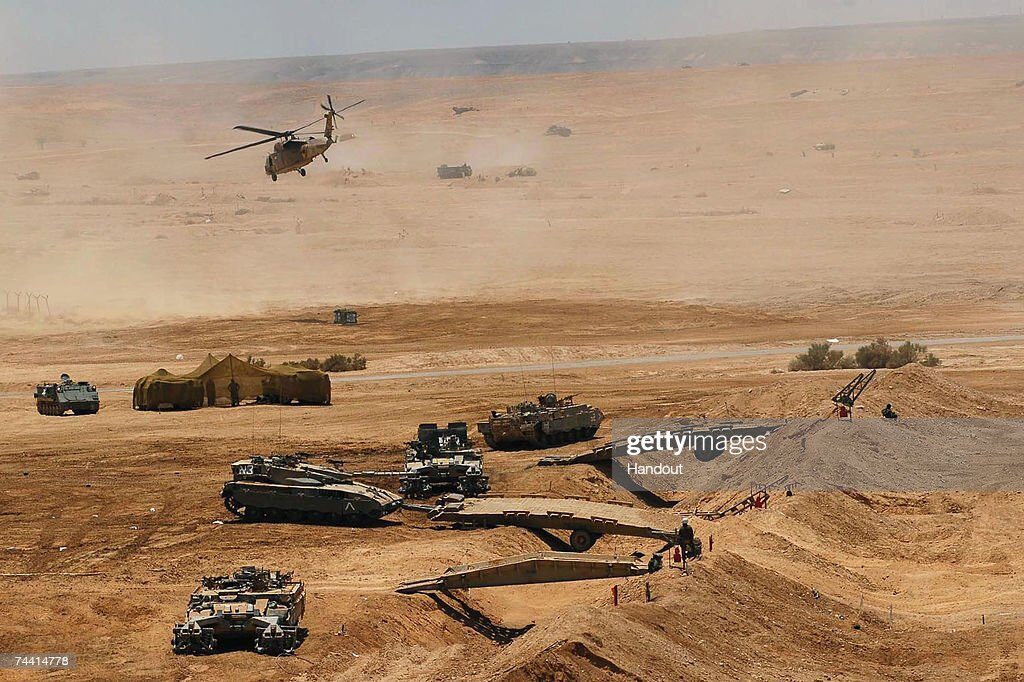
© IDF via Getty ImagesIn this handout photo distributed by the Israel Defense Forces (IDF) helicopters and tanks are mobilized as the Israeli army takes part in a military manoeuvre to conquer a Syrian outpost.
At around 11:35pm (local time) Israel launched surface-to-surface missiles "from the direction of the occupied Syrian Golan, targeting some points in the vicinity of Zakiya town," according to Syrian state media. Syrian opposition media then claimed that a Syrian military base used by pro-Iran militias was struck.
It was the third Israeli strike within the past month, with the previous attack occurring just last week. On January 31, Israeli airstrikes near Damascus reportedly targeted weapons belonging to Lebanese Hezbollah.
Wednesday's airstrikes came shortly after a speech delivered earlier that day by the Secretary General of Hezbollah, Sayyed Hassan Nasrallah in which he addressed the Israeli attacks. He claimed that his group possesses the ability "to transform our thousands of rockets into precision-guided missiles" with the cooperation of "experts from the Islamic Republic of Iran." During his televised address, Nasrallah also said that Hezbollah has been developing precision missiles and "drones in Lebanon for a long time," jokingly adding "whoever wants to buy them, submit an order."
Nasrallah also threatened Israel with "another Ansariya," which is the name for a 1997 operation in which Hezbollah ambushed and killed 12 Israeli soldiers attempting to plant explosives in Lebanon. After referring to a number of known engagements between Hezbollah and Israel, labeled by Nasrallah as "the battles in between wars," he remarked that "when it comes to the actual implementation of operations, they need to bring in commandos, generals, soldiers, elite groups...they bring them from the sea," he stated, warning Israel that "we are ready for them."
According to an alleged insider source found through journalist Laith Marouf, Nasrallah's speech referred to a thwarted Israeli special forces operation, describing it but refraining from announcing it. The "resistance source" did not wish to be named for security reasons, claiming that on February 2, two Israeli special forces teams had allegedly landed in the areas of Zouk Mosbeh (18km North of Beirut), and Jounieh (22km North of Beirut) attempting to reach beachfront safehouses. This information could not be independently verified.
"They [the Israeli forces] had activated their local network of agents...they had two operations running simultaneously, because the Israeli modus operandi is that they have one operation to distract from the other, which would go after the target. Alternatively the second team could complete the operation if the other fails," the source claimed.
"The communications opened up between the teams and their agents, revealing the agents and so they were captured [by Hezbollah], these were not those in the safe houses but those who were on the ground preparing for the action against the targets," the source claimed. I asked whether any of those captured were Israeli nationals and the reply was that only Lebanese agents were arrested. According to the source, Hezbollah had discovered only one of the teams, faced with the choice of engaging would mean killing or capturing them, but without the second team located this would have been costly. What then allegedly occurred, was that Hezbollah forces allowed for the Israelis to withdraw to sea, after the teams' cover was blown, in order to avert the possibility of war between the two sides. "They [the Israelis] thought that they had located a manufacturing site for either missiles or drones," according to Laith Marouf, who alleged that this was the target of the Israeli special forces teams.
Beyond the tensions between Lebanese Hezbollah and Israel is also the Israeli fixation on cementing its presence in the Golan Heights, internationally recognised as an occupied territory belonging to Syria.
Israeli Prime Minister Naftali Bennett, speaking at the 'Makor Rishon Golan Conference' on October 11, said that his government intended to quadruple the Israeli settler population in the area. In December, Israel approved a $317 million plan to double the settler population. Since October, it has launched over 10 known attacks on Syria, allegedly assassinated an ex-member of the Syrian parliament, and bombarded the civilian port of Latakia twice, directly targeting Syria's air defense systems, weapons storage facilities, and killing soldiers in the process.
Although the war in Syria has come to a somewhat temporary halt, giving time for the Syrian government to attempt to normalize ties throughout the region and reintegrate itself into the Arab League, Israel is making it clear that, without concessions, little will return to normal.
In June 2015, it spoke of creating a "safe zone", or buffer-zone, between it and the rest of Syria in order to protect the Druze community that primarily live near or in the Syrian province of Sweida. Israel even began forming strong relations with Druze opposition groups in southern Syria to achieve this aim. According to an investigation by The Intercept, in early 2018 Israel was at stage two of implementing a buffer zone - which was to be set up in southern Syria - with the intention of solidifying its hold on the Golan Heights. However, this plan was ruined when Syrian opposition groups and ISIS militants were defeated and the Syrian government retook the south in an offensive in July 2018.
Rare anti-Syrian government demonstrations erupted last week in Sweida province over collapsing living conditions and corruption. Preceding these was the inauguration of the Syrian al-Liwa Party, a sectarian Druze party attached to the military enitity known as the Counter-Terrorism Force.
Speaking to al-Monitor, Nowras Aziz, an independent journalist from Sweida now living in France, said that "Abo Kheer [Syrian al-Liwa Party leader] had contacted the [US-led international] coalition forces at Al-Tanf base in the second half of 2020, explaining his plan in Suwayda [province]. Abu Kheer had informed the forces that the steps would include declaring full control over the eastern villages [of Suwayda] and removing any presence of the Syrian regime or Iran in that area." This information, if true, indicates the threat the group poses to the Syrian government and how it aligns with the goals of Israel. There is no proof that Israel is involved with the Syrian al-Liwa Party but, given its connection to the US, it's likely that the two groups' alignment on strategy is not simply chance.
Israel similarly seeks to weaken Damascus and disrupt the movement of Iran-aligned armed groups inside Syrian territory and this includes attempting to eliminate the weapons of any such groups. Although Hezbollah claims it is not affected by Israeli airstrikes, the Syrian government is most certainly being made to pay a price by Tel Aviv, both for threatening its presence in the Golan Heights and for facilitating the presence of Hezbollah and Iran - real strategic threats to Israel - in the country. Although the Syrian war has quieted down, Israel is not letting go of its goal to force concessions on Syrian President Bashar Assad and its attempt to send a message to Hezbollah and Tehran.
Robert Inlakesh is a political analyst, journalist and documentary filmmaker currently based in London, UK. He has reported from and lived in the occupied Palestinian territories and currently works with Quds News. Director of 'Steal of the Century: Trump's Palestine-Israel Catastrophe'. @falasteen47





Israel does not lift reconnaissance and fighter planes for the second day, fearing a harsh response from Russia.
Against the backdrop of large-scale Russian exercises in the Eastern Mediterranean and the arrival of Russian Aerospace Forces tactical aviation in Syria, Israel was afraid to take its reconnaissance planes and fighters to the sky for the second day, albeit sooner. of the Israeli one, air flights were observed several times during the day.
According to the Syrian observer, Israel demonstrates a complete refusal to lift its military reconnaissance and combat aircraft into the sky. At the same time, no tanker flights are recorded either, a similar situation previously would also have testified to the preparation of the IDF for strikes.
To date, there is no obvious aerial activity from the 122nd squadron (and even the oil tankers) of the Israeli Air Force.
It can be said that air traffic is completely absent and this behavior was observed a few hours before the air strikes against Syria ", the note reads.
At the same time, given previous reports that Russia is using its electronic warfare systems in the eastern Mediterranean (although the Russian side has not officially confirmed this information), Israel simply cannot conduct electronic intelligence due to the interference.
According to official data, the longest-range mobile electronic warfare system in service with Russia today is the Krasukha family complex. With its range of approximately 250-300 kilometers, this weapon has always been more than enough to successfully disrupt the operation of most electronic and electronic intelligence equipment, disable sensitive equipment, or even clog enemy radars with interference, for example to simulate an air strike or missile bombing. However, as it turned out, another electronic warfare complex was recently located in Syria, the radius of "defeat" of which is at least 400 kilometers.
The fact that we are talking about Russian electronic warfare systems is indicated by a previous statement by the Israeli Defense Forces (IDF).According to experts, Russian weapons hit the air systems of the British Air Force's F-35 fighters based in Cyprus, as well as Israeli military aircraft, preventing the latter from conducting reconnaissance in Syria and using weapons. A day ago, American planes were also attacked.
The suppressed Israeli air defenses have mistakenly identified their drone as hostile, the Israeli army, due to the disruption of the air defense systems, mistakenly destroyed their drone. As it became known, Israeli air defense systems detected an unknown drone at the border with Lebanon. Since the drone could not be identified, fire was opened on it, as a result of which the UAV was shot down. Subsequently, it turned out that the drone is Israeli
As it turned out, the Israeli drone was not identified due to the disturbance. At the moment, it is unknown who exactly did the jamming. Shortly before, the Israeli Defense Forces accused Russia of the fact that it was the Russian military that was using its electronic warfare equipment. In this regard, the work of the air defense systems in northern Israel was stopped.
Israel has not officially commented on the details of the incident. Apparently, the Israeli military started having very serious problems with the use of their drones and fighter jets. Furthermore, the interference is very likely due to Israel ignoring the security of the Russian military and deliberately resorting to provocation.
Russia has again raised its fighters to prevent Israel from launching attacks on Syria.
After Israel launched an unsuccessful attack on Latakia, where the Russian army headquarters is guarding this Syrian port city, Russia has again had to relieve its fighters due to a new threat of Israeli attack; on the night of February 9, 2022, extremely high activity of Russian fighter aircraft was observed over the eastern Mediterranean Sea and in the area of the Russian Navy base in Syrian Tartus. Similar Israeli air activity was observed over Lebanon and northern Israel. This could indicate that the IDF has decided to make another attempt to strike Syria and the Russian army in Latakia, however, the Russian fighters did not allow this to happen.
The IDF attack on Syria may be true, as none of the Israeli combat air strikes were successful, as all eight missiles were intercepted by Syrian air defenses.