

© Image by RuinDig available at Wikimedia CommonsThe Olympic Rings monument, in front of Japan Olympic Museum.
When the Cyberspace Administration of China (CAC), the country's chief internet regulatory and control body, issued new regulations on live-streaming back in February this year, concerns over the protection of youth and over data security were topped by language about "enhancing mainstream value leadership" (提升主流价值引领), code for the need for platforms to enforce the values of the CCP. The rules also talked about the need for "positive energy" (正能量) to permeate livestreams and the internet generally - this being a term closely associated with the suppression of criticism of the leadership.
But while enforcing censorship guidelines may sound like a rather straight-forward business, it can actually be a messy process for the authorities and internet companies alike. In some cases, enforcement can backfire, achieving the opposite of the intended effect.
An excellent example of this occurred recently during the opening ceremony of the Tokyo Summer Olympics, for which the Chinese internet giant Tencent has been sublicensed broadcasting rights from the state conglomerate China Media Group. Sublicenses were granted to operators like Tencent and Kuaishou, a leading video platform, in order to help boost access to the Games, allowing Chinese users to view sports content through mobile services like Tencent Sports, Tencent Video, QQ.com, Tencent News, and of course WeChat.
During the Olympic opening ceremony on July 23, however, Tencent Video, which has more than 600 million monthly active users in China, made a major fumble as it sought to abide by censorship guidelines. As the Taiwanese delegation of athletes entered the stadium and was introduced by an anchor as being from "Taiwan" rather than from "Chinese Taipei" - the latter being a condition of the island's participation in the Games settled back in 1981 with the International Olympic Committee (IOC) to respond to China's objections on sovereignty grounds - Tencent Video responded by quickly interrupting the live broadcast. The livestreaming app replaced the broadcast of the ceremony with a 20-minute segment discussing Olympic sports.
As the talk dragged on, millions of Chinese tuning in to the live stream at Tencent Video were missing an event they had tuned in especially to see: the entry of the 777-strong delegation of athletes from the People's Republic of China, the largest delegation in Olympic history. Many were furious, as could be seen by the bullet comments streaming across the broadcast. "We want to see the Olympics," said one frustrated comment. "What are you doing?" another asked. "Cut back!" several demanded.

A screenshot of the live broadcast of the Olympic opening ceremony on July 23, with sports talk replacing the broadcast from the Olympic Stadium.
Tencent's intention, no doubt, was to circumvent a possible violation of propaganda guidelines in their live broadcast. But its inadvertent censorship of the grand entry by China's own national team immediately rankled with patriotic users, who took to Weibo and other platforms to accuse Tencent of "disrespecting the Motherland," calling the company "a traitor that deserves to be investigated."
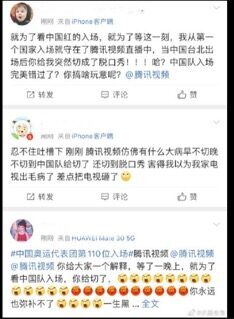
Weibo users furious at Tencent’s decision to interrupt its broadcast of the opening ceremony of the Tokyo Summer Olympics leave angry comments on the Tencent Video app.
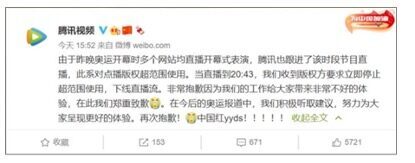
Tencent Video issues an apology via Weibo on July 24 concerning its decision to cut away from a live-stream of the Tokyo Olympics opening ceremony.
"In Olympics reports from now on," Tencent Video said, "we will listen to the views of others, and do our utmost to do better." In the fast-paced and fast-growing livestreaming sector, and with both users and censorship authorities to please, that may prove a difficult promise to keep.



Reader Comments
I've never gotten my head around non-Latin scripts (Greek, Cyrillic, Arabic etc.) - All part of our general dumbing down, I also have difficulty with symbolism, such as found in alchemy