KTIVWed, 26 May 2021 09:52 UTC
Imagine trying to get up and get ready for your day but instead of having to shut off your alarm clock, you are greeted by a cannonball-sized chunk of ice.
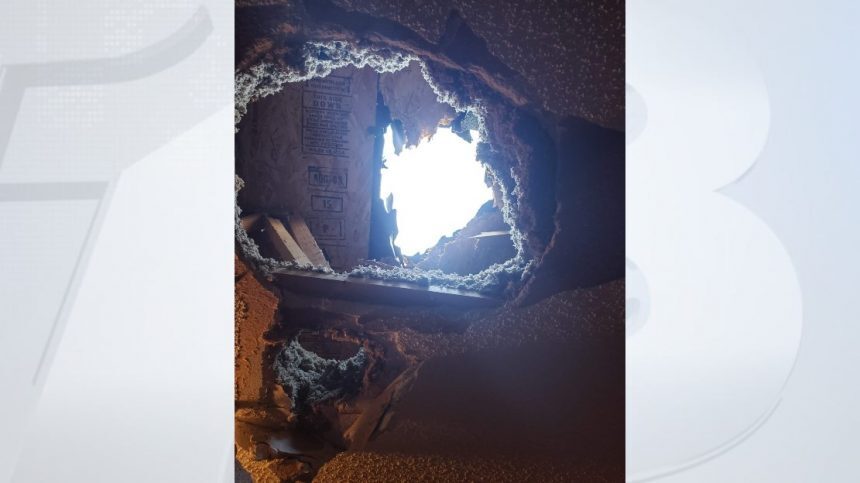
While Mother Nature can be known for some pretty interesting weather, this strange icy incident left one Elk Mound family with a large hole right above their bed.
A large ball of ice, weighing 12.6 pounds, crashed through the bedroom ceiling.
"It grazed me," said homeowner Ken Millermon. "I would've probably been out, kicked the bucket [if it landed on me]. As soon as that came through, everything else was like dust of insulation. I couldn't see."
The 12 pounds of ice causing thousands in damage.
"We've got a $1,000 deductible, which, I don't know where we're going to come up with that before it can get fixed and there's more than $1,000 of damage up there," Millermon said.
The big question on everyone's mind is where did it come from?
"There was a big black cloud above it. Of course we just had storms this morning," said neighbor Nathaniel Schery.
Officials from the National Weather Service in Chanhassen, Minnesota said Tuesday morning's storms
weren't strong enough to cause any hail that big.
"All I know is God had to have been watching out for me because I could've died, I could've," Millermon said.
News 18 reached out to the University of Wisconsin-Eau Claire's chemistry and biochemistry department to take samples and analyze the contents of the ice but haven't heard back as of publishing.
Comment: Footage of another possible megacryometeor crashing to earth was captured by CCTV in London in 2019:
Block of ice falls from sky landing metres from London street cleaner (VIDEO)Website Strange Sounds has
documented a number of other similar events in
California,
Scotland,
Italy, and
India.
As for the cause behind this phenomena, Wikipedia
notes:
A megacryometeor is a very large chunk of ice which, despite sharing many textural, hydro-chemical, and isotopic features detected in large hailstones, is formed under unusual atmospheric conditions which clearly differ from those of the cumulonimbus cloud scenario (i.e. clear-sky conditions). They are sometimes called huge hailstones, but do not need to form under thunderstorm conditions. Jesús Martínez-Frías, a planetary geologist and astrobiologist at Institute of Geosciences (Spanish: Instituto de Geociencias, IGEO) in the Spanish National Research Council (Spanish: Consejo Superior de Investigaciones Científicas, CSIC)[1] in Madrid, pioneered research into megacryometeors in January 2000 after ice chunks weighing up to 6.6 pounds (3.0 kg) rained on Spain out of cloudless skies for ten days.
Formation
The process that creates megacryometeors is not completely understood, mainly with respect to the atmospheric dynamics necessary to produce them. They may have a similar mechanism of formation to that leading to production of hailstones.[4] Scientific studies show that their composition matches normal tropospheric rainwater for the areas in which they fall. In addition, megacryometeors display textural variations of the ice and hydro-chemical and isotopic heterogeneity, which evidence a complex formation process in the atmosphere.[5][6][7] It is known that they do not form from airplane toilet leakage because the large chunks of ice that occasionally do fall from airliners are distinctly blue due to the disinfectant used (hence their common name of "blue ice").
Some have speculated that these ice chunks must have fallen from aircraft fuselages[4] after plain water ice accumulating on those aircraft through normal atmospheric conditions has simply broken loose. However, similar events occurred prior to the invention of aircraft.[8][9] Studies indicate that fluctuations in tropopause, associated with hydration of the lower stratosphere and stratospheric cooling, can be related to their formation.[5] A detailed micro-Raman spectroscopic study made it possible to place the formation of the megacryometeors within a particular range of temperatures: −10 to −20 °C (14 to −4 °F).[10] They are sometimes confused with meteors because they can leave small impact craters.
And, indeed, there are many signs in our skies that our atmosphere is undergoing a shift towards cooling:








His sense of humor as re things unknown was fantastic.
R.C.