Bethany Allen-Ebrahimian
AxiosWed, 22 Jul 2020 00:00 UTC
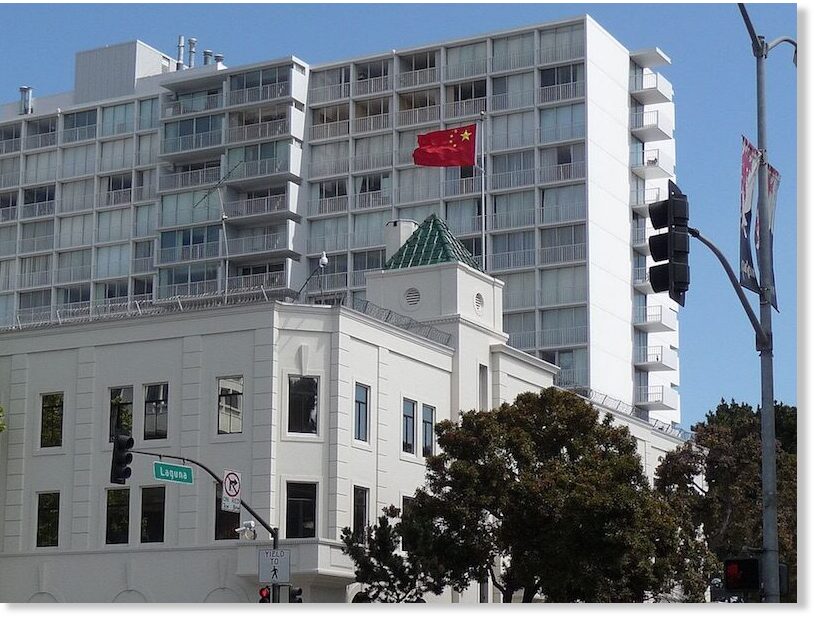
A researcher who lied about her affiliation with a Chinese military university entered the Chinese consulate in San Francisco after being interviewed by the FBI on June 20 about alleged visa fraud and has remained there, according to an FBI assessment in
court filings dated July 20.
Why it matters: Using a diplomatic facility to shelter someone charged with a federal crime could cause serious tension between the U.S. and China, especially as the U.S. is seeking to crack down on Chinese espionage and research theft.
"It is highly unusual for a Chinese diplomatic post to associate so closely with a suspect in an intellectual property theft-related case," said Minyao Wang, a New York-based lawyer who has worked on IP theft cases related to China.
- "Sheltering a defendant in a criminal case by using the diplomatic immunity of a consular building, if true, is really extraordinary."
Context: On July 21, the U.S.
told China that it must close its Houston consulate within 72 hours.
- State Department spokesperson Morgan Ortagus said the move was intended to "protect American intellectual property and American's private information."
Details: According to documents filed on July 20 in the San Francisco division of the U.S. district court for the Northern District of California, Tang Juan came to the U.S. on a J-1 visa and was a researcher at the University of California, Davis.
- On her visa application, Tang stated that she did not have any affiliation with the People's Liberation Army (PLA), the Chinese military.
- But an investigation revealed that she worked at the Air Force Military Medical University (FMMU), a PLA-affiliated university in China, and she is considered to be active military personnel.
- After obtaining a warrant, the FBI searched her home and found evidence of her affiliation with the PLA.
- On June 26, Tang was charged with visa fraud.
Tang appears to have taken refuge inside the San Francisco consulate.
- Federal prosecutors wrote that "at some point following the search and interview of Tang on June 20, 2020, Tang went to the Chinese Consulate in San Francisco, where the FBI assesses she has remained," according to court filings.
- "As the Tang case demonstrates, the Chinese consulate in San Francisco provides a potential safe harbor for a PLA official intent on avoiding prosecution in the United States," prosecutors stated.
What they're saying: "We made the Chinese government aware that she is a charged individual, so it unquestionable that they know the defendant is a fugitive from Justice," a Department of Justice official told Axios.
- The Chinese embassy in Washington, DC and the Chinese consulate in San Francisco did not respond to a request for comment.
- The State Department declined to comment.
The big picture: Federal prosecutors believe this isn't an isolated case.
- Tang's case is listed among several similar recent ones that appear "to be part of a program conducted by the PLA — and specifically, FMMU or associated institutions — to send military scientists to the United States on false pretenses with false covers or false statements about their true employment," the court filing states.
- At least one among this group of cases involved a military scientist who had allegedly been directed by military superiors to steal information from a U.S. institution.
- In other cases, the Chinese government directed military scientists to destroy evidence, and had helped them leave the U.S, according to court filings.
Related: The White House issued an
executive order on May 29 barring entry to certain Chinese students and researchers from PLA-linked universities, stating that they are at "high risk of being exploited or co-opted by the PRC authorities" to serve as "non-traditional collectors of intellectual property."
The bottom line: If the FBI's assessment is correct, the San Francisco consulate's decision to shelter a fugitive affiliated with the Chinese military is highly provocative behavior that goes against basic diplomatic conventions.
Comment: All of this is occurring on the heals of the
US shutting down China's Houston, Texas Consulate:
The Chinese foreign ministry, on Thursday, said that the U.S.'s decision to shut down China's consulate in Houston, Texas, "severely harmed," relations between the two countries.
While speaking at a daily media briefing on Thursday, Chinese Foreign Ministry spokesman Wang Wenbin said, "In response to the U.S.'s unreasonable actions, China must make a necessary response and safeguard its legitimate rights," but declined to detail any specific measures, according to Reuters.
"This is tearing down the friendly bridge between the people of China and the U.S.," he added.
The comments from the Chinese foreign ministry come shortly after the U.S. announced that they have ordered China to close its consulate in Houston "to protect American intellectual property."
According to the Washington Post, firefighters in Houston responded to reports of papers being lit on fire on the consulate grounds but they were not permitted to enter the building.
The U.S. announced that the consulate will be closed in a brief statement.
"The United States will not tolerate the PRC's (People's Republic of China) violations of our sovereignty and intimidation of our people, just as we have not tolerated the PRC's unfair trade practices, theft of American jobs and other egregious behavior. President Trump insists on fairness and reciprocity in U.S.-China relations," said Morgan Ortagus, a State Department spokesperson. "We have directed the closure of PRC Consulate General Houston, in order to protect American intellectual property and American's private information."
During the daily media briefing on Thursday, Wang described the U.S. allegations as "malicious slander."
"For some time, the U.S. has held ideological bias to continuously surveil, harass and even arbitrarily detain Chinese students and scholars in the U.S.," Wang said. "We urge the U.S. to stop using any excuse to restrict, harass or oppress Chinese students and researchers in the U.S."
Trump is
threatening even more action:
President Donald Trump said on Wednesday it was "always possible" he would order the closure of more Chinese consulates in the United States in the wake of the State Department's order to close Beijing's consulate in Houston.
Trump, at a White House news conference, noted that a fire was spotted on the Houston consulate's grounds after the State Department ordered the closure in 72 hours. "I guess they were burning documents and burning papers," he said.
To make matters between the two nations even worse, Beijing is claiming that its Washington D.C. embassy is
now receiving bomb and death threats:
A spokeswoman for the Chinese Foreign Ministry has blamed alleged bomb and death threats made against the country's embassy in Washington, DC on the US government.
The US' order that the Chinese consulate in Houston, Texas be closed represents an "unprecedented upgrade" in "political oppression" against China, Foreign Ministry Spokeswoman Hua Chunying tweeted on Wednesday, adding that the embassy in Washington has received bomb and death threats "as a result of smears and hatred fanned up by the US government."




R.C.