
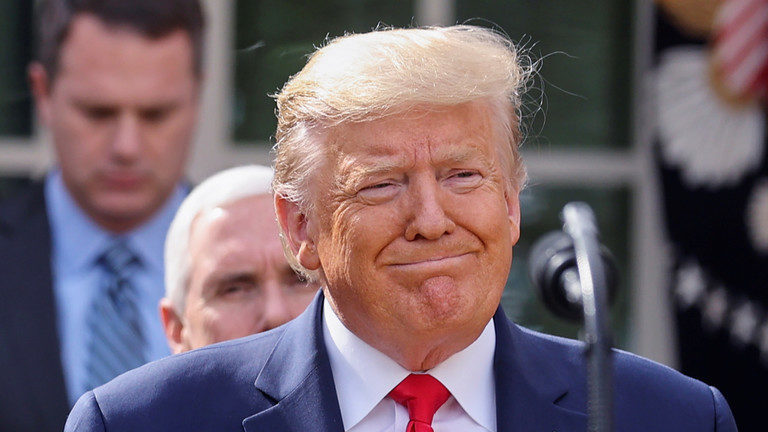
© REUTERS/Jonathan Ernst
"Last night after an in-depth discussion with the president regarding Covid-19 testing, he elected to proceed. This evening I received confirmation that the test is negative," the statement put out by Trump's physician, Sean P. Conley, read.
While initially brushing off concerns about him potentially contracting the deadly virus at the reception he hosted for a Brazilian delegation at Mar-a-Lago, Trump acquiesced, telling a news conference on Saturday that he had taken the test.
Pressure for Trump to undergo testing for Covid-19 - a flu-like virus that is now ravaging Europe and America after the outbreak wound down in China - has been mounting since it became known that three Brazilian officials all tested positive for the virus. They were ambassador to the US, Nestor Forster; Senator Nelsinho Trad; and Fabio Wajngarten, the press secretary for Brazilian President Jair Bolsonaro.
All three were present at the meeting with Trump that took place over the past weekend in his Florida residence.
On Friday, Trump's Brazilian counterpart, Bolsonaro, announced that he had also tested negative for the virus amid reports that a growing number of the Latin American country's officials were not so lucky as to dodge the disease.
The all-clear given to Trump by the White House medical staff has failed to persuade the #Resistance on Twitter, members of which wasted no time in casting doubt on the statement, with some going as far as to suggest that Trump had never taken the test.
Trump's supporters, however, used the occasion to tear into mainstream media for fanning Covid-19 hysteria and defaming the US leader by "spreading disgusting rumors" about his health.
Spanish PM's wife tests positive for Covid-19 after Madrid imposes national lockdown to tackle the disease
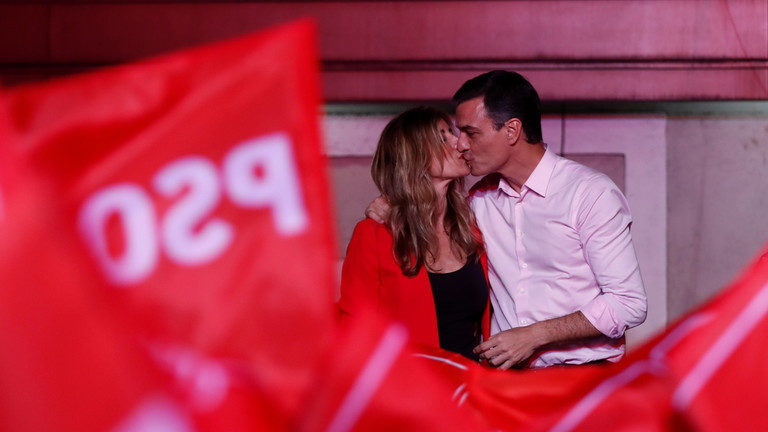
© REUTERS/Sergio PerezSpain's Prime Minister Pedro Sanchez of the Socialist Workers' Party (PSOE) kisses his wife Begona Gomez while celebrating the result in Spain's general election in Madrid, Spain, April 29, 2019.
Both Gomez and her husband, the prime minister, are feeling well, Sanchez's office reported Sunday night.
The news comes shortly after Sanchez unveiled what he described as "drastic" and "extraordinary" measures as part of the state of emergency to fend off the spread of the disease that has so far claimed at least 193 lives across the country, and infected over 6,250.
The restrictive measures, which will last at least 15 days and might be extended further, envision a ban on all travel within the country except for work, medicine or in case of emergencies.
Citizens, who are strongly encouraged to stay indoors and work from home if possible, will still be able to stock up on necessary supplies and groceries, but all restaurants, bars, hotels and non-essential retail outlets will shut their doors.
Students will also be staying put in their homes with educational centers being ordered to close.
Spain has become yet another major European country to go to great lengths to curb the spread of the virus, which originated in China's Wuhan in December last year.
Italy, the nation that has borne the brunt of the pandemic in Europe - the new hotbed of the disease, according to the World Health Organization (WHO) - has been in lockdown since Tuesday.
Germany's capital, Berlin, meanwhile, has ordered all public venues, including museums, bars and brothels to close their doors to visitors in an attempt to contain the virus.
While France has also shut down all entertainment, most of the shops, schools, nurseries, universities and day care centers, the French as well as the German federal authorities have been reluctant to impose stricter border controls inside the EU despite the measure being widely considered an effective way of stopping the disease.
French President Emmanuel Macron, in particular, spoke in defense of open borders, stating that the coronavirus "has no passport."







Comment: See also: