EN24Wed, 02 Oct 2019 01:29 UTC
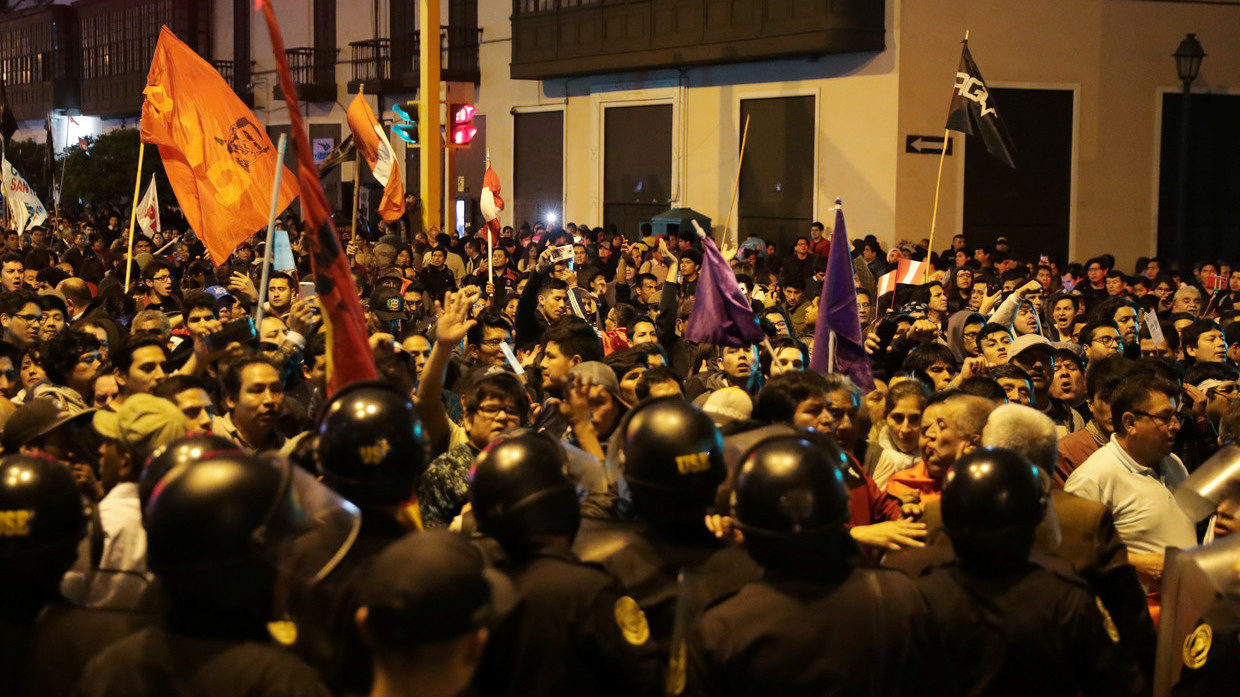
© Reuters / Guadalupe PardoA protest in support of President Martin Vizcarra in Lima, Peru. September 30, 2019.
The Washington government supports the democratic institutions of Peru and will continue as its partner in democracy, a spokesman for the US embassy in Lima said today, a day after the Peruvian president closed Congress.
"As a hemisphere, we are defined by our commitment to democratic principles, including the separation of powers, the rule of law, transparency and accountability in governance and the fight against corruption," said the spokesman, consulted for the political situation of the Andean country, in an email sent to Reuters.
It should be remembered that yesterday, September 30, President Martín Vizcarra dissolved the Congress, after indicating that he had been denied the issue of trust and called for early legislative elections.
For its part, Congress responded by approving the one-year suspension of Vizcarra for "temporary disability" and swore to his replacement, Vice President Mercedes Aráoz, as the president in charge.
Comment: Peru has been in turmoil for several days now, but has gone unnoticed in the US except for this banal statement. RT
reported on October 1:
The slow-burning political crisis in Peru reached the boiling point after Vizcarra dissolved the opposition-controlled parliament on Monday and called for a new general election in January.
"May this exceptional measure allow citizens to finally express themselves and decide the country's future at the polls," he said in a televised address.
Vizcarra previously threatened to dissolve parliament if the opposition continues to block his anti-graft bills. The president finally decided to make the move after lawmakers voted to replace almost all Constitutional Court judges despite his objections.
While Vizcarra insists that his actions are completely legal, parliament declared them to be unconstitutional and "a threat to democracy." Lawmakers then voted to remove Vizcarra from office and swore in Vice President Mercedes Araoz as acting president of Peru.
Vizcarra has made it clear that he will not step down. Shortly after dissolving the parliament, he met with the chiefs of the army, navy, air force, and police, with all of them affirming their loyalty to him as president.
"Martin Vizcarra is the Commander-in-Chief of the Armed Forces and the National Police of Peru," the military later said in a statement.
At the same time, rallies were held in various cities in support of Vizcarra and his move to dissolve parliament.
Not everyone is cheering him on, though. Several prominent figures, like former Interior Minister Fernando Rospigliosi and veteran politician Lourdes Flores, blasted Vizcarra's actions as a "coup d'etat."
During his election campaign, Martin Vizcarra championed the fight against corruption, which has plagued the nation for decades. His predecessor, Pedro Pablo Kuczynski, was forced to resign last year over allegations of graft and vote-buying.
Vizcarra's primary opponents come from the Popular Force (FP) party, whose leader, Keiko Fujimori, is currently being held as part of a corruption investigation. She is the daughter of former President Alberto Fujimori, who is serving jail time for corruption and embezzlement.
And on
October 2:
Unlike in Venezuela, where opposition leader Juan Guaido enjoys full backing from Washington, the US had previously refrained from taking a side in Peru's burgeoning struggle. Vizcarra's government ironically threw support behind Guaido in January, soon after he declared himself "interim president" of Venezuela.
Some online couldn't resist drawing comparisons between the two embattled countries. "It will be very fun to listen to Vizcarra, the Lima Group and the [Organization of American States] explaining why the interim president of Mercedes Araoz in Peŕu is not valid but that of Guaidó in Venezuela is," one user tweeted.
"The interim Vizcarra dissolves the Congress and the Congress suspends the interim Vizcarra. Guaido will have to take care of Peru," another commenter joked, while a third asked "Did Guaidó proclaim himself President of Peru yet?"
With Washington finally taking notice of Peru's crisis, however, some noted the country may soon find itself in bigger trouble, and become another victim of US-imposed "democracy" abroad. Previous initiatives yielded outcomes such as Iraq and Libya, where the floodgates of violence and extremism were smashed open by American bombing campaigns - or Syria, where US support for "moderate rebels" prolonged a bloody conflict by years and helped to tear the country apart - all in the name of "democratic institutions."









So we have Venezuela, Ecuador, Argie and now Peru on fire of some sort and Colombia and Brasil on the watch list.