

© Adam Stanford, Aerial-CamThe latest excavations have revealed a Bronze Age burial mound that was built around 1,000 years after the Neolithic passage tomb of Bryn Celli Ddu.
And although the burial mound is much older than the Druids - who lived about 2,000 years ago, if they existed at all - the excavations have cast new light on the ancient inhabitants of the island of Anglesey.
Overlooking the Irish Sea from the northwest corner of Wales, Anglesey is dotted with numerous Neolithic and Bronze Age stone monuments. The most famous is the 5,000-year-old passage tomb of Bryn Celli Ddu (Welsh for "the mound in the dark grove"), which has an entrance passage that aligns with the rising midsummer sun. It was archaeologically excavated in 1928 and 1929, and later reconstructed.
Modern archaeologists have turned their attention to a burial mound about 150 feet (50 meters) from the famous passage tomb, in the expectation that today's scientific techniques will reveal new details about the people who built it.
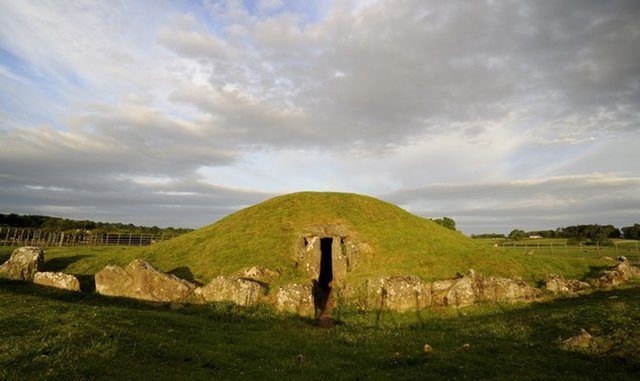
© Cadw/Welsh HeritageThe Bryn Celli Ddu passage tomb on the island of Anglesey was built around 5,000 years ago, and excavated in 1928 and 1929. Credit: Adam Stanford, Aerial-Cam
Reynolds, who also works for the Welsh heritage agency Cadw, told Live Science that the excavations of the burial mound were now almost complete, and scientific tests would now help to determine the presence of any human remains there.
The excavations have shown that the burial mound was built during the Bronze Age, much later than the original Neolithic tomb, while some artifacts could be even older than the tomb, she said. "This suggests that Bryn Celli Ddu has been a special ceremonial location for thousands of years."
Druid island
Anglesey is most famous today for its supposed links to the Druids, who were described by the Roman general Julius Caesar and by the later Roman historian Cornelius Tacitus.
Although no archaeological evidence of the Druids has ever been found, generations of writers have portrayed them as the religious leaders of the Celts, a Bronze Age people who spread across Europe about 3,000 years ago.
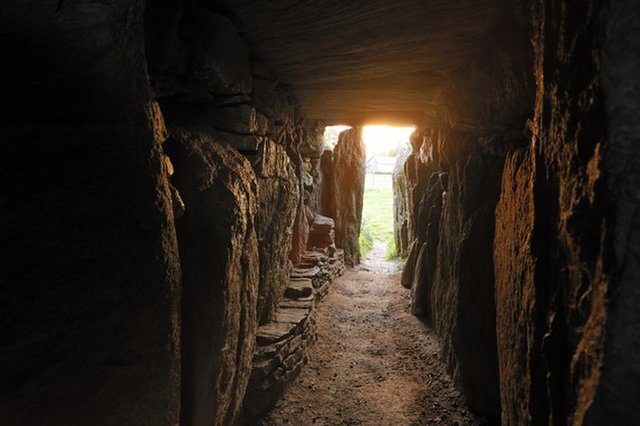
© Cadw/Welsh HeritageThe entrance passage of the Bryn Celli Ddu tomb aligns with the sunrise at mid-summer, casting light on the stone-lined chamber within.
According to Tacitus, Druids played a part in the Roman invasion of Anglesey, which he described as a center of Celtic resistance to the Roman Invasions of Britain.
Tacitus - writing at the end of the first century, around 50 years after the invasion of Anglesey - noted the surprise of the Roman soldiers when they saw Druids among the military defenders of the island, shouting curses at the invaders.
The myth of a link between the mysterious Druids and Anglesey has taken hold from that single mention, said University of Bristol historian Ronald Hutton, author of "Blood and Mistletoe: The History of the Druids in Britain" (Yale University Press, 2009).
Although the British defenders of Anglesey were eventually defeated, the description of the Druids by Tacitus was taken up by later writers, who exaggerated his account to turn the island of Anglesey into a center of Druidic power, Hutton told Live Science.
But there was no evidence of the presence of Druids at Anglesey, or indeed anywhere else in Britain, he said.
"It may have been based on an eyewitness statement or may have been made up entirely by Tacitus himself to enliven his account of the attack on Anglesey," Hutton said. "We just can't tell."
Ancient tomb
Decades of archaeological work in Britain have also failed to find any evidence of the Druids. But the connection between the island of Anglesey and the Druids has become an almost indelible legend.
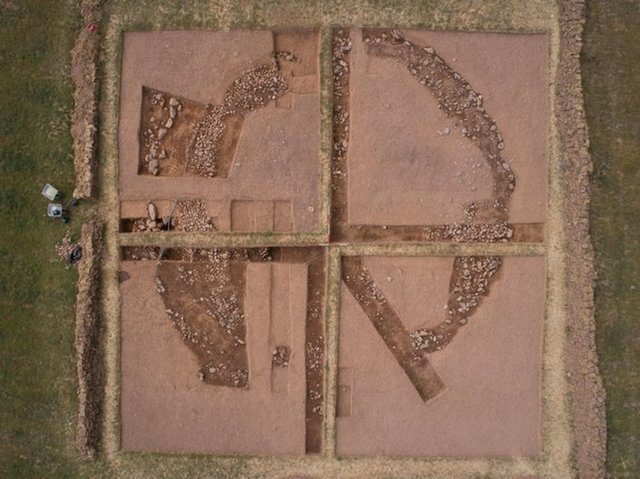
© Adam Stanford, Aerial-CamArchaeologists say the Bronze Age burial mound built next to the Neolithic tomb suggests that Bryn Celli Ddu was used as a ceremonial site by different peoples over thousands of years.
However, evidence from sites like Bryn Celli Ddu showed that ancient monuments were often used for ceremonial purposes by later peoples, she said.
At Bryn Celli Ddu, archaeological evidence now suggests that the original tomb was started in the Neolithic period, about 5,000 years ago, and added to over the centuries, she said.
Distinctive pieces of Bronze Age pottery and flint tools were found during the latest excavations, which indicated the burial mound was built around 1,000 years later than the Neolithic passage tomb, she said.
Geophysical surveys and excavations also revealed much older structures and artifacts buried at different locations around the Bryn Celli Ddu tomb, including a circle of Neolithic pits, pieces of Neolithic pottery and the remains of a stone ax.
"People have been coming back to this landscape over thousands of years," she said. "They were adding their own mark onto the landscape."




Meanwhile, the MSM continues using mere unproven scientific - and UNscientific - THEORIES as FACT!
Kudos on the LKJ Quote. She's my vote for The True Floridian Hall of Fame!*
R.C.
* So I just made it up. IF there is one and LKJ is not in it, then it's not worth knowing about.
LKJ: You've opened far more minds to true truth - and truth-seeking - than anyone else I am aware of. KUDOS!
R.C.