RTFri, 07 Jun 2019 16:04 UTC
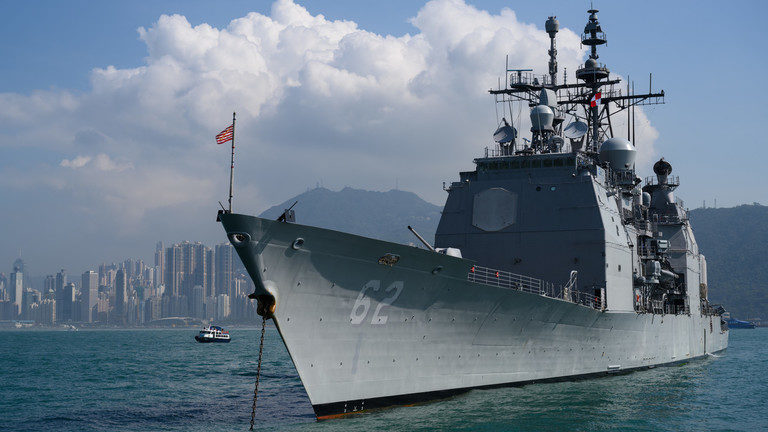
© AFP / Anthony WallaceUS Navy's USS Chancellorsville
Russia has accused the US Navy of "unacceptable" and dangerous maneuvering, after a US warship almost caused a catastrophic collision with a Russian destroyer in the East China Sea.
The Russian Navy said that the USS Chancellorsville, a guided-missile cruiser, unexplainedly changed direction and came within just 50 meters of the Admiral Vinogradov on Friday at 6:35 Moscow time. It added that a collision was only prevented after the Russian crew implemented emergency maneuvers and changed course.A statement from Russia's Pacific Fleet added that a complaint had been lodged with the command of the American cruiser.
"We made our protest to the command of the American ship on an international wavelength and pointed out that such actions are unacceptable."
The US Navy denied responsibility for the near-collision. Instead, it blamed the
Admiral Vinogradov for accelerating at Chancellorsville while it was waiting for its helicopter to land onboard.
"This unsafe action forced Chancellorsville to execute all engines back full and to maneuver to avoid collision."
The incident follows a period of growing tensions in the waters around China, with Washington frequently sending its warships on so-called 'freedom of navigation' exercises to challenge China's territorial claims. In recent months, American incursions in the South China Sea have seen US vessels come within 12 nautical miles (22km) of Chinese islets, the closest they may stray without violating international law.
Following another tense near-collision between Chinese and US warships last October, China's defense ministry said it "resolutely opposes" any actions by foreign vessels that challenge its territory under the guise of freedom of navigation.
Comment: In fact, US media is reporting a mirror version of events, in which the Russian ship was in the wrong. Video and photo evidence appears to support the Russian account:
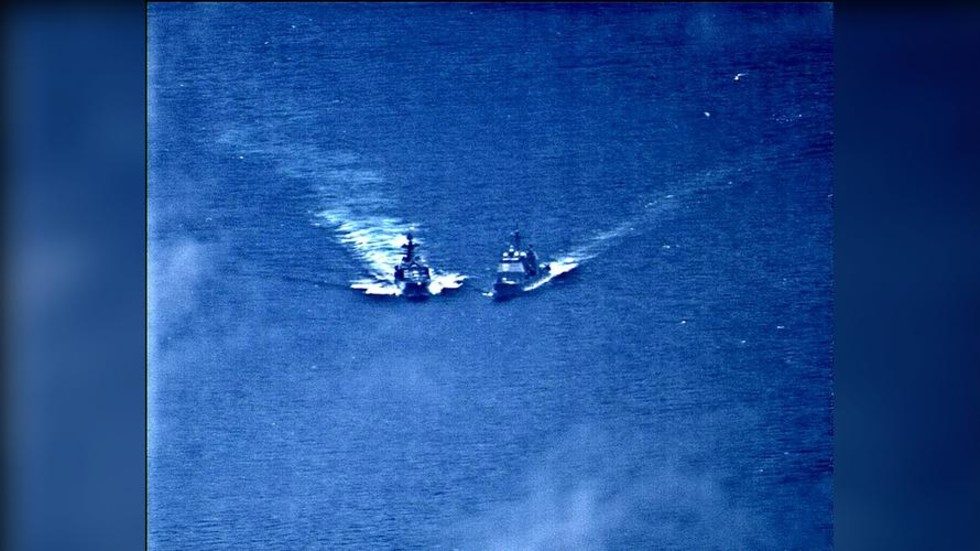
That's the Russian ship on the left
As pointed out
by Moon of Alabama:
The Handbook of Nautical Rules lists as the International Maritime Organization Rule 15:
When two power-driven vessels are crossing so as to involve risk of collision, the vessel which has the other on her own starboard side shall keep out of the way and shall, if the circumstances admit, avoid crossing ahead of the other vessel.
The book explains further:
Rule 15 requires the vessel that has the other on its starboard side to stay out of the way, and to pass behind. The vessel on the right becomes the stand-on vessel and must follow Rule 17 (Action by Stand-on Vessel). The vessel on the left becomes the give-way vessel and must follow Rule 16 (Action by Give-way Vessel).
...
The give-way vessel is required (if the circumstances of the case admit) to pass behind the stand-on vessel and so a turn to starboard would be in order. To keep the area to the left of the stand-on vessel clear for the give-way vessel's maneuvers, Rule 17 directs the stand-on vessel to refrain from turning to port.
Rule 16 says:
Every vessel which is directed to keep out of the way of another vessel shall, so far as possible, take early and substantial action to keep well clear.
and Rule 17:
Where one of two vessels is to keep out of the way, the other shall keep her course and speed.
Here's US Navy footage of the near-collision:
The Russian ship is clearly 'to starboard', meaning, according to basic nautical rules, it is the American ship that must change course.
In this case, it didn't, forcing the Russians to alter course to
their starboard, something the US Navy has spun as a 'dangerous maneuver', but without which one or both ships would now be at the bottom of the ocean...
There was likely a bigger maneuver in play here. Besides the issue of who had right of way at the moment of 'near-miss', the fact that the ships were anywhere near each other - off the coast of China - speaks to the Russian-Chinese 'challenge' of American 'ownership' of the oceans...








Comment: In fact, US media is reporting a mirror version of events, in which the Russian ship was in the wrong. Video and photo evidence appears to support the Russian account:
The Russian ship is clearly 'to starboard', meaning, according to basic nautical rules, it is the American ship that must change course.
In this case, it didn't, forcing the Russians to alter course to their starboard, something the US Navy has spun as a 'dangerous maneuver', but without which one or both ships would now be at the bottom of the ocean...
There was likely a bigger maneuver in play here. Besides the issue of who had right of way at the moment of 'near-miss', the fact that the ships were anywhere near each other - off the coast of China - speaks to the Russian-Chinese 'challenge' of American 'ownership' of the oceans...