
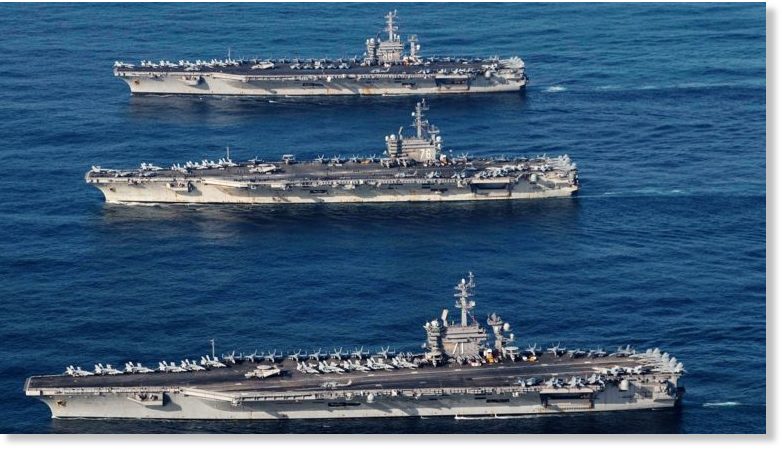
© James Griffin / US Navy / Reuters
'Sending a message' in Persian Gulf
US naval forces have become a semi-permanent fixture in the international waterways off Iran's coast, 6,800 miles (10,943 km) from Washington, DC. While the naval presence is likely designed to ensure American military dominance over the whole region, it seems that recent deployments are specifically aimed at Iran, which is trying to resist unilaterally imposed sanctions after US President Donald Trump tore up the 2015 nuclear deal.
But when sanctions aren't enough, there's always the Navy. The White House announced on Sunday that the USS Abraham Lincoln Carrier Strike Group and a bomber task force will be deployed to the Middle East in order "to send a clear and unmistakable message to the Iranian regime."
Comment: The Americans and can huff and puff all they want, but the learned a few years ago that they have a legitimate opponent in Russia in war. It wasn't that long ago that the Russians made outfoxing the US military look like child's play:
- Russia's latest electronic warfare networking system coordinates jamming of NATO communications
- Russia using super-advanced electronic warfare to keep NATO/ISIS blind in Syria
- Invisible Shield, Invisible Sword: Russia's electronic warfare is 'second to none'
- US Special Ops hints that Russian electronic weapons are 'disabling' US aircraft in Syria
- The stealth game: Russia's top-of-the-line air defense systems to become invisible to enemies
Coincidentally, the strike group's deployment was announced just hours after Tehran vowed to bypass US sanctions and sell its oil in the "grey market."
Using America's naval might - especially its aircraft carriers - to "send messages" has been described by some Trump administration officials as a form of diplomacy. In April, US ambassador to Russia, Jon Huntsman, argued that "each of the carriers operating in the Mediterranean at this time represents 100,000 tons of international diplomacy."
Comment: If Trump's advisors think sending the military dinosaurs that are aircraft carriers to "send messages" is a form of diplomacy, he needs to fire all of them. The Americans need to grow up, take a seat at the table, and talk to other world leaders instead of using empty threats.
The message, however, has not been well received in Iran, which has warned that the United States would be solely to blame for any fighting that may break out as a result of the naval deployment.
'Freedom of navigation' in South China Sea
Since Trump took office, the US has stepped up its naval activity in the South China Sea, much of which has been claimed by Beijing as part of its own territorial waters. Washington insists that its vessels are entitled to pass through the sea, citing the principle of "freedom of navigation," and periodically sends warships to probe the Chinese-claimed waterways.
On Monday, the US military announced that two US guided-missile destroyers had traveled within 12 nautical miles off the coast of the Spratly Islands, which are under Chinese control.
The incursions have become almost monthly occurrences, with Washington vowing to continue to defy Beijing's claim over the area.
Tellingly, the most recent incident came just a day after Trump said he would hike American tariffs on $200 billion worth of Chinese goods. The announcement followed a break-down in negotiations aimed at ending a months-long trade war with Beijing.
US naval activity in the region has even extended to projecting Washington's position on Taiwanese independence - a non-negotiable issue for Beijing. Last week, two US warships sailed through the Taiwan Strait. A spokesman for the US Navy's Seventh Fleet said the exercise demonstrated "the US commitment to a free and open Indo-Pacific."
Bumping shoulders with Russia in Black Sea
Washington's sanctions - and conspiracy theories - aimed at Moscow have been complimented by a more aggressive naval presence in Russia's backyard.
In January, a US destroyer entered the Black Sea to "conduct maritime security operations and enhance regional maritime stability." Similar missions were carried out in the region in 2018.
The US's regional allies have also gotten in on the act.
Three Ukrainian ships violated the Russian maritime border in the Kerch Strait, between Crimea and mainland Russia, in November 2018. The incident led to a lengthy naval chase and culminated in the Russian coastguard using force to stop the perpetrators. Washington announced in March that it would impose fresh sanctions on Russia over the standoff.
Comment: That's a rather clear sign that the Ukrainian military was following orders given in Washington.
Do as I say, not as I do
Of course, it goes without saying that using naval power to "promote" national interests is a privilege solely reserved for Washington. At least, that's what its statements seem to be telling the world, like in May, when the Pentagon expressed concern that China may seek new naval and military bases outside its borders in order to ensure the security of its One Belt, One Road project.
China currently has one overseas military facility, in Djibouti. In contrast, the US boasts an estimated 800 bases in more than 70 countries and territories, ranging from huge air bases in Europe to small radar facilities in the Pacific.


On another level, their threatening behaviour will only push others into forming alliances with each other, as is happening, giving them some formidable opponents all over the place.