
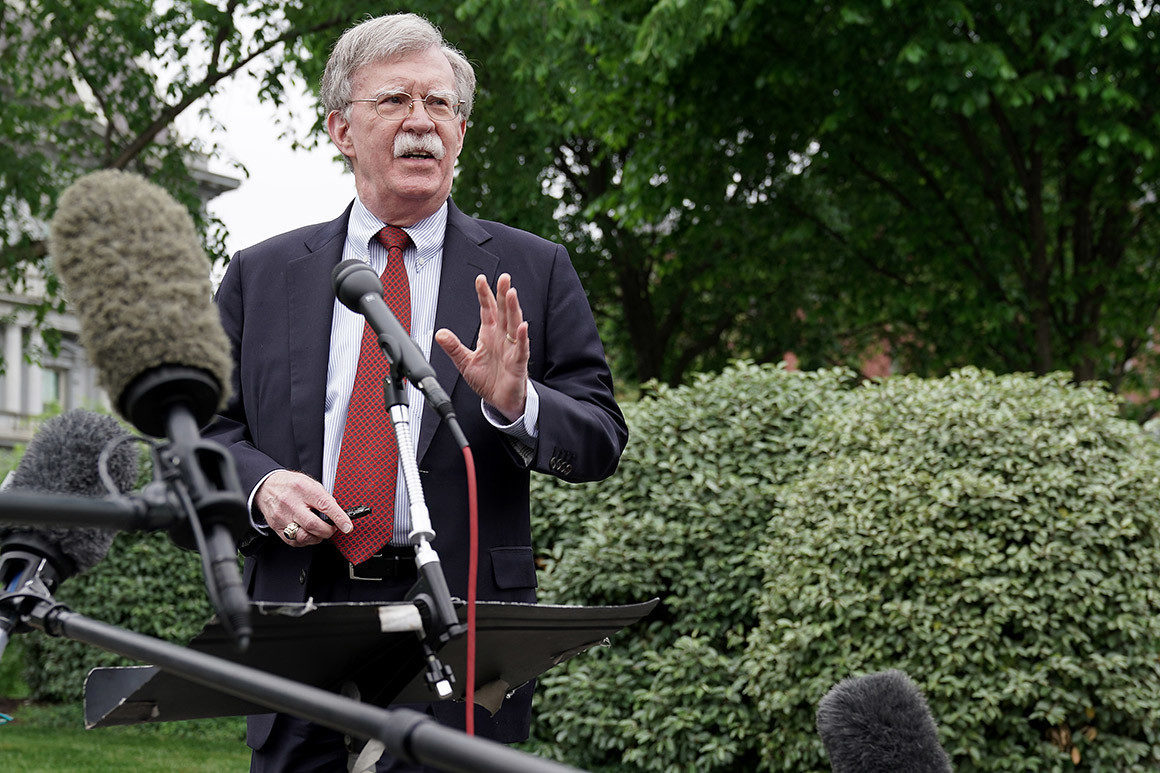
© Chip Somodevilla/Getty ImagesJohn Bolton has said America’s interest in Venezuela is unique because of the country’s location in the Western Hemisphere.
The Trump administration is tumbling into a proxy battle with Russia over Venezuela, the latest international standoff that threatens a return to the tense Cold War years.
The two sides traded barbed accusations this week after Venezuelan opposition leader Juan Guaidó called on the public and the military to rise up and oust autocrat Nicolás Maduro. Secretary of State Mike Pompeo threatened military action and accused Russia of persuading Maduro to cling to office instead of fleeing to Cuba amid growing street protests. Russia, in turn, chided Pompeo for spreading "fakes" as part of an "information war."
The disagreement spilled into a phone call Wednesday between the two countries' top diplomats - a U.S. description shows Pompeo chastising Russia for its "destabilizing" behavior, while the Kremlin's recounting details its foreign minister blasting America's actions as "the rudest violation of international law."
The face-off, which also involves Cuba backing Maduro, is a potentially explosive confrontation between President Donald Trump and Russian leader Vladimir Putin as the president heads into his reelection bid. And it threatens any effort to ease relations with the Kremlin in the wake of special counsel Robert Mueller's conclusion that Trump's campaign did not criminally conspire with the Kremlin to meddle in the 2016 campaign.
Comment: The Putin-Trump phone call was long, cordial and 'productive'. Bolton is the one, along with Pompeo who is stirring up trouble. Why is Politico not calling them out on their behavior?
Trump and Putin discuss Venezuela and North Korea during phone call, Mueller report 'only briefly'
"This is our hemisphere - it's not where the Russians ought to be interfering," Trump national security adviser John Bolton told reporters on Wednesday. "This is a mistake on their part. It's not going to lead to an improvement in relations."
Comment: A deliberately provocative remark on Bolton's part. :
Lavrov: Bolton's Monroe Doctrine remark on Venezuela is an 'insult to entire region'
Analysts say Russia and the U.S. are testing the depth of each other's commitment to oil-rich Venezuela. And given Russia's willingness to send troops to places such as Syria and Ukraine, while the U.S. provides only a limited military role, the better bet is probably Russia.
"What the Russians seem to have effectively figured out is how to call our bluff," said Fernando Cutz, a former top National Security Council official under Trump. "When they send troops into Georgia, or Ukraine, or Syria, or Venezuela, what are we going to do about it? It complicates our calculus and gives Russia the upper hand."
In Venezuela's capital on Wednesday, anti-Maduro protesters came out at Guaidó's urging. But, according to media reports, many pro-Maduro protesters also showed up, adding to the mayhem. The dueling protests came a day after pro-government security forces clashed with demonstrators, leading to the death of at least one person and scores of injuries.
Trump has been leaning on Maduro to leave office - and on Russia to end its support of the Venezuelan leader - since late January, when the president recognized Guaidó, an opposition activist and National Assembly leader, as the interim president of Venezuela. Dozens of other countries, especially in Europe and Latin America, followed suit, arguing that Maduro, who has overseen a collapse in Venezuela's economy and an uptick in repression, did not fairly win reelection.
But Cuba, Russia, China and other countries that often oppose the United States on the international stage have supported Maduro. U.S. officials say Cuba has thousands of troops in Venezuela while Russia has sent roughly 100 military advisers to help Maduro, although experts have said the assistance is hard to quantify. Both Cuba and Russia have either dismissed or downplayed such claims, with the Kremlin only saying it sent "military specialists" to service already existing contracts for Russian weapons.
It was not immediately clear whether U.S. officials had planned for the possibility of Russia inserting itself so dramatically, but observers say it should not be a surprise. Russia is a major creditor of Venezuela's, and poking America's eye in the Latin American state is a relatively cheap proposition for Putin, who is intent on reviving Russia's standing as a global power.
"Venezuela is a resource-rich nation in a strategic location. Russia will want its interests there guaranteed, and will be reluctant to be seen slinking away from the American backyard," said Molly McKew, a Russia expert who advises governments on strategic communications.
Still, the Trump administration appears to have decided its plan to topple Maduro will include regular Russia bashing.
Pompeo on Tuesday claimed that Maduro had been preparing to quit and even had a plane ready for him to fly to Havana, but that Russia had persuaded him to stay. Russia denied the allegation. On Wednesday, Pompeo told Fox Business Network that U.S. "military action is possible. If that's what's required, that's what the United States will do."
Comment: Or the neocons got played for fools by Maduro's officers, deceiving Guaido that they would back him, and then left him hanging, looking more foolish than ever. Moon of Alabama comments that Guaido, and by extension the US, got snookered:
There is no official explanation why the Trump administration believed that the comical coup attempt by Juan Guaidó and his master Leopolo López would work.
There are signs though that the government of President Nicolas Maduro set a trap. Several people in the top echelon of the Venezuelan government gave false promises that they would join the U.S. proxy side. They snookered Guaidó into launching his coup to let him fail.
A Washington Post wrap-up says that everyone expected important people to change sides:The chaos in Caracas indicated that, while a plan had been in motion, it may not have unfolded as anticipated.
...
Announcements by senior Maduro officials that they were changing sides did not materialize, and the administration appeared increasingly concerned as it debated next steps.
...
Earlier Tuesday, Bolton had told reporters that Trump is watching political developments in Venezuela "minute by minute." Bolton also put unusual public pressure on individual Venezuela government officials to renounce Maduro and embrace the political opposition.
...
"It's a very delicate moment," Bolton said. "The president wants to see a peaceful transfer of power," which he added would be possible if enough military and government figures switch allegiances.
...
In an apparent attempt to divide Maduro's government, Bolton said senior officials, including Defense Minister Vladimir Padrino López, had been in secret talks with Guaidó, and he called on them to "make good on their commitments" to help oust Maduro.
...
Bolton called by name for three officials in Venezuela - the defense minister, the chief judge of the Supreme Court, and the commander of the presidential guard - to support Guaidó taking power.
...
A senior Latin American official said opposition talks had been going on with Padrino and the other two for "the last several weeks," and that the three had been promised retention in their current positions if they came out publicly in support of "constitutional order" that would allow Guaidó to take power. The official, who spoke on the condition of anonymity about the fast-moving and confusing situation, said those involved in the negotiations had no initial explanation for what went wrong, ...
Acting Defense Secretary Patrick Shanahan, meanwhile, canceled a trip to Europe to focus in part on Venezuela. He told lawmakers that the U.S. still hopes that diplomatic and economic pressure will push out Maduro - the Trump administration has hit Venezuela with a series of financial penalties, including some that target its critical oil sector. But, he added, the U.S. has done "exhaustive planning" and has plans for an array of scenarios.
The U.S. and Russia are already at odds in several geopolitical hot spots around the world.
In Syria, the U.S. has troops battling the Islamic State terrorist group while Russian forces are there supporting Syrian dictator Bashar Assad. But the two countries have taken pains to avoid direct military conflict in the region.
In Ukraine, the U.S. has long opposed Russian-backed separatists fighting in the country's eastern region. The U.S. has sent weapons to local forces battling the Russian-supported groups.
Bolton has said America's interest in Venezuela is unique because of the country's location in the Western Hemisphere. He has repeatedly invoked the Monroe Doctrine, the notion that the U.S. will not tolerate outside interference in the Western Hemisphere, as justification for U.S. actions.
Notably, Trump himself has said nothing this week about Russia's role in Venezuela. Instead, he's forcefully gone after Cuba, threatening to strengthen the U.S. embargo on the country over Havana's aid to Maduro. Although Trump has in the past said Russia "has to get out" of Venezuela, his reluctance to repeat that call this week may be a sign that he still hopes for a rapprochement with Putin.
It could also mean Trump is worried about the political implications of increasing America's role in Venezuela.
Although Trump has threatened to take military action in Venezuela in the past, he has generally been averse to posting U.S. troops overseas. Indeed, sending U.S. troops to Venezuela risks angering the isolationist wing of Trump's GOP base. But such a move also could boost Trump's support among Cuban Americans and Venezuelan Americans in the crucial swing state of Florida during the 2020 presidential race.
Yet, the very idea of having U.S. troops in Venezuela could infuriate other Latin American countries who up to now have supported the U.S. approach. Many Latin American citizens remain deeply resentful of America's history of interfering in their countries, including backing coups.
Trump aides insist the U.S. is not trying to engineer a coup because it is relying on a constitutional mechanism in recognizing Guaidó over Maduro.
"What is a coup is the presence of Cuba and Russia directing the top affairs of the government of Venezuela," Bolton told reporters Wednesday.
Maduro, meanwhile, slammed Pompeo's claim that he was ready to flee to Cuba but stayed at Russia's urging.
"Dear God," Maduro said in televised remarks, according to The Washington Post, "how far will the U.S. go?"

Comment: