

Governments rarely attempt outright martial law. The reason should be obvious; no military, no matter how advanced, has the capacity to suppress a unified citizenry. If the public is armed, the task becomes even more impossible. The laws of attrition alone would make the conflict bloody and costly.
Martial law is a mechanism that cannot be exploited in a vacuum. The-powers-that-be understand that it can only be used when a large percentage of the public is conned into supporting it. This is usually accomplished through the triggering of engineered crisis events, but there is also another method for getting the masses to back martial law, and that is to push both sides of the political spectrum to extreme zealotry until one side decides to use government as a weapon against the other.
Whether by disaster or political division, the public can be influenced to rationalize government dominance of every aspect of life.
The agenda to engineer crisis is evident. In past articles such as 'The Federal Reserve Is A Suicide Bomber With A Deeper Agenda', I have outlined the facts behind economic decline and how it is often utilized by central banks and their international banking partners to accumulate and centralize wealth while also manipulating society into accepting reduced living standards for generations to come. There is another more important motive, though. The banking elites also use the controlled demolition of the economy as a tool to create fear.
The Hegelian Dialectic of problem-reaction-solution is a powerful potion that mesmerizes the unaware population. Those who are dependent are easily frightened because they have no control over their own futures. They become reactive rather than proactive; they seek to be led rather than to lead. They will readily accept promises and solutions from anyone in apparent authority rather than maintaining their objectivity and reason. They become slaves to the social and political tides, always waiting for someone else to fix the problems around them.
This conundrum also transfers over to political conflict. In my article 'Order Out Of Chaos: The Defeat Of The Left Comes With A Cost', published just after the 2016 election, I explored the dangerous possibility that Trump supporters were being fooled into participating in the false Left/Right paradigm while believing that they had transcended it.
When we refer to the "false Left/Right paradigm" in the alternative media, we are referring to the fact that the political gatekeepers within government actually tend to share the same beliefs and agenda regardless of the "party" or ideology they claim to support. That is to say, Republican and Democratic leaders play their respective roles and their battles are scripted, not legitimate. The Trump campaign was a rather different animal, in that Trump was a candidate without a longstanding political record. He was a relative unknown compared to Clinton, and this made him enticing to conservatives and liberty activists that had all but abandoned participation in US elections.
It takes time to identify a political fake or controlled opposition. With Trump, we had no point of reference. Two years have changed this...
Trump's campaign was built upon two very important positions: First, Trump promised small government conservatives that he was going to "drain the swamp" in Washington of the kind of globalists and banking elites that Clinton was notorious for associating with. Trump's background already had at least one red flag in this regard - his empire was bailed out by the Rothschild banking family in the 1990's during his debt crisis and Taj Mahal casino failures. This alone was not enough to discount him, though. Many businessmen have at least some interactions with banking elites by necessity and the way the system is designed. Unfortunately Trump's relationship with the bankers did not stop there.
Trump's cabinet picks were a perfect opportunity for him to establish his independence from globalists, bankers and their think tank partners. This did not happen. Trump brought in Wilber Ross as Commerce Secretary, the same Rothschild agent who arranged his bailout in the 1990's. He brought in people like Steve Mnuchin, formerly of Goldman Sachs, Larry Kudlow, formerly of the NY Fed, and John Bolton from the Council On Foreign Relations. Trump was adding to the swamp, not draining it.
Second, Trump also argued for economic transparency during his campaign, which for many of us was a breath of fresh air. Trump pointed out the fallacy of the stock market and the fact that the Fed had been supporting a fabricated rally for years using artificially low interest rates and stimulus. Trump argued against false economic stats like mainstream unemployment numbers, which ignore the 95 million jobless people in the US that are no longer counted by the BLS.
Yet, as soon as Trump entered office, all of this changed. Trump immediately started taking credit for the bull market rally in stocks as if it was his own rather than a product of Fed manipulation. He took credit for fraudulent jobs numbers too, despite the tens of millions of people still listed as "non-participatory". Trump has tied his administration to the performance of a fake economy sitting atop a massive deflating bubble.
I would also note that during Trump's campaign and in the two years since Trump has barely mentioned the word "Constitution". This is rather odd to me. A liberty advocate should be defending constitutional protections regularly, driving home the need for the Bill of Rights to be secured and honored. Our very society depends upon the survival of such principles, after all.
It has become clear that Trump is not the "savior" that the liberty movement was hoping for, but many people will continue to applaud him all the same because of a specific factor: The increasingly deranged political left.
Consider the endless absurdity of Russiagate; a conspiracy theory with absolutely no evidence to back it. It never seems to die despite all logic and reason, but the motives behind this are not what conservatives usually assume. Russiagate is a drug, a drug for leftists. They love it, they need it, it dulls the pain of their loss in 2016 and it confirms their biases. They didn't "fail" in 2016, and they aren't the biggest losers of all time; the election was "stolen" from them by Trump and his Russian handlers. Therefore, they are now justified in any level of insanity they display in their activism and opposition. They believe they are righteous.
At the same time, conservatives are ever more bewildered by the cultism and zealotry of the left. Each new incident pokes at their ribs with a pointy knife. Trump is being "railroaded", they think to themselves. The left must be planning a coup. They won't let him build the border wall. They try to delay or obstruct his State Of The Union Address. They spew nonsensical drivel and froth at the mouth and scream and wail and act like overgrown toddlers. They are dangerous. Drastic measures might need to be taken...
And so we are confronted with a perilous choice; do we as conservatives becomes zealots ourselves in order to defeat the zealotry of leftists?
But this is a false choice. The left hand of the paradigm has reached full bore lunacy, but this is designed to push conservatives into our own brand of blindness. The goal? To get conservatives to champion actions that are completely contrary to our principles. The goal, I believe, is to condition us into cheering for greater government power and centralization in the name of stopping the leftist menace.
Three weeks from now the government shutdown fight is set to return. The mainstream media has been avidly reporting that the uncertainty is over, but this is a preposterous conclusion. What the nation faces now is even greater confusion as the shutdown fight prepares to return in February or a national emergency is declared, or both. My concern is that this is leading to conservative support for extreme measures.
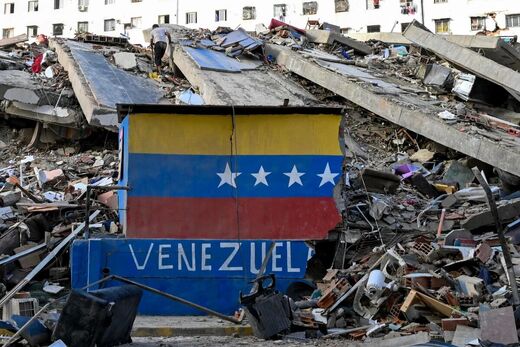
Consider the current geopolitical environment in the western hemisphere today. South America is on the verge of potential implosion, in no small part due to the failures of socialism, but also due to Trump's globalist infested administration seeking destabilization of an already fragile region. Increasing US sanctions on Venezuela, Trumps support for Madruro's political opponent (John Guaido), and John Bolton's notepad snafu would suggest there are military plans being made to take advantage of the chaos.
I have warned in the past that the ongoing breakdown in South America is suspiciously similar to the martial law scenario described in the US government's secretive Rex 84 plan which was exposed during the Iran/Contra hearings. To summarize, it suggests that a South American crisis would lead to mass migrations to the southern US border, and that this would be used as a rational for martial law measures in America. I have to say, this sounds a lot like what is happening now.
If you think the border wall debate is a hot button issue this year, just wait until a collapse in Venezuela or an economic disaster in Brazil or Argentina results in millions of people seeking refuge illegally in the US. Trump's wall will be all that any conservatives talk about, while leftists will be blaming his administration for the very calamity that brought about the migrant hordes in the first place. Both sides would be fully disillusioned with each other if they are not already. Conservatives would certainly support a declaration of national emergency for the wall.
The cleverness of this ruse is that both sides would be partly right, but also mostly wrong.
What would a national emergency entail? Simply building a border wall? Building a border wall using the military? What about martial law on the border? Why stop there? Why not have martial law throughout the entire country? That would finally put an end to leftist interference, right? Knowing what we now know about Trump's associations with banking elites, how can we trust that it will end at the border?
It seems to me that the fight between left and right is being driven beyond the information wars and beyond activism into a realm that could include actual civil war. If the current trend continues, I see no other outcome. But as always we must ask who benefits the most from this?
While the left has gone off the deep end into cartoonland and must be stopped, the real threat to America is the banking cabal which influences both sides of the paradigm. The fact is, Trump works with them everyday in the White House. Economic crisis and geopolitical crisis are inevitable catalysts for greater centralization and totalitarianism, and the left is being used as a cattle prod to ensure that the political right is infuriated enough to jump on the bandwagon.
The only right answer, the only solution is to refuse to support martial law under any circumstances or under any president, and to fight against it should it ever arise. Borders can and should be secured without giving government carte blanche to do whatever it pleases without restriction. In fact, any problem can be better resolved without selling our souls to big government in exchange for temporary power over our political opponents.
I would remind liberty activists that by opening such a Pandora's box, there is no going back. It is a power that would allow for infinite and irreversible corruption, a power that can only be used for evil and never for good. Even if you truly believe Trump's motives to be honorable, there are no guarantees that these measures will ever be rescinded once they are started, nor can we be sure that they will not be used by a future president with ill intent once Trump is gone. Some people might argue that my concerns are unwarranted; that it will never come to martial law. We shall see. The trend developing today is certainly not encouraging.



The Left throw a two-year tantrum over the wall, send manufactured caravans at the border like shame torpedoes in an attempt to swing the mid terms, dig in their heels to prevent any action toward anything even resembling wall-building, all of which backs Trump into a corner.
And the result?
He's on the verge of exercising the only option left; enacting a state of emergency to get the thing built, mobilizing the US military within the borders of the US. Ta Da! Martial Law is now in effect! -And the Libs are massively complicit. Amazing! Astonishing!
In this crazy wavy world with all this magical energy flying around, what you fear most and deep down believe you deserve to experience, is going to materialize in your life. -Oh, those self-hating Liberals, trying to project their darkest selves. Those flies always land back on you when you stop flailing around.
The 'secret' isn't that visualization works, it's that you don't control it; it controls you!