
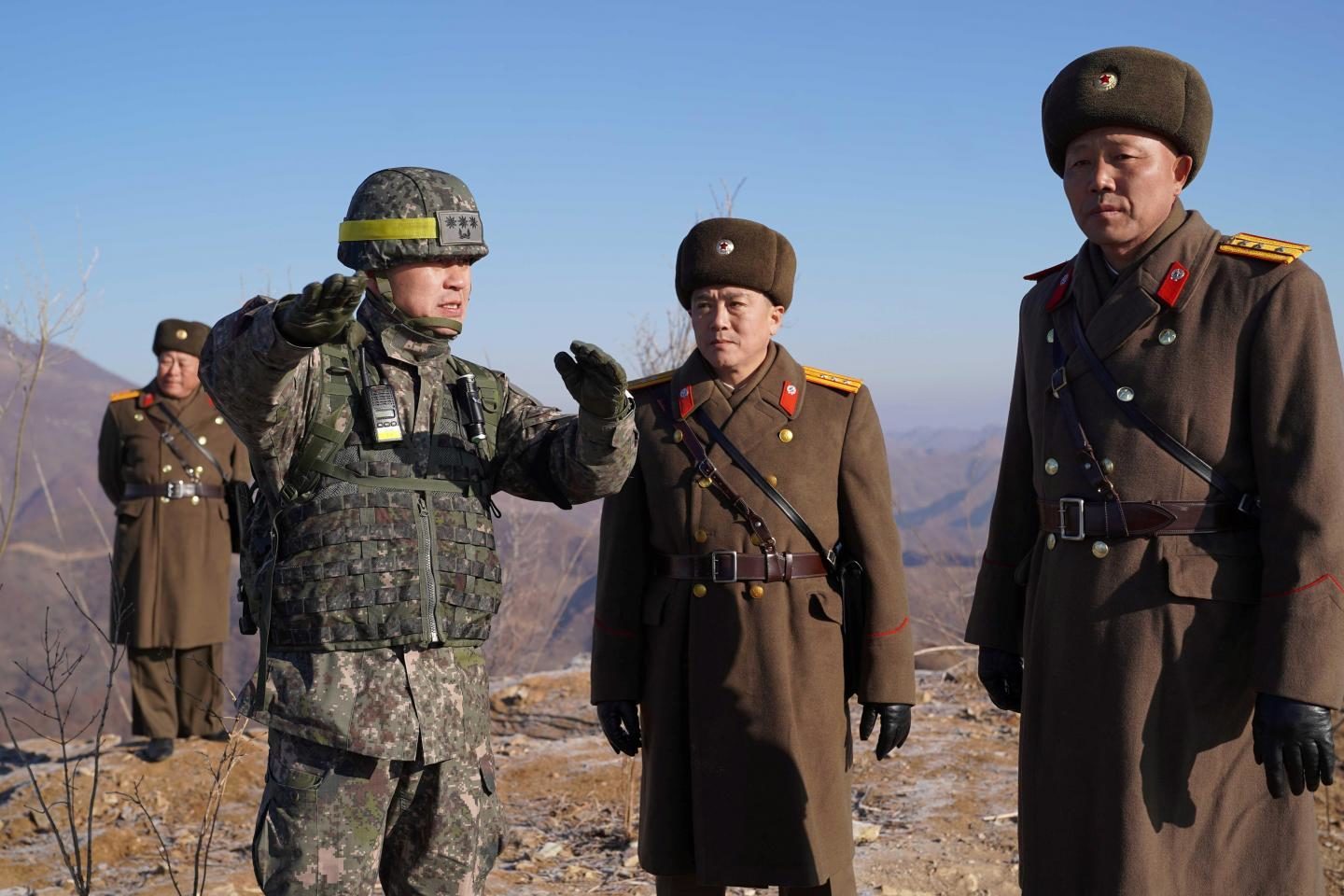
© AlamayNorth and South Korean soldiers have made several friendly meetings follow a diplomatic rapprochement between North and South Korea
Second, follow Kim's script. He set up wide-ranging official meetings, encouraged cultural, sporting, and other private exchanges, and ended the travel ban (both on Americans going to the DPRK and North Koreans coming to the United States). Offer to initiate diplomatic relations, with the proviso that all issues would be in play, negotiate a treaty formally ending the Korean War, which ended more than sixty-five years ago anyway. At the same time, challenge the North Koreans to respond with steps moving forward on denuclearization. Lock in any concessions, including some of those listed above, while looking for opportunities to encourage full denuclearization.
Third, drop the illusion that Washington can achieve denuclearization for nothing. Washington is filled with analysts, officials, and pundits who imagine that the North can be bludgeoned into disarming without any change to America's very military posture which threatens North Korea. Indeed, there is a strange consensus that it would be better for the U.S. to accept the threat of nuclear war than offer a troop withdrawal in return for denuclearization. Yet Washington's alliances and deployments are supposed to be the means, not the end. Security and peace should be the objectives. The American people might be surprised to learn that those supposedly acting on their behalf prefer to risk the incineration of American cities than give up America's attributes of an imperial power.
Finally, accept an imperfect but improved outcome. Obviously, there are good reasons not to trust the North. But then, Kim would be a fool to trust the United States. A North Korea that looks and acts almost "normal," like so many other states - brutal toward its own people, but without the saber-rattling of yore - would be a major advance for Northeast Asia. That would be more than the president's recent predecessors achieved.
Trump took a chance on North Korea. Despite the barbs from his critics, he created opportunities for bilateral and regional détente that did not previously exist. However, he must temper his expectations and moderate his goals. Simply turning the North into a responsible international stakeholder would be a major triumph.
Doug Bandow is a senior fellow at the Cato Institute, specializing in foreign policy and civil liberties. He worked as special assistant to President Ronald Reagan and editor of the political magazine Inquiry. He writes regularly for leading publications such as Fortune magazine, National Interest , the Wall Street Journal , and the Washington Times . Bandow speaks frequently at academic conferences, on college campuses, and to business groups. Bandow has been a regular commentator on ABC, CBS, NBC, CNN, Fox News Channel, and MSNBC. He holds a JD from Stanford University. A former special assistant to President Ronald Reagan, he is author of Tripwire: Korea and U.S. Foreign Policy in a Changed World and coauthor of The Korean Conundrum: America's Troubled Relations with North and South Korea .




[Link]