

© Richard Baker/In Pictures Ltd/Corbis via Getty Images
I'm British. Soon after moving to Switzerland, where I lived for six years, I threw a house-warming party and was taken aback when all 30 guests arrived exactly on time. Years later, having moved to France, I turned up at the appointed hour for a dinner, only to find that no other guest had arrived and my hostess was still in her bathrobe.
Every culture is riddled with unwritten rules, such as ones on punctuality. They are the invisible scaffold that frames the behaviour of individuals so that the collective can function in a frictionless and productive way. But the rigour of these rules and the exactitude with which they are enforced varies dramatically. Some nations tolerate singing in an elevator, swearing during an interview or entering a bank barefoot, for example, while others frown upon such behaviours. Perhaps these aren't mere quirks. Perhaps the best way to understand societies is to look at their social norms.
That is the argument being made by cultural psychologist Michele Gelfand at the University of Maryland in College Park. She and her colleagues describe societies with strict, rigorously enforced norms as "tight" and those with more laissez-faire cultures as "loose". They argue that this key difference underpins all sorts of others, from creativity and divorce rates to the synchronicity of public clocks. What's more, they believe they know why some nations are tighter than others - and how to influence social norms. If they are right, this could clear up many cross-cultural misunderstandings, not just between nations, but also within countries, corporations and households.
Ever since 1961, when Stanley Milgram started persuading people to obey his commands to give others electric shocks, experimenters have manipulated social rules and observed the pressure people feel to conform. However, researchers tended to study norms within societies - Western ones, mainly - rather than between them. One person to buck the trend was Dutch social psychologist Geert Hofstede.
Starting in the 1960s, he developed a model for understanding cross-cultural differences based on six dimensions (see "Six degrees of separation"). Since then, one of his metrics, individualism/collectivism, has attracted considerable interest and proved useful in explaining cultural differences, especially those epitomised by typically Western or Eastern modes of thought. But Gelfand believes the focus has been too narrow, and that tightness/looseness is a neglected source of cultural variation that has a huge influence on our behaviour - "a Rosetta stone for human groups", she says.
The Fear Factor
In fact, the idea of cultural tightness also dates back to the 1960s, when anthropologist Pertti Pelto studied 21 traditional societies and found big differences in the rigour of their social norms and how these were enforced. The tightest included the Hutterites, while the !Kung people of southern Africa came at the other end of the scale. Pelto's insight was to suggest that tightness was connected to ecological factors such as high population density and dependence on crops for survival.
Gelfand wondered how this might apply to modern societies. She suspected that tightness is determined by the level of external threat to which a society was exposed historically - whether ecological, such as earthquakes or scarce natural resources, or human-made, such as war. "Tightness is about the need for coordination," she says. "The idea is that if you are chronically faced with these kinds of threats, you develop strong rules in order to coordinate for survival."
To test the idea, Gelfand teamed up with colleagues from 43 institutions around the world, and compared 33 nations in a study published in Science in 2011. First they asked nearly 7000 people from diverse backgrounds to shed light on the tightness of their national culture by rating their agreement with statements such as: "There are many social norms that people are supposed to abide by in this country" and "People in this country almost always comply with social norms". The volunteers also revealed how constrained they felt in everyday situations by rating the appropriateness of 12 behaviours, including eating, crying and flirting, in 15 contexts ranging from a bank to a funeral to the movies. There was high agreement among people from different walks of life within nations.
"Understanding what makes other cultures tick is at a premium"
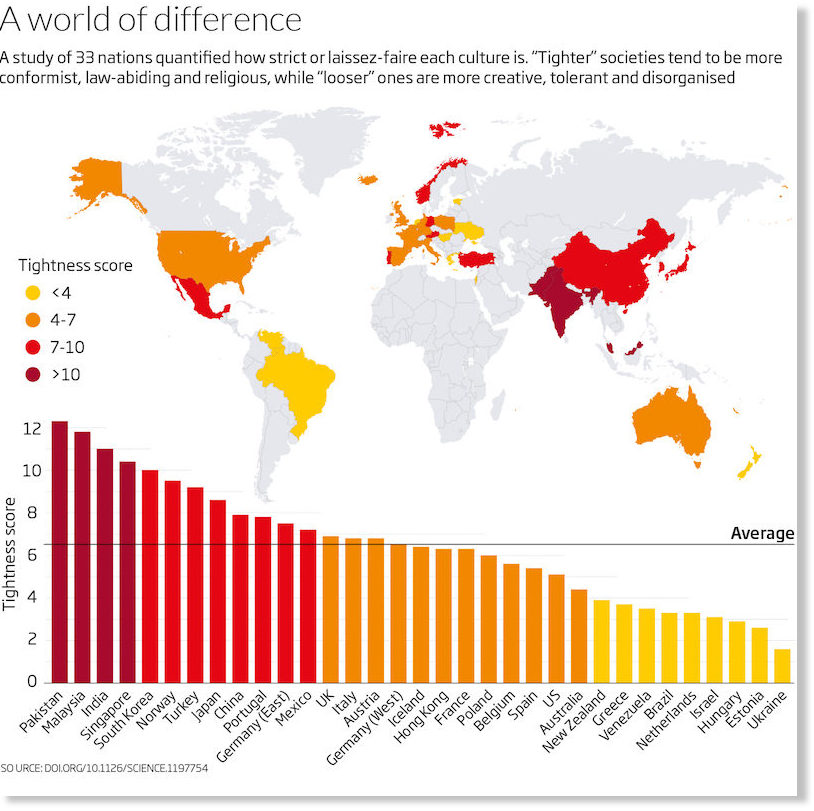
Next, the team calculated national averages for tightness (see "A world of difference") and compared these with past threats to each country, as gauged by a battery of measures including natural disasters, exposure to pathogens, territorial conflict, lack of access to clean water and high population density. Sure enough, there was a correlation. Societies that had faced a high level of threat, such as Pakistan and Malaysia, did more to regulate social behaviour and punish deviance than loose countries, which included the Netherlands, Brazil and Australia. Israel, which is also loose, was a notable exception. The UK came out slightly tighter than average, and the US looser.
But it doesn't end there. Gelfand and her colleagues found that the degree of tightness was reflected in all sorts of societal institutions and practices - even after taking national wealth into consideration. Tight societies tend to be more autocratic, with greater media censorship and fewer collective actions such as demonstrations. They are also more conformist and religious, and have more police, lower crime and divorce rates, and cleaner public spaces. "Tightness brings with it a lot of order and social control," says Gelfand. "Even stock markets are more synchronised." Loose societies tend to be more disorganised, but also more creative, innovative and tolerant of diversity.
Three years later, Gelfand and her doctoral student Jesse Harrington carried out a similar comparison across all 50 US states. This time they assessed tightness using factors including legality of same-sex marriage, percentage of foreign-born inhabitants and strength of religious institutions. Again, they found a correlation between tightness and threats such as tornado risk and exposure to hazardous waste. And again, they found that tightness corresponded with lots of other aspects of society. Tighter states, such as Kentucky and Alabama, had lower rates of drug abuse and homelessness than loose states such as Oregon and Vermont, for example. They also had higher rates of incarceration and discrimination and, interestingly, lower happiness.
© Damir Sagolj/Reuters
Not surprisingly, Gelfand's research has attracted attention. In our globalised world, understanding what makes other cultures tick is at a premium. With nations in ever-greater contact with one another, misunderstandings can have profound consequences in all sorts of areas, from trade to diplomacy to war. Furthermore, some of our most-pressing problems - notably climate change and nuclear proliferation - require different cultures to cooperate to find solutions.
Of course, dividing the world's cultures into tight and loose isn't going to bring prosperity and peace, but it does have some advantages. "For one thing, it breaks up our ideas about East Asia," says Dov Cohen at the University of Illinois at Urbana-Champaign. All East Asian countries score highly for collectivism, but some are tighter than others - South Korea and Singapore, for example, compared with China. "Tightness/looseness allows you to look at much higher resolution," he adds. We might also be more sympathetic to different social norms if we accept that the way nations function is connected to levels of threat. "[Tightness/looseness] may sound like a rather specific difference," says Gerben van Kleef at the University of Amsterdam in the Netherlands, "but I'm now convinced that it explains a lot of the variance in behaviour and perceptions across cultures."
Simon Levin at Princeton University is more circumspect. He points out that tightness is conceptually similar to cultural "stickiness", something he and others have been talking about for years. "What is new is trying to associate the degree of stickiness or tightness to driving factors in terms of threat," he says. But he also points out that the link may be more complex than it seems. For example, a norm that says you shouldn't marry outside your group could ultimately enhance threat as a result of inbreeding.
Nevertheless, Gelfand's model appeals to many, not least because it might help explain some of the sweeping social changes happening in the world today. Her computer modelling experiments with virtual agents show that upping an external threat pushes a group to enforce its norms more strictly, while lowering it does the opposite. She notes that populist leaders including Donald Trump and Marine Le Pen direct their messages at groups who feel particularly threatened by the economic situation, and who are therefore likely to favour a tightening of norms. And certain politicians may not be above exaggerating the real threat to persuade people to vote for them.
There could also be a backlash effect. Too much looseness can invite what Gelfand calls "autocratic recidivism". "We can see that the places where ISIS was able to take over are places where people felt there was no security or infrastructure," she says. Conversely, the fact that Ukraine was the highest scoring country for looseness in 2011 could be partly explained as a reaction against the tight Soviet culture it was formerly in thrall to.
The Best Way To Be
Preventing such pendulum swings may be neither feasible nor desirable. However, politicians and voters might want to heed the results of another study explicitly addressing the question of whether societies should emphasise freedom or constraint. On a range of measures, including health, wealth, happiness and political stability, moderate cultures came out best. "The most successful societies balance tightness and looseness," says Gelfand. Extremes can cause problems in any type of group. For example, she argues that a series of scandals concerning United Airlines last year - one involving a passenger being dragged off a plane - were the product of an overly tight organisational structure.
Although many would baulk at the mere suggestion of social engineering, nations can consciously change their social norms (see "Uptight in Iceland"). They can also underscore unwritten social rules through their choice of more formal ones. In New York state, for instance, the fine for a first-time littering offence is $250, whereas in Singapore it is the equivalent of $1500. No prizes for guessing which has the cleanest streets. Simple things can make a big difference, too. Gelfand has suggested that part of the solution for United Airlines could be to empower low-level personnel to resolve problems with passengers as they see fit.
In their pioneering global study on tightness, Gelfand and her colleagues concluded: "From either system's vantage point, the 'other system' could appear to be dysfunctional, unjust, and fundamentally immoral, and such divergent beliefs could become the collective fuel for cultural conflicts." If they are correct, simply understanding why societies differ in this way could be the first step towards greater global harmony. "Some of our biggest messes in US foreign policy happened because we really did not understand the cultures we were dealing with," says Cohen. "The more armed policy-makers are with cultural information, the better off we will all be."
Six Degrees of Separation
Differences between cultures can be understood in terms of six factors, according to a model developed from the 1960s, which is now being challenged (see main story).
Individualism - The degree of personal independence as opposed to mutual interdependence.
Power distance - The extent to which citizens expect and accept an unequal distribution of power.
Masculinity - The extent to which the use of force is endorsed socially.
Uncertainty avoidance - The level of anxiety and distrust in the face of the unknown.
Long-term orientation - The degree of belief that the world is in flux as opposed to seeing the past as providing a moral compass for the future.
Indulgence - The tendency to value freedom, impulsiveness and friendship rather than seeing life in terms of struggle and duty.
Uptight in Iceland
Social engineering has a terrible reputation: think China's Cultural Revolution, or the atrocities of Cambodia's Khmer Rouge. Nevertheless, it can have positive results. Take Iceland.
In the early 1990s, the country had a problem: its young people were abusing drugs and alcohol, and becoming a social menace. When the authorities consulted addiction expert Harvey Milkman at the Metropolitan State University of Denver, Colorado, he proposed a seemingly simple solution. They should give teens the high they craved in a healthier form - sports.
It sounded promising, on paper. The challenge was to get the kids to comply. A night-time curfew was imposed on 13 to 16-year-olds, and the state invested in sports, dance and arts programmes. Meanwhile, teachers, parents, journalists and politicians all took part in a concerted campaign to enforce a new social norm: excessive use of drugs and alcohol was no longer acceptable, and participation in sport and arts programmes was the expected standard.
It worked. By 1998, substance abuse was in decline, and today the campaign is regarded as an unqualified success. The curfew is still in place. "Everybody's proud of it," says Milkman. Icelanders even credit the new norm with contributing to their victory over England in the 2016 European football championship.

I think the best cultures are those that produce the most garbage.
Stuff, data, information that is passed off as valuable and important, because it makes somebody a bunch of money and moves them up the 'social success ladder' (they gain a really satisfactory reputation), but just has a rather psychotic way of piling up and piling up and piling up and taking the place of good, breathable air and potable water and the health maintaining local supply of food and shelter.
Or maybe those are the worst cultures.
I forget.
I forget because I am hungry and thirsty, shivering and I cannot breathe.
Other than that, things are great.
ned,
out