
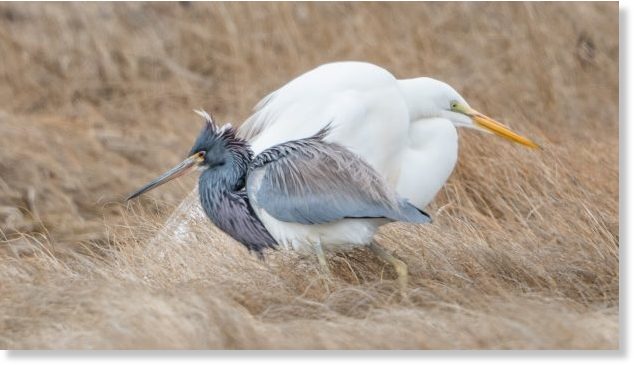
© Jason DainThe tricoloured heron, sighted this weekend in Sambro Head, N.S., is more commonly found in the southeast United States.
On Saturday, Diane LeBlanc left her home in Portuguese Cove to make her usual rounds of looking for birds. Once she was five minutes from home, she spotted an unusual bird in a marsh in Sambro Head.
"I immediately noticed this very large white bird in the middle of the marsh. Of course, my heart started racing, I got excited. I pulled the car over and saw this beautiful great egret, which is a bird that shouldn't be in Nova Scotia, so it was an exciting bird to see," she said.
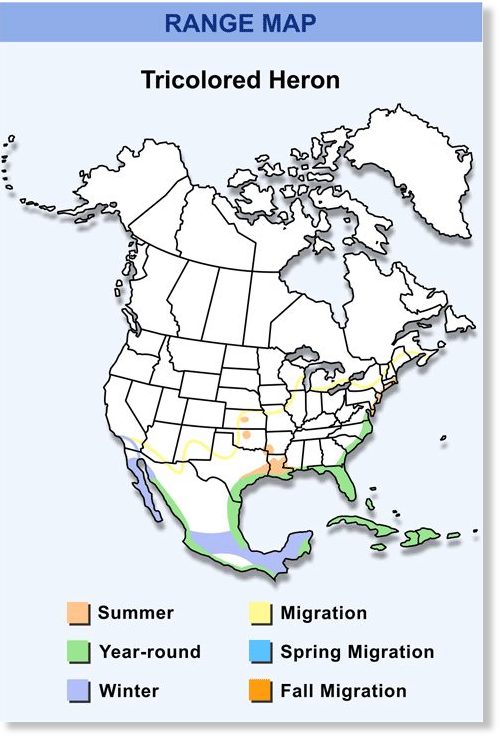
The bird is common in the southern United States, according to the National Audubon Society website .
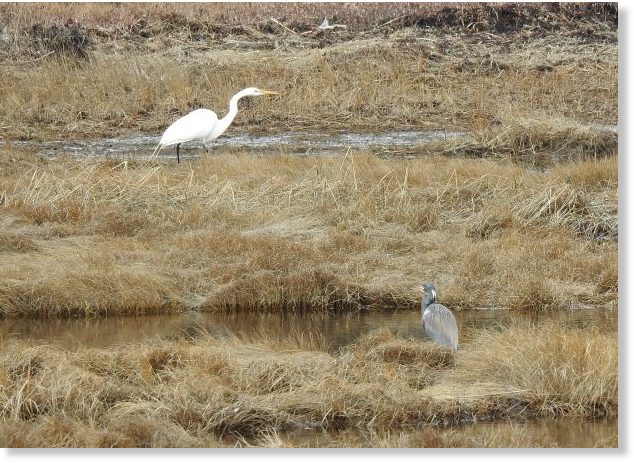
© Diane LeBlancBirders were eager to get a look at the great egret, left, and a tricoloured heron, which happened to land in the same marsh in Sambro Head, N.S., not a usual location for either bird.
Later in the day, a tricoloured heron, which the Audubon Society says is common in the southeast U.S., was discovered hanging out at the same marsh.
"They look prehistoric. They look like something not of our time. They are massive birds, quite large birds with very large bills, and to watch them is really quite amazing," said LeBlanc.
"They are great fishers, they flit and fly around those marshes and no matter where they land, they manage to find the fish and feed well."
'Your heart goes kerthump'
The rare sightings have prompted many birders to head to Sambro Head, which is about 25 kilometres south of Halifax.
On Sunday, Miles Thompson and his wife headed there from Enfield, which is about 65 kilometres away, to see the birds. He said there were about 15 birders on site when they got there.
"Your heart goes kerthump, right, you just get turned on by seeing a bird that you don't ever see here," he said.
The couple didn't take photos because their camera is broken, but the sight will remain in his head forever, Thompson said.
LeBlanc said she thinks frequent storms this March, coupled with southerly winds, are what caused the birds to end up here.
"Because of the weather, probably the global changes, but also these little storms that happen, they have a big impact on birds," she said.


Reader Comments
to our Newsletter