

© Brendan Smialowski/AFP/Getty ImagesAttendees at the annual session of the National Baptist Convention in 2016.
For Black History Month, here are five facts about the religious lives of African Americans.
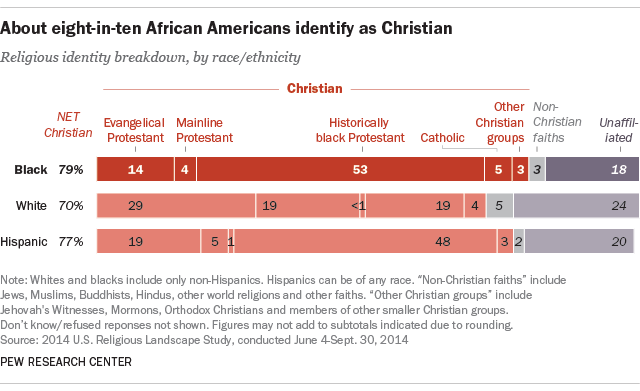
1. Roughly eight-in-ten (79%) African Americans self-identify as Christian, as do seven-in-ten whites and 77% of Latinos, according to Pew Research Center's 2014 Religious Landscape Study. Most black Christians and about half of all African Americans (53%) are associated with historically black Protestant churches, according to the study. Smaller shares of African Americans identify with evangelical Protestantism (14%), Catholicism (5%), mainline Protestantism (4%) and Islam (2%).
© Pew Research Center
© Pew Research Center
4. The share of African Americans who identify as religiously unaffiliated has increased in recent years, mirroring national trends. In 2007, when the first Religious Landscape Study was conducted, only 12% of black Americans said they were religiously unaffiliated - that is, atheist, agnostic or "nothing in particular." By the time the 2014 Landscape Study was conducted, that number had grown to 18%. As with the general population, younger African American adults are more likely than older African Americans to be unaffiliated. Three-in-ten (29%) African Americans between the ages of 18 and 29 say they are unaffiliated compared with only 7% of black adults 65 and older who say this.
5. Older African Americans are more likely than younger black adults to be associated with historically black Protestant churches. While 63% of the Silent Generation (born between 1928 and 1945) say they identify with historically black denominations, only 41% of black Millennials say the same. (When the survey was conducted in 2014, Millennials included those born between 1981 and 1996.)
David Masci is a senior writer/editor focusing on religion at Pew Research Center.


For my perspective, I went with my family and father from Cal. then Florida and back to his roots in South Carolina where he was born into poverty as a child of white sharecroppers. (Grandma moved the brood to San Francisco in the 1930's for greater opportunities for her five kids. She became another Rosie Riveter, especially as she was 4'11" and could get out into airplane wings and rivet their tips together.)
In the mid 1960s,we moved to the Florida with the space program, but in 1966, visited 'kin' in S.C. It was still the Jim Crow South, there, and I well remember asking my father why the water fountains - 1/3 of which were marked 'colored' - were all the same color.
I have huge respect for what black culture did in my lifetime. If you drive to a white lower middle class area in central Florida and a black middle class area, (i.e., with similar median incomes) the black middle class is more well kept up. (Like my dad, they know the value of a buck, and how to stretch it, and are not 'above' doing manual labor - which lazy white folk have 'learned' from its pathetic ability to attempt to copy the habits of the rich while not appreciating at all what they have.)
(Talking generalities, of course.)
R.C.