© Screenshot/MSNBC
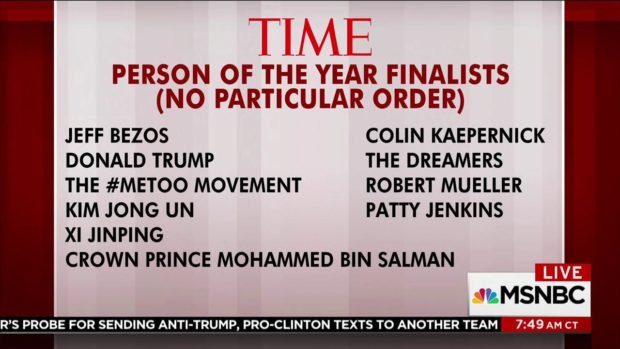
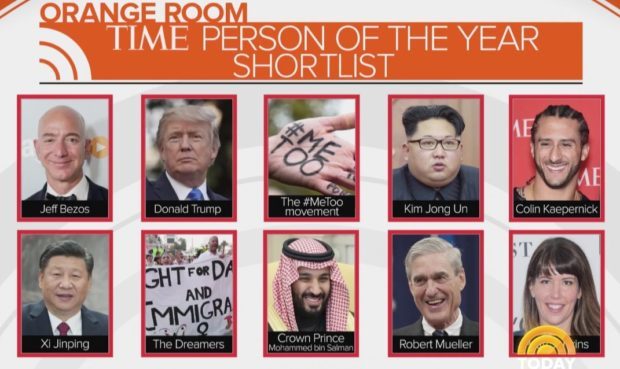
has released its finalists for person of the year in 2017 Monday morning. It seems the easiest way to make the list is to be apart of the "Resistance."
President Trump was one of the ten finalists on the list. However,
the vast majority of the finalists for person of the year have something very interesting common: they are combative opponents to POTUS. At least six of the finalists on the list have gone on the record against the president for a diverse range of issues.
Here is a truncated version:
Colin Kaepernick: Facing off with Trump over kneeling for the national anthem.
Dreamers: Political lightning rod in the immigration debate.
Robert Muller: Investigating Trump for collusion with Russia.
Jeff Bezos: Owns
The Washington Post, regular media target of Trump.
Kim Jong Un: Wants to kill all Americans.
Xi Jinping: President of China, regular Trump campaign punching bag.
Patty Jenkins: Not very political, but a Hillary Clinton
fan.
© NBC/Screenshot
The magazine has faced recent criticism from president Trump over its selection process. Earlier in November president Trump tweeted about being contacted by
TIME for the issue, adding that he turned it down:
TIME responded, saying Trump was incorrect:
It seems everything is political.
Comment: The winner(s):
the women of #MeToo. Which just demonstrates how pervasive social hysteria can be. That's not to say there's nothing to the issue, however. Some of the accusations are pretty serious. For example, the
TIME piece on the winners describes
Selma Blair's story:
Other women, like the actor Selma Blair, weathered excruciating threats. Blair says she arrived at a hotel restaurant for a meeting with the independent film director James Toback in 1999 only to be told that he would like to see her in his room. There, she says, Toback told her that she had to learn to be more vulnerable in her craft and asked her to strip down. She took her top off. She says he then propositioned her for sex, and when she refused, he blocked the door and forced her to watch him masturbate against her leg. Afterward, she recalls him telling her that if she said anything, he would stab her eyes out with a Bic pen and throw her in the Hudson River.
Blair says Toback lorded the encounter over her for decades. "I had heard from others that he was slandering me, saying these sexual things about me, and it just made me even more afraid of him," Blair says in an interview with TIME. "I genuinely thought for almost 20 years, He's going to kill me." (Toback has denied the allegations, saying he never met his accusers or doesn't remember them.)
But there are problems with the whole movement too. How many of the accusations are false or misleading? What are the consequences of lumping all of the accused together, when guilt has not been established? And is it really helpful to include serious allegations side by side others that amount to littler more than potentially inappropriate behavior or language (like "
talking about sex" in front of someone)?
While #MeToo was
TIME's choice, their readers
picked Mohammed bin Salman, who scored 24% of the vote. (#MeToo came in second, with 6%.)

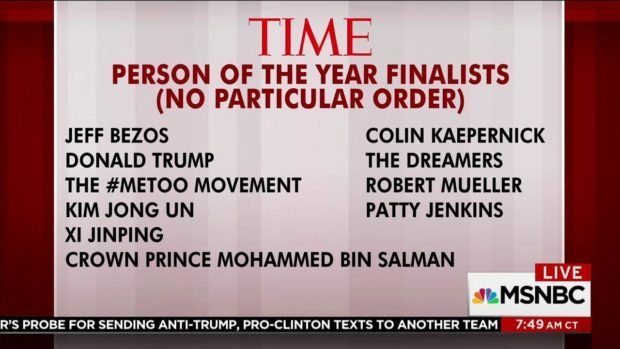
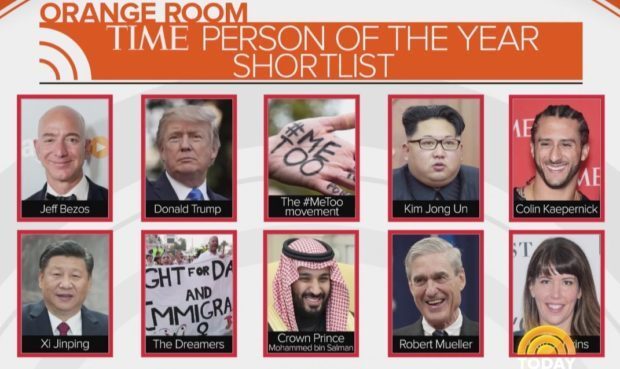



Comment: The winner(s): the women of #MeToo. Which just demonstrates how pervasive social hysteria can be. That's not to say there's nothing to the issue, however. Some of the accusations are pretty serious. For example, the TIME piece on the winners describes Selma Blair's story: But there are problems with the whole movement too. How many of the accusations are false or misleading? What are the consequences of lumping all of the accused together, when guilt has not been established? And is it really helpful to include serious allegations side by side others that amount to littler more than potentially inappropriate behavior or language (like "talking about sex" in front of someone)?
While #MeToo was TIME's choice, their readers picked Mohammed bin Salman, who scored 24% of the vote. (#MeToo came in second, with 6%.)