Back in 2008, one of the biggest arguments in favor of Obamacare was that the legislation would help alleviate bad debt at hospitals created by people who required emergency care but didn't have health insurance or the financial means to cover their treatment. Of course, like most promises made about Obamacare, the exact opposite of the Left's original theories has played out in reality as
restructuring lawyers are now warning that the healthcare industry is about to experience a massive wave of hospital bankruptcies. Per
Bloomberg:
A wave of hospitals and other medical companies are likely to restructure their debt or file for bankruptcy in the coming year, following the recent spate of failing retailers and energy drillers, according to restructuring professionals. Regulatory changes, technological advances and the rise of urgent-care centers have created a "perfect storm" for health-care companies, said David Neier, a partner in the New York office of law firm Winston & Strawn LLC.
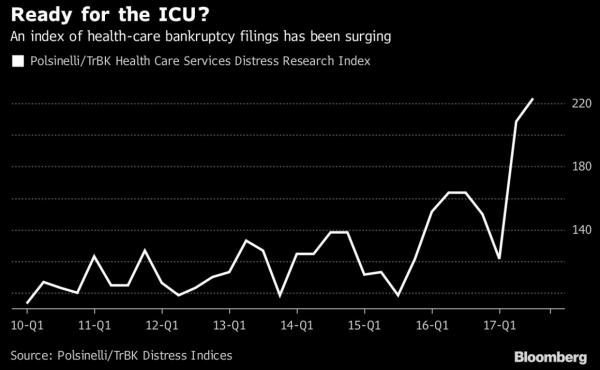
Some signs are already there: Health-care bankruptcy filings have more than tripled this year according to data compiled by Bloomberg, and an index of Chapter 11 filings by companies with more than $1 million of assets has reached record highs in four of the last six quarters, according to law firm Polsinelli PC. Junk bonds from companies in the industry have dropped 1.4 percent this month, a steeper decline than the broader high-yield market, according to Bloomberg Barclays index data.
Since 1997, health-care cases have made up only 5.25 percent of all U.S. bankruptcy filings, according to Bloomberg data. Year to date, they already comprise 7.25 percent of all filings. Emergency-room operator Adeptus Health, cancer-care provider 21st Century Oncology, and cancer treatment specialist California Proton Treatment are the largest filings. Those statistics exclude pharmaceutical company Concordia, which is restructuring in Canada, and Preferred Care Inc., one of the U.S.'s largest nursing home groups, operating 108 assisted living facilities.
So what has caused the sudden onset of hospital failures? Well, because Obamacare's architects were so certain their legislation would completely eliminate uninsured citizens in the U.S., they decided to offset the costs of the "Affordable Care Act" by eliminating subsidy payments to hospitals that had previously been used to cover losses from treating uninsured patients...
Hospitals, including private rural ones, may be among the hardest hit, Winston & Strawn's Neier said. The Affordable Care Act, known as Obamacare, reduced payments to hospitals that serve a large number of poor and uninsured patients, known as "disproportionate share hospitals," on the theory that more patients would be insured under the law. Congress delayed those cuts several times, but didn't do so for the current fiscal year, which may "single-handedly throw hospitals into immediate financial distress -- many operate on less than one day's cash," he said in an interview.
"Smaller hospitals have already been struggling for years," said Kristin Going, a partner in the New York office of Drinker, Biddle & Reath LLP. Both lawyers declined to discuss specific companies. Since 2010, a growing number of patients have enrolled in high-deductible health plans that force them to shoulder more of costs when they get treatment, according to the U.S. Centers for Disease Control and Prevention. That has translated into more bad debt from customers for hospitals and other providers.
Some publicly traded hospital companies that were already under pressure from high debt loads have been further buffeted by this year's hurricanes. Community Health Systems Inc., with $1.9 billion in debt maturing in 2019, has suffered doctor revolts over crumbling, cash-strapped facilities, as well as losses linked to the storms in Texas and Florida earlier this year. A representative for Community Health didn't return a call seeking comment.
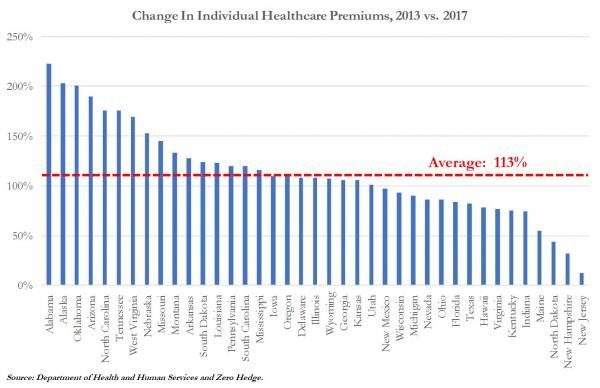
...of course, here in reality, things didn't quite play out so perfectly as surging Obamacare premiums have pushed more and more people into high deductible plans or have forced them to forego insurance altogether and opt instead to simply pay the tax penalties levied by the legislation. Shocking that folks could simply absorb a doubling of their healthcare premiums in 4 years.
Just more proof that Obamacare is working perfectly and should be left just as it is...




Reader Comments
If you don't know how to take care of yourself outside of going to a hospital (go if you have a gunshot wound or broken leg), please learn now.
I'm still puzzling over what it means - the small hospitals I knew were certainly not free from corruption or greed or small time psychopathy by a few within - nor were they particularly efficient, financially speaking.
The big corporate take over may be disguised as "saving" the smaller hospital by taking a 51% interest in it, pouring in money to save it, and promising with fingers crossed not take control of the hospital away from the local community. Soon enough, though it becomes very clear to everyone where the control now lies as changes take over the hospital - either slowly or quickly becoming a mini-me of the larger corporate structure.
Almost surprisingly the big corporate approach starts to really bring in money, something the independent hospital was unable or unwilling to do. There's typically quite on toll on employees and patients of course.
End result seems to be trading petty tyrants of the small hospital for bigger tyrants of the corporate structure. And increased funneling of money from the population to fewer and fewer have-it-alls. And control being concentrated in fewer hands at very high levels.
Only it wasn't Obamacare that did this - it was happening years before Obamacare - although Obamacare may have accelerated the progress - and may have been part of the purpose for it. Bringing affordable healthcare for the population was never, ever any part of it.