
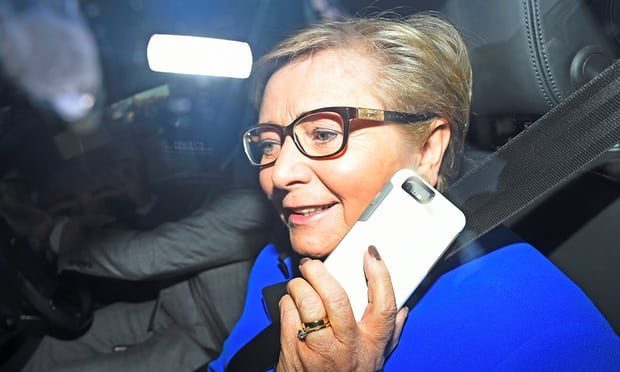
© Clodagh Kilcoyne/ReutersFrances Fitzgerald told the Irish cabinet she would leave office to avert a snap Christmas election.
Ireland's prime minister, Leo Varadkar, will go into next month's crucial European summit on Brexit without the fear of a general election at home after one of his key allies resigned from the cabinet hours before a parliamentary vote that would have led to the collapse of the government in Dublin.
Varadkar's deputy, Frances Fitzgerald, offered her resignation at lunchtime on Tuesday, thus averting a vote of no confidence that could have brought down the minority Fine Gael-led coalition.
Fitzgerald's decision to stand down brought Ireland back from the brink of a pre-Christmas election and gives Varadkar a freer hand to enter critical negotiations on Brexit, the Irish border and the future relationship between the EU and the UK at the summit in December.
She has been under intense pressure over her handling of information about the treatment of a police whistleblower who made allegations of corruption and malpractice in the Garda Síochána.
The political crisis over what Fitzgerald knew about the Garda high command's strategy to allegedly smear the whistleblower deepened on Monday night when three emails from the Irish government's Department of Justice were made public.
The communications appeared to show that Fitzgerald had been aware of the campaign against Sgt Maurice McCabe although she has always insisted she supported the whistleblower.
In two of the emails, from 2015, when she was justice minister, Fitzgerald was warned about "aggressive tactics" being deployed against Sgt McCabe by the Garda leadership.
Fitzgerald had previously told the Dáil she was unaware of any smear strategy being used against the Garda officer.
The country's main opposition party, Fianna Fáil, whose confidence and supply arrangement keeps the minority Fine Gael-led coalition in power, threatened to table a motion of no confidence in the government at 8pm on Tuesday. If this had passed, as was likely, it would have triggered the collapse of the government.
However, the deputy prime minister, or Tánaiste, prevented this by offering to resign - an offer the Fianna Fáil leader, Michael Martin, accepted.
In a reference to the EU Brexit summit in a few weeks' time, Fitzgerald explained that she had decided to resign "to avoid an unwelcome and potentially destabilising general election at this historically critical time".
She thanked the Taoiseach for defending her over the past few days from opposition attacks and hoped that a public inquiry being held into the way the Garda management had treated Sgt McCabe would "vindicate my good name".
The 67-year-old veteran Fine Gael politician insisted she had always defended whistleblowers in the state.
She said Varadkar had not asked her personally to resign. Later, during a parliamentary question-and-answer session in the Dáil, Varadkar said it was with regret that he had accepted Fitzgerald's resignation. He said she was a good woman who had left office "without getting a fair hearing" and that she was "one of the most reforming ministers we have ever had".
While Varadkar can now attend the European summit in Brussels on 14 December without the worry of a snap election, the Fitzgerald affair will have longer-lasting implications for his premiership.
Although some Fine Gael TDs had been calling for Fitzgerald's head, many other backbenchers are unhappy at the way Varadkar has handled this crisis.
Fine Gael has been ruthless in the recent past with leaders who have enjoyed honeymoon periods of popularity but later lost public support. In 2011, Enda Kenny led Fine Gael back to power with its highest number of seats, but five years later failed to get close to an overall majority.
In the aftermath of the 2016 election, Fine Gael had to seek a deal with old rivals Fianna Fáil to remain in power. The party then replaced Kenny with Varadkar.
Fianna Fáil sources told the Guardian that Brexit negotiations in December would determine whether the party continued with the confidence and supply arrangement that keeps Varadkar and his government in power.
"If the negotiations, as we expect, continue long beyond December with further Brexit-related summits in February or March, then Fianna Fáil will hold off to allow for a stable Irish approach to the discussions in Europe.
"But I can't see the confidence and supply arrangement going beyond the summer of 2018, trust has been damaged by the Fitzgerald affair, more revelations about other ministers might emerge in this tribunal into the treatment of Sgt McCabe and I think by late spring, early summer there will be an election," a senior Fianna Fáil source said on Tuesday.
The confidence and supply deal that props up Varadkar and the Fine Gael/Independent Alliance is similar to the one the Democratic Unionist party operates to keep Theresa May in Downing Street.
But given the potential for turbulence in southern Irish politics, it is more likely that the controversial DUP deal to keep the minority Tory government in office will survive beyond the one in Dublin.
Fianna Fáil sources told the Guardian that once Fitzgerald had gone, it would not proceed with the vote of no confidence.
Timeline
Ireland's police scandals
An Garda Síochána, Ireland's national police service, has faced a series of scandals in recent years that have led to the resignations of two Garda commissioners, played a key part in former prime minister Enda Kenny stepping down, and now threaten to bring down the Irish government.
November 2012 - Police whistleblowers allege misconduct
Then justice minister Alan Shatter receives an interim Garda report on allegations that drivers' penalty points were being cleared, with no reasons given. Two officers described as whistleblowers - former Garda John Wilson and Sgt Maurice McCabe - had raised the issue, alleging misconduct and corruption within the force.
September 2013 - Report supports some allegations
A report from the Comptroller & Auditor General supports some of the whistleblowers' allegations, finding "operational weaknesses" in the fines system, and saying the Garda had lost significant revenue from irregularities.
25 March 2014 - Garda commissioner resigns
Martin Callinan, then Garda commissioner, announces his retirement amid calls for his resignation, after he said he found the whistleblowers' allegations "quite disgusting".
7 May 2014 - Justice minister resigns
Alan Shatter, who had also criticised the whistleblowers, steps down after receiving a critical report into how his department handled McCabe's allegations. The government launches an inquiry into the scandal, led by the former high court judge, Kevin O'Higgins.
10 May 2016 - O'Higgins report released
The 362-page report identifies serious flaws and failures but finds no evidence of Garda criminality or corruption. It upholds many of McCabe's complaints, but also says some of his claims were overstated. The report also finds Shatter "did his work well".
October 2016 - Another whistleblower emerges
Supt David Taylor, former head of the Garda press office, says he was directed by senior officers including Callinan and his replacement Nóirín O'Sullivan to discredit McCabe. Commissioner O'Sullivan denies any involvement in the alleged smear campaign.
24 February 2017 - The Disclosures Tribunal
The first public investigation into the alleged smear campaign against McCabe begins, chaired by Supreme Court judge Peter Charleton. It is ongoing.
23 March 2017 - More allegations of police misconduct
Senior Garda officers reveal that almost one million drink-driving tests recorded by the police did not take place, and a separate error caused almost 15,000 wrongful traffic convictions. The Gardaí apologise, but the mistake could cost Irish taxpayers millions.
18 May 2017 - Prime minister resigns
Enda Kenny resigns after party pressure over his failure to secure a majority government in the general election in 2016 and his handling of the crises in the Irish police.
10 September 2017 - Second police commissioner steps down
Nóirín O'Sullivan announces her retirement, saying she had faced an "unending cycle" of investigations into the Garda Síochána. New Irish prime minister, Leo Varadkar, says her decision ensures the police can now focus on reforms.
24 November 2017 - Fianna Fáil threatens snap election
The party propping up Ireland's minority coalition government submits a no confidence motion against deputy prime minister, Frances Fitzgerald, over her handling of the police whistleblower scandal. It threatens to pulls its support for the government, unless she resigns.


As is happening everywhere across the West these days, 'unresolved' or 'artificial' historical fault-lines are surfacing and forcing hitherto nominally 'democratic' regimes to confront the fact that they are - in substance - 'Athenian' democracies of liberal-metropolitan elites supporting a degenerate 'Western World Order', not regimes that actually reflect the will of (most) people in the nations they rule over.
Fault lines, where the will of the people are ignored, look at at Brexit, at Catalan, dissent concerning Macrons election in France and his policies since he assumed office. What about May in the UK, Merkel in Germany, the EU is a conflict zone.
There is a whole slew of people out there that see another vision, another way to deal with political problems.
Does it not seem strange to most people, that a President, a country called Russia, that is demonized in the west well...when it comes to conflict and some ideas or advice on conflict resolution there are a whole bunch of high profile leaders and ministers that seem to migrate toward to Russia and shake the hand of Putin!
I find that strange, where is the US when it comes to real diplomacy, as usual stirring up trouble, the US does not understand the word diplomacy, they have never advanced since the days of cowboys and Indians.
Just my thoughts.