
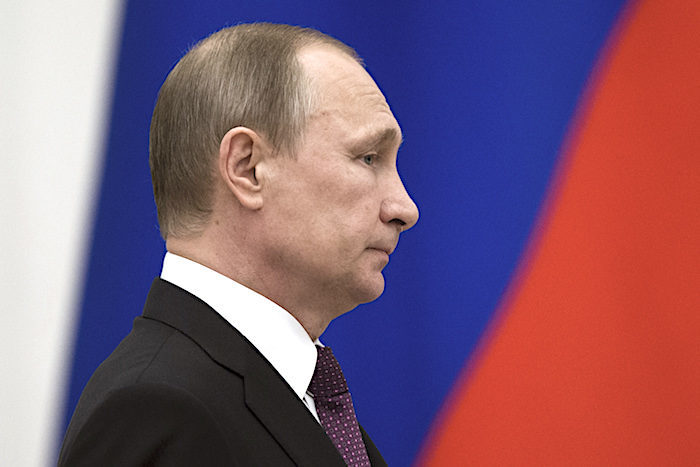
© NewsweekDecisions
It's the question President Vladimir Putin is obliged to ask about Russia's options facing a US regime in which, as the Kremlin now acknowledges, a military junta has installed itself behind President Donald Trump. "We have seen this all before", Putin declared yesterday.
The president went on to say that he himself is in two minds on what is to be done, and rues having to make the decision. On the one hand, according to Putin, the US junta is preparing new operations for the purpose of escalating the war in Syria, as well as the war against Russia. "We have information from a variety of sources that such provocations (I cannot find another word for this) are being prepared in other parts of Syria, including in southern suburbs of Damascus, where they are planning to plant certain substances and accuse Syrian authorities of using them."
On the other hand, Putin also said, "we are ready to put up with that for a while in the hope that it will eventually lead us to some positive trend based on interaction. For consumption within America, there are reasons for this. Simply put, political opponents of the incumbent president are still out there, and if anything happens, it will be blamed on him. I have no doubt about that."
If Putin has no doubt, then why the reluctance to decide what is to be done and the hesitancy to say so? Following the US attack on Syria, the Russian Defence and Foreign Ministries swiftly announced the results of their investigations, and also new policy measures, including the warning that US military deployments in Syria are now Russian targets.
Putin is saying less. "Things like this should be thoroughly investigated. We plan to officially address the appropriate UN institution in The Hague and call on the international community to thoroughly investigate these matters. A weighted decision can then be taken depending on the findings of the investigation.
Although they aren't saying so publicly, the Russian Defence Ministry, the Foreign Ministry, the intelligence agencies and the security services know perfectly well from the case of the downing of Malaysian Airlines Flight MH-17 in Ukraine in 2014 that such an option leads to show trials for Russian culpability at the United Nations and in the international courts of Europe. Their advice to Putin is to stop proposing a ruse or an impossibility. Speaking of "political opponents of the incumbent president" and "international investigations" Putin is opening a door to indecision, retreat, and destruction, so the president has been advised.
To the president this sounds like bad news. Sources who know believe Putin "doesn't like bad news. He likes it even less when bad news is presented as pressure on him to decide something. So he has cut himself off from the news, and he's isolated himself from those he once trusted to talk to. Putin has now less of a team he listens to than Stalin had in 1941. Also, Putin doesn't decide anything."
The sources of this assessment add that Putin lacks Stalin's option of understanding Hitler's intentions and provocations while pretending war could be avoided and delaying as long as possible the day of reckoning. "Stalin didn't hope that Germany would not attack Russia," says one of the sources making the comparison. "Stalin believed that was certain. Putin says he hopes the US can be brought round. He's anything but certain."
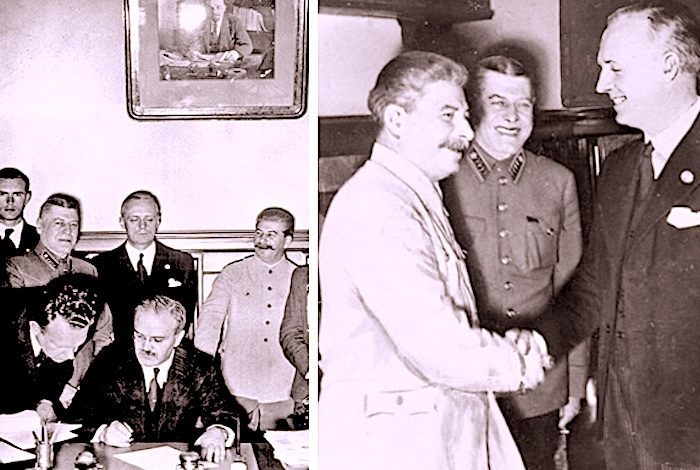
© alamy.comLeft: Foreign Minister Vyacheslav Molotov signs, while standing directly behind him is German Foreign Minister Joachim von Ribbentrop, with Stalin to the right. Pictured right: Stalin and von Ribbentrop, with Chief of the General Staff Boris Shaposhnikov in between. Whether Putin will decide to shake the hand of Rex Tillerson, the US Secretary of State visiting Moscow today, and to smile as he does so, remains unknown as this goes to print. The current Chief of the Russian General Staff, Valery Gerasimov, will not be included in the group photographs.
So the grand strategy question again: how to rule Russia facing the US junta's war on multiple fronts? Grand strategy answer - revive the State Defense Committee (GKO), put Russia on a war footing, and as Stalin did in 1941, redistribute the power Putin has so far kept to himself. Military rule, Russian style.
To understand how Stalin's team worked before, during and after the world war, read this [On Stalin's Team: The years of living dangerously in Soviet politics by Sheila Fitzpatrick]. The evidence of Stalin's collective decision-making was gathered from newly released evidence, such as Stalin's personal correspondence and his office meeting logs. One of the measures of collective decision-making at the top, in Stalin's time as in Putin's, is the use of the Russian addresses - the formal vy (Вы) and the informal ty (ты). A core group of five officials around Stalin exchanged ty with him. They were also the men who appear most frequently in the office diaries and the dacha records. After the war they became seven; by Stalin's death, six.
Nowadays there is the official Kremlin meeting log and the secret one. Subtract the time required for the events reported on the president's website from the eight to ten hours of the president's working day, and evidently at least half Putin's meeting time is concealed.
As for the question, with what officials or friends does Putin exchange ty rather than vy, the number and the names have almost never been reported in print. According to this two-year old publication, the ty count may be fewer for Putin than for Stalin. How many of Putin's ty intimates are his friends in business - the cronies, according to the US Treasury's Office of Foreign Assets Control (OFAC) - isn't known. The one economic policymaker believed by Russian sources to use ty is Alexei Kudrin. Vladimir Yakunin, head of Russian Railways, exchanged ty with Putin until he was fired eighteen months ago. Igor Sechin, the powerful Kremlin advisor on natural resources and now chief executive of Rosneft, is reported to use vy with Putin; Alexei Miller, head of Gazprom, is reported to use ty. Kremlin spokesman, Dmitry Peskov, is reported to be "too afraid of Putin to use anything but vy".
On the morning of April 7, after the US attack on Syria the evening before, the Kremlin press service issued a statement at 0900. The Foreign Ministry followed with its statement at 10:27. The only official meeting Putin had that day, according to the Kremlin website, followed after midday when Putin met with the members of the Security Council. In the routine record-keeping of Security Council meetings, several photographs are usually posted showing officials seated by descending rank on each side of the table, with Putin at the head (pictured below, left) . Last Friday, however, only Putin appears in the photo record (right).
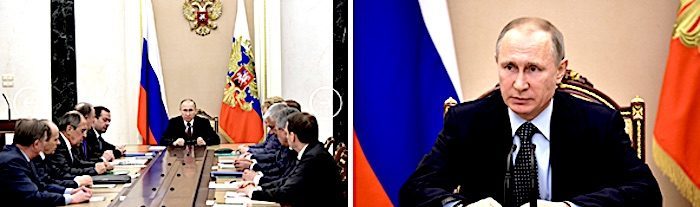
© LinkedinLeft: Security Council meeting on March 31 -- 10 attendees.
Right: Security Council meeting on April 7 – 9 attendees. Foreign Minister Sergei Lavrov, absent from the second Moscow meeting, was in Tashkent for a session of CIS foreign ministers.
Right: Security Council meeting on April 7 – 9 attendees. Foreign Minister Sergei Lavrov, absent from the second Moscow meeting, was in Tashkent for a session of CIS foreign ministers.
While US military threats are now intensifying the internal pressure on Putin to adopt more of the Stalin posture - that's the collective approach of the war period - and overcome his bouts of isolation and indecision, what would the domestic Russian reaction be if Putin moved in Stalin's direction, and the Security Council became a war-fighting GKO?
The answer, according to this nationwide poll by the Levada Centre last July, is more positive than negative - and much more positive than the US and its allies in Europe and Asia are calculating.


Lots of roaring Rs in this short article and comment.
Rue
Ruse
Rule
Reaction
Revive
Russia
(US) Regime
(Ir)rational
Redistribute
Remain
Rosneft
Railway
Right
Report
Response
Routine
My respects to the author.