
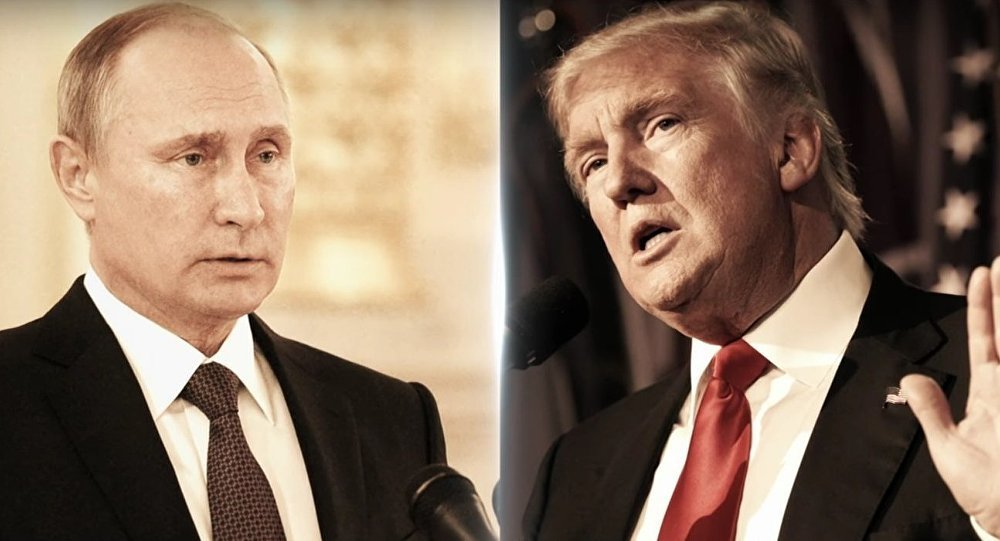
Everything that is mind-boggling and distressing about Trump for liberal Americans is even more so for democratic Europeans, and that's because of the angst attached to geopolitics. With Trump about to settle in the White House and Putin gloating in the Kremlin, two illiberals who like zero-sum games, Europe finds itself dramatically caught between a rock and a hard place.
The rock is Trump's propensity to disparage alliances and show sympathy for illiberal European politicians. The hard place is Putin's expectation that more, not fewer, opportunities lie ahead to further his foreign policy goals - not least a rewriting of Europe's architecture, to Russia's benefit. Noises in central Europe that Trump will be keenly interested in the region because his wife was born in Slovenia smack of either irony or despair.
Comment: For the spineless tools in European government, yes, we imagine it does feel like a rock and a hard place. For anyone with a brain, however, it's more like a breath of fresh air.
For Europe, two dangers arise. The first is that the principles on which the transatlantic link was founded in the 1949 North Atlantic Treaty, including the pledge to uphold "democracy, individual liberty and the rule of law", might head for the dustbin. The second is that Europe may witness a return to spheres of influence, something that has historically plagued it, and essentially amounts to saying this: might makes right, and the strong do what they can while the weak suffer what they must. Not much seems to separate Trump from Putin on that account.
Comment: What BS. NATO was set up to counter the Soviet beast (paradoxically using Nazis in the process). That beast is dead. Russia is a normal country. NATO is useless.
If this is the new normal, expect an unseemly European scramble, with governments rushing to try to secure their own interests whatever the cost to neighbours and the continent's future. Putin will be waiting with open arms for those who, whether out of admiration or fear, might want to compensate American strategic withdrawal by seeking lofty arrangements with the great eastern neighbour. Peeling Europe away from the US is an objective Putin has long made clear. A strong, coordinated Europe is in Putin's interest only if it is ideologically favourable to him - with cultural nativists such as Marine Le Pen, Geert Wilders and Viktor Orbán calling the shots. If liberal democracy can resist, however, especially in France and Germany, then he will continue working to achieve a weak and fractured Europe.
Comment: Putin is SO evil! Well, no. Because those new relationships would actually be of benefit to said countries, to Russia, and to the region as a whole. A strong, coordinated Europe is only in Russia's interests (not just Putin) if it is not run by idiots, plain and simple. Today, it is run be idiots. It's not that hard to understand.
Here lies the immediate challenge. Senior figures, including heads of intelligence, in Berlin have been publicly sounding the alarm about a Russian strategy devised to disrupt forthcoming German elections through disinformation and hacking campaigns. Officials in Paris have been much less vocal but are similarly anxious. It is significant that Germany's democratic parties have been consulting on how to react in case of a massive email hack. The intent seems to be a pledge to refrain from exploiting their content in the campaign. But with a US president ready to condemn any criticism or exposure of Russia's cyber activities, do European politicians not risk finding themselves out on a limb?
Comment: These people are insane. They might as well be afraid of Russian giants and Chinese dragons. That would be about as believable.
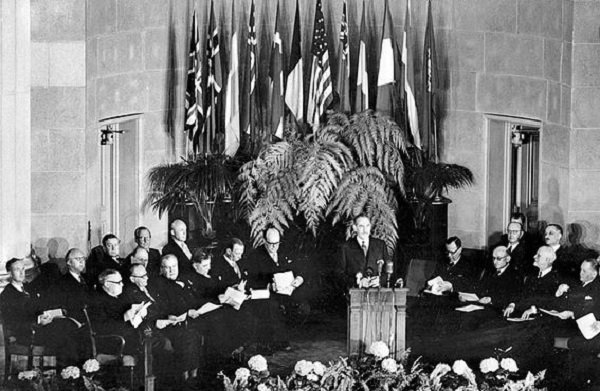
© EPA The official signing ceremony in Washington that created the North Atlantic Treaty Organisation in April 1949.
Nor would making "deals" with Putin, as Trump has promised, be in itself a crime or a fallacy. After all, Obama made deals with Russia on nuclear issues and on Afghanistan. The question that haunts Europe is whether Trump's definition of a deal entails alignment with whatever conditions Putin may set forward. So far the mood within major European governments seems to be to try for damage limitation.
In Berlin the hope is that Trump can gradually be convinced to uphold a legacy of 70 years of US engagement in Europe. Germany, however much it may be embraced as "the last leader of the west", can hardly go it alone. In Paris, anti-terrorism cooperation is likely to be put forward. Britain wants to salvage whatever it can from the "special relationship" as it heads for its EU exit. Pressure from traditional Republicans in Congress is undoubtedly counted on. But European officials are still left despondent. "We're waiting, let's see" is the general comment.
It's expected that the first key test will play out in the Donbass. If Trump backtracks on sanctions against Russia over Ukraine, will the EU be able to maintain a common front? German officials privately hint this may create a transatlantic rift that they wouldn't shy away from if Europe's collective interests are deemed at stake. "We may need to go there" says one, quickly adding a lot will depend on the French presidential vote.
Comment: Why would they even want to maintain a common front on Ukraine? Does Europe like supporting Nazis and corrupt oligarchs?! Is that really in its interests?
There are a few bright spots in this otherwise bleak picture. If anything has contributed to strengthening European cohesion on Putin, it's the indignation produced by Russia's mass bombing raids on civilians in Aleppo. There is also continuing talk of boosting European defence resources.
Comment: More BS. Jesus, the Guardian sure has become a cesspool of lies and idiocy.
But no one knows quite what to make of Trump's maverick style or, for that matter, his strategy. There is real bitterness in the air. Obama had confidently promised one high-level EU official last year: "Don't worry, I won't let this guy get near the White House." Some say the only advantage to Trump's arrival is that Putin has suddenly lost the monopoly on utter unpredictability. A short-term consolation perhaps, but not one that does much for confidence-building.








Personally I think the world should choose a global leader with absolute veto. Conflict resolution would become so much simpler.