
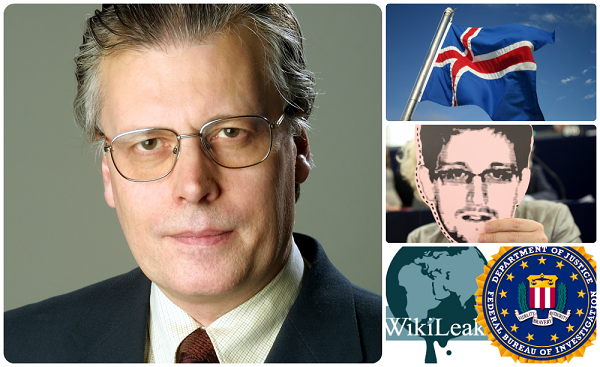
© WikiMedia CommonsÖgmundur Jónasson
Before becoming a member of the Althing, the Icelandic Parliament, Ögmundur Jónasson was a journalist engaged in trade union politics. In 1988 Mr. Jónasson became the chairman of BSRB, the Federation of state and municipal employees. A Left-Green Movement politician, he has held office as minister for health, minister for justice and human rights and minister for transport, communications and local government. The last two ministries were united to form the Ministry of the Interior at the beginning of 2011 and he became the first Icelandic minister for the interior.
Throughout our conversation, the politician shared his thoughts on the current political situation in Iceland, freedom of information and whistleblowers. Finally, he explained how Iceland overcame the financial crisis and analysed the political setting of the European Union.
l. Iceland, whistle-blowers & data protection
What led you into politics?
I have been politically and socially active all my life. I studied history and politics and was a journalist for ten years — a TV reporter at Icelandic State Radio — and part time lecturer in history at the University of Iceland. Also, for over 20 years, I led the public services unions in Iceland.
I entered politics in 1995 and had a dual role as politician and trade unionist until I became minister for health in 2009. Critics sometimes asked if it was proper to be a politician in parliament while a trade union leader. But after entering parliament I never took pay for my work in the union and was always on the same side of the table whatever my role was!
After serving as minister for health for just under a year I resigned from the government over the "Icesave" dispute — a dispute Iceland had with the British and the Dutch governments on tax-payer responsibilities related to the fallen banks and the financial crisis. I came back into government a year later.
As an Icelandic parliamentarian with 20 years of experience and several ministerial posts, how do you see recent developments in Iceland?
Anti-politics is on the rise. I think we are experiencing similar developments in Iceland as elsewhere, meaning a growing distrust in representative democracy. In parallel, traditional political dividing lines are becoming unclear. We are moving into an age of uncertainty. There are new discernible horizons with new opportunities and positive openings, but there are also dangers that we should take very seriously. I say with great concern that in this new age, democracy and the rule of law should not be taken for granted.What's the meaning of the Pirates' rise and why it is occurring?
The Pirates are responding to a demand in society on both sides of the political spectrum for more openness, more transparency and to some extent more accountability, more democracy, more direct democracy. On all of these points I agree with the Pirates' ideology and vision.What kind of government do you expect to be formed now?
But this also means that people with strong left or right political affiliations would not vote for the Pirate party even if they agree with their basic principles.
When sharing their views with the electorate on issues other than freedom of the Internet and transparency, the Pirates became unclear and diffuse — particularly on privatisation, NATO, fishing policy, etc.
Because they focus on a very limited scope of politics, the Pirates aren't as radical as they may seem. The IMF recently claimed that the Pirate Party posed no threat. That is not a compliment in my mind!
This explains why the Pirates ranked so high in opinion polls but got much less when it came to the actual elections. The longer the campaign dragged on the less support they became, and they plummeted from 30% in the opinion polls down to 14,5% in the election.
The Pirates' idea is better than their flesh and blood. But I suppose, this applies to all of us politicians. We all look better at a distance than close up.
All kinds of constellations are being tried. I long for a left-leaning government led by the Left Greens, including the Pirate Party and Social Democrats. The problem is that we would need five parties to form such a majority.Extrapolating from Iceland, how could recent developments affect other European countries?
Besides, the whole political spectrum, including my own party, the Left Greens, has moved to the right. The Social Democrats are very much in the European mould.
The worst scenario is a right-wing coalition. Some compromise might also be on the cards. We will see this shortly.
Here we have some contradictions. While the institutional political world has been moving to the right there has been a radicalisation at the grass-roots and in political discourse there. See what happened to Syriza in Greece where expectations had been high and then came disillusionment at grass-roots level.You are "the minister" who refused to cooperate with the FBI because you suspected their agents on mission in Iceland were of trying to frame Julian Assange. Do you confirm this?
It happened also to some extent in Iceland when we, the left, came to power in 2009 on a radical surge. We did indeed do many good things and most importantly we did not do what the right wing no doubt would have done, namely use the shock of the crisis to privatise and sell off the infrastructure. But we were expected to introduce systemic change, especially in the banking world.
When we didn't live up to these expectations many people were disappointed, and rightly so. If the institutional world of politics does not give radical solutions to extreme conditions, the dangers are that these two worlds drift apart.
And this is what is happening with uncertain and in some instances alarming consequences. The left - not least social democratic parties but also the socialists - must rethink its approach to politics. I fear it has a long and winding road ahead.
Yes. What happened was that in June 2011, US authorities made some approaches to us indicating they had knowledge of hackers wanting to destroy software systems in Iceland. I was a minister at the time. They offered help. I was suspicious, well aware that a helping hand might easily become a manipulating hand!Do you think that whistle-blowers should be protected?
Later in the summer, in August, they sent a planeload of FBI agents to Iceland seeking our cooperation in what I understood as an operation set up to frame Julian Assange and WikiLeaks.
Since they had not been authorised by the Icelandic authorities to carry out police work in Iceland and since a crack-down on WikiLeaks was not on my agenda, to say the least, I ordered that all cooperation with them be promptly terminated and I also made it clear that they should cease all activities in Iceland immediately.
It was also made clear to them that they were to leave the country. They were unable to get permission to operate in Iceland as police agents, but I believe they went to other countries, at least to Denmark. I also made it clear at the time that if I had to take sides with either WikiLeaks or the FBI or CIA, I would have no difficulty in choosing: I would be on the side of WikiLeaks.
Yes, I think that it is very important. The role played by whistle-blowers could be seen as public service. We owe a lot to Chelsea Manning. We owe a lot to Edward Snowden. We owe a lot to Assange. We owe a lot to WikiLeaks. It's not only about the Iraqi war and other illegal military aggression and immoral power-political manoeuvres, but also the recent international trade agreements TISA, TTIP and CETA. By granting Snowden asylum we would be paying tribute to democracy, to openness and to all the whistleblowers of the world. Who were the people originally giving us insight into these behind-closed-doors negotiations? It was WikiLeaks who revealed what was meant to be secret. The stakes are high in these negotiations. This is not just about trade, it is about giving international capital access to the infrastructure of our societies. We are talking about handing over the very heart of democracy.What do you think of Julian Assange?
I don't know him personally, although I met him when he came to Iceland. But I look at what he stands for and that is where I side with him; his endeavours to open the secret world of the military and of power-politics.How do you see the possibility of Iceland giving citizenship to Edward Snowden?
I have raised this issue in our Parliament on several occasions. By granting Snowden asylum we would be paying tribute to democracy, to openness and to all the whistleblowers of the world. But there has not been political consensus. Iceland is part of NATO and such a decision would be strongly objected to by the US. The Cold War lingers on. Or it might just be the power of the big and mighty.How do you read the "hero vs. traitor" paradox around whistle-blowers?
They are certainly not villains in my view. However, this is a reminder of how we tend to see the world in black and white. Either we are for whistle-blowers and openness or we are against them.Iceland is about to become an international transparency safe haven for journalists and whistle-blowers. Will the Icelandic Modern Media Initiative (IMMI) resolution be strong enough to protect future whistle-blowers?
But the real picture is more complex. We are not only for openness. We also find ourselves in a world where it is important to protect privacy. We don't want the American secret services listening to our phones, or the Russian secret services, or the Chinese! We are therefore limiting our demands for transparency and openness to matters that are relevant to politics.
This should be open, but at the same time we want to prevent attempts to break into the private world of individuals. So what I'm really saying is that we need to have a very deep and serious discussion about how to balance the open world and the private world. Whistle-blowers fight the real villains who refuse to respect our rights, including our right to privacy. So when judging them, we must always ask ourselves who they are, why they are acting, to what extent and to what end?
I think this is quite a long way off. It is an idea that has to be developed much further. The good thing about it is that we concentrate on freedoms and democracy, on whistle-blowers and on protecting these people.The term "cyberwar" has become commonplace in recent times. In 2012, Forbes London bureau chief Parmy Olson claimed in her book We Are Anonymous that WikiLeaks members contacted hackers because they wanted help "infiltrating several Icelandic corporate and government sites". What do you think of such actions as a politician in office at the time?
But then of course when it comes to protection of freedom on the Internet there are darker sides as well. We certainly don't want to be a haven for paedophiles. I do not want to talk this idea down because I see its positive side, namely the protection of whistle-blowers. But there are more dimensions to this and we should avoid being naïve on this issue.
I have nothing positive to say about this, but then I must say that in this world of cyberwar I don't take anything for granted. I think we should be critical towards WikiLeaks as we are towards others: they are not infallible. But we should remember that there have been attempts to smear them in order to undermine them. I want all the facts on the table before coming to any conclusions.What about the resignation of your former prime minister over the Panama Papers leak?
This definitely falls into the category of good revelations. Panama Papers revelations involving Iceland proved politically important and led to a discussion that is still ongoing. They are likely to change the political world. We have covered this issue extensively in the Council of Europe, where I have been active.In today's world, we are confronted with increasing security challenges. How do you balance security needs with the right of citizens to know what their governments, and security agencies in particular, are doing, and the right of citizens to preserve their privacy from governmental intrusion?
This is about political morality, taxation and tax evasion, the welfare system, openness, transparency and accountability. We are not finished with this subject, in Iceland or on the world stage.
Before meeting security challenges, we must ask why we are facing these challenges. And in seeking the answer we should get hold of some useful working tools: I suggest a mirror.II. Iceland and the European Union
The rich part of the world should start by looking at its own reflection and asking what it is doing to itself. In other words, it should ask, what is my role? Could it be that the poor parts of the world, the ostracised, the uprooted and unwelcome immigrants, the unemployed, see the rich and the powerful, the military machines of state power, as the real security challenge to their lives?
If this is the case, the answer to security threats would be to remove the conditions that make people feel threatened. And then we would need more social justice, more equality in society, more security. We must analyse why it is that millions of people leave their homes against their will and flock to the rich parts of the world, which in turn become obsessed with security.
In South East Turkey, 450,000 Kurds are on the move, uprooted from their homes after longstanding curfews by Turkish authorities. These people will end up as asylum seekers. And who is the terrorist: the one who is killed by a drone or the one who kills with the help of a drone? Let us start by using the mirror, holding it up to our own faces and asking all these questions.
How do you think that the EU could counter the recent surge of populism?
What do we mean by populism? Sometimes I think we should not use this term because it is a little arrogant, being popular is close to democracy, is it not?See entire article here.
What we understand by populism, presumably, is that prejudice is being exploited in order to gain power and then to use that power to further entrench prejudice; that populism is manipulative and fascist in nature.


Comment: See also: Iceland's Interior Minister ran off planeload of FBI agents sent in 2011 to frame Assange