
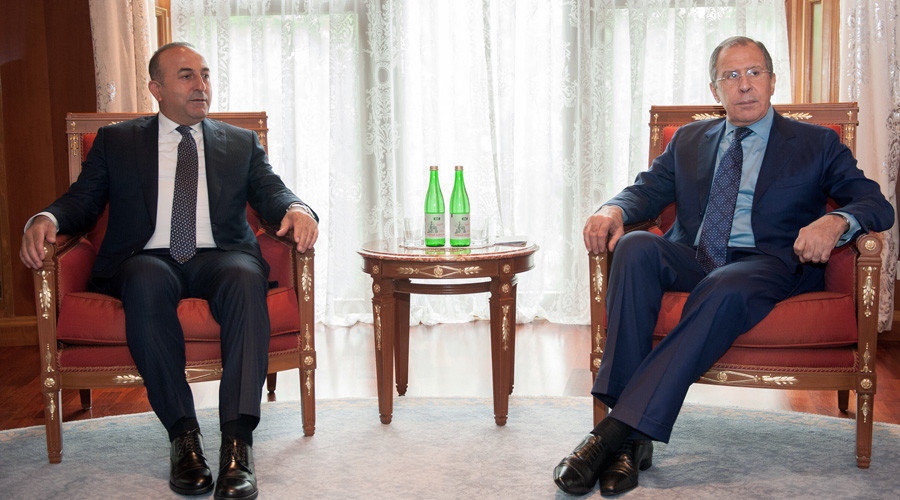
© Nina Zotina / ReutersRussian Foreign Minister Sergei Lavrov, right, and Turkish Foreign Minister Mevlut Cavusoglu during a meeting on the sidelines of the Council of Foreign Ministers from the member states of the Organization of the Black Sea Economic Cooperation (BSEC) in Sochi.
Normalizing relations between Russia and Turkey will start through establishing closer diplomatic contact, Russian Foreign Minister Sergey Lavrov said Friday following talks with his Turkish counterpart, Mevlut Cavusoglu.
"We agreed today with Minister Cavusoglu that such contact would be established in the nearest future," Sputnik quoted the Russian FM as saying.
Lavrov's Turkish counterpart agreed that the meeting in Sochi had been a constructive one, combining discussions of both bilateral and regional issues.
"We discussed bilateral relations and measures on how to return to the level we had before," Cavusoglu said, mentioning top-level contact between the two countries' presidents, prime ministers and foreign ministers. "This was a constructive meeting," the Turkish minister added.
Putting an end to the Syrian conflict topped the list of the regional issues discussed at the session, which took place on the sidelines of the Black Sea Economic Cooperation Organization (BSEC) Council of Ministers of Foreign Affairs in the Russian resort city of Sochi.
"We can discuss everything in the framework of our bilateral dialogue, even the most difficult issues, including the task of preventing the terrorist infiltration into Syria from abroad, the task of preventing the use of Turkish territory in support of terrorist organizations in Syria," Lavrov said.
Comment: This is a highly significant statement. When the Turks were unwilling to negotiate, Russia responded with a fairly big stick: exposing direct complicity between Turkish leaders and Daesh. Now, Turkey appears to have agreed to follow some semblance of 'the rules', and the issues can be dealt with under the cover of "security concerns", "fighting terrorism", etc. As long as it gets results, the Russians don't care what narrative is used.
Both Lavrov and Cavusoglu agreed that moderate rebels who want to avoid the offensive by Syrian troops and Russian airstrikes should withdraw their forces from areas controlled by Islamic extremists.
Comment: U.S. just got smacked.
"Those who don't want to get hit need to leave positions occupied by Jabhat al-Nusra [Al-Nusra Front] and Islamic State [IS, formerly ISIS/ISIL]. If the patriotic opposition, constructive opposition, remains in areas controlled by terrorists, it needs to withdraw its units. Otherwise it will be considered an accomplice," Lavrov said, adding "our Turkish colleagues confirmed today that they absolutely agree with this logic."
Lavrov also told reporters that he and Cavusoglu have no disagreements over which groups should be considered terrorist "for the most part."
"In accordance with UN Security Council resolutions, the terrorist groups are Islamic State, Jabhat al-Nusra and various smaller organizations affiliated with them," Lavrov said.
Comment: Oh no, Kerry is going to cry!
The Turkish foreign minister agreed with Lavrov, saying that "if these disagreements do exist, we need to meet and discuss them with our Russian colleagues."
He added that "IS attacks Turkey because Turkey directly fights IS, including by helping the coalition and hindering foreign terrorists. We are truly killing the ideology of this terrorist organization."
Comment: Not entirely true, but see above. If the tree bears fruit, that's better than nothing.
The coordination of anti-terrorist efforts by Russia and Turkey has become of particular importance following the recent terrorist attack at Istanbul's international airport.
"Our joint efforts to combat terrorism have become more relevant," Lavrov said, adding that it was agreed to "promptly resume" the work of the two countries' counter-terrorist workgroup.


there was an interesting comment on another site about how this is the result of America's shift in the region, one in which Turkey looks to lose territory to the new Kurdish state now being fashioned in DC, Tel Aviv and elsewhere... same situation for the House of Saud and others, as the Western noose starts to pinch their necks and their illusions of grandeur start to get stepped on without explanation. Saddam had a similar problem a little while ago, too bad these idiots don't learn who they are dancing with... some partners never change their movements, always stepping on your toes, and sooner or later you have to submit or at least complain... at least a little, right? and perhaps act like a 'free agent' in search of a better deal.