
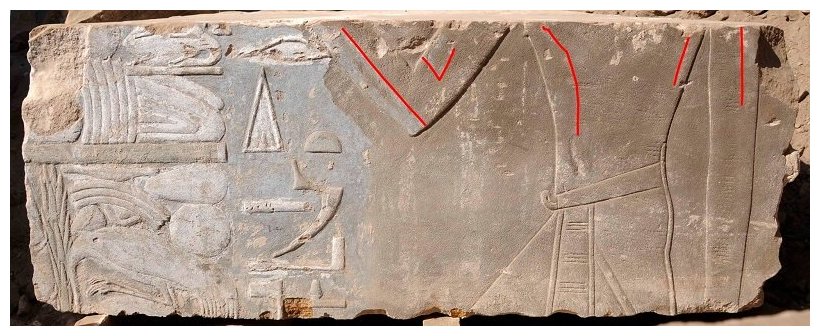
© German Archaeological InstituteA stone block found on Egypt's Elephantine Island shows Queen Hatshepsut as a female (highlighted by red lines). Later images of the pharaoh portrayed her as a male king.
On several of the blocks, Queen Hatshepsut was represented as a woman, according to the Ministry, suggesting that the blocks and building it came from were erected during the early part of the first female pharaoh's reign, which lasted from 1473 B.C. to 1458 B.C. Later in her reign, the queen was depicted as a male.
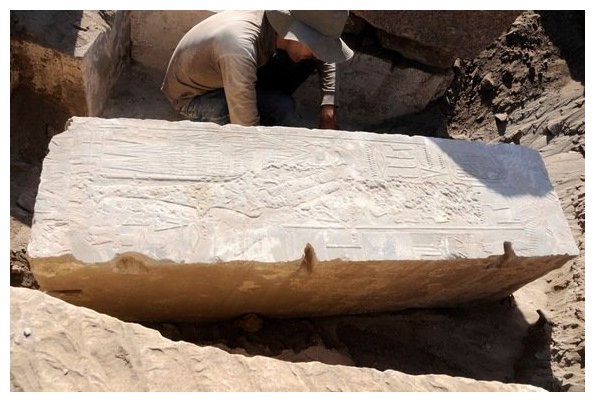
© German Archaeological InstituteHere, an ancient pillar from the barque station in Egypt erected by Queen Hatshepsut for the god Khnum.
It was unusual for a woman to become pharaoh of Egypt. As Egyptologist Ian Shaw noted in his book "Exploring Ancient Egypt" (Oxford University Press, 2003), "In the history of Egypt during the dynastic period (3000 to 332 B.C.) there were only two or three women who managed to rule as pharaohs, rather than wielding power as the 'great wife' of a male king."
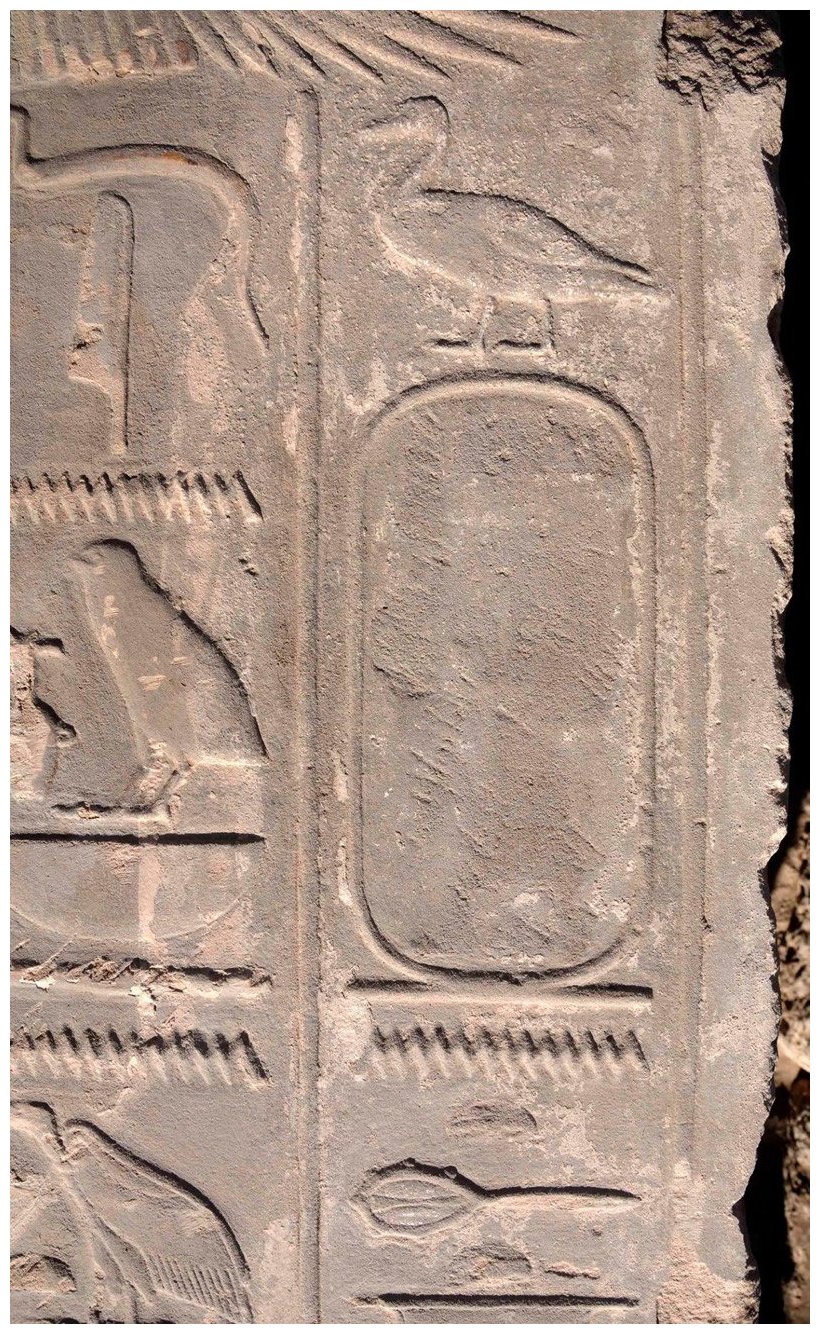
© German Archaeological InstituteAfter Queen Hatshepsut's death, mentions of her were erased, as shown here.
During her reign, Hatshepsut erected and renovated many temples and shrines to the gods.
In fact, the newfound blocks likely were part of a previously unknown building of Queen Hatshepsut that was discovered this year by the German Archaeological Institute, said Mahmoud Afify, head of the Ancient Egyptian Antiquities Sector, in the Ministry of Antiquities' statement on Facebook.
In previous excavation seasons at the same site, members of the Swiss Institute also discovered some blocks that may have come from the same building.
The building would have served as a way station for the festival barque of the god Khnum, said Felix Arnold, field director of the Elephantine Island mission.
In ancient Egypt, "barques," or sacred boats, were used to help carry the dead to the afterlife.
Based on the discoveries thus far, in the same statement, the Ministry of Antiquities described the building's construction as a chamber for the barque of the god Khnum, which is surrounded by pillars on all four sides.
"On the pillars are representations of several versions of the god Khnum, as well as other gods, such as Imi-peref 'He-who-is-in-his-house,' Nebet-menit 'Lady-of-the-mooring-post' and Min-Amun of Nubia," according to the Ministry statement on Facebook.
"The building thus not only adds to our knowledge of the history of Queen Hatshepsut, but also to our understanding of the religious beliefs current on the Island of Elephantine during her reign."



Reader Comments
Stone spent approximately ten years engaged in research of the lesser-known, sometimes hidden depictions of the Sacred Feminine, from European and Middle Eastern societies, in preparation to complete this work. In the book, she describes these archetypal reflections of women as leaders, sacred entities and benevolent matriarchs, and also weaves them into a larger picture of how our modern societies grew to the present imbalanced state.
Possibly the most controversial/debated claim in the book is Stones' interpretation of how peaceful, benevolent matriarchal society and Goddess-reverent traditions (including Ancient Egypt) were attacked, undermined and ultimately destroyed almost completely, by the ancient tribes including Hebrews and later the early Christians. To do this they attempted to destroy any visible symbol of the sacred feminine- including artwork, sculpture, weavings and literature. The reason being that they wanted the Sacred Masculine to become the dominant power, and rule over women and Goddess energies. According to Stone, the Torah or Old Testament was in many ways a male attempt to re-write the story of human society, changing feminine symbolism to masculine............
[Link]